

Best Ethics and Compliance Software Solutions in 2026
Our blog explores key components of ethics and compliance software like employee training tools, task management, and risk management.
Ethics and compliance programs are being tested in ways they were not built for ten years ago.
A policy document is no longer enough. A hotline number is no longer enough. A once-a-year training record is no longer enough. Boards, regulators, auditors, employees, customers, and investors now expect organizations to prove that compliance is active, monitored, and working in practice.
That expectation is rising because the risk environment has changed. Employees are reporting more concerns through formal channels. Regulators are paying closer attention to whistleblower protections, retaliation, AI risk, third-party conduct, and whether compliance programs are supported by real data. Business teams are moving faster, using more vendors, adopting more technology, and operating across more regulatory requirements.
The numbers show why this matters. A recent Whistleblowing & Incident Management Benchmark Report found that whistleblowing reporting volumes remain at record highs, web intake has surpassed hotlines, and case substantiation reached 46%, the highest level reported in its benchmark data. That means internal reporting systems are not just administrative tools. They are becoming a critical source of risk intelligence for organizations.
At the same time, the SEC received approximately 27,000 whistleblower tips in fiscal year 2025, showing that external reporting channels remain highly active when employees, investors, or market participants believe concerns are not being addressed internally.
Compliance technology adoption is also accelerating. PwC’s Global Compliance Survey 2025 found that 49% of respondents use technology for 11 or more compliance activities, with training, risk assessment, compliance monitoring, customer due diligence, and regulatory reporting among the most common areas of use.
This is the environment where ethics and compliance software becomes essential.
The right platform helps organizations move beyond scattered policies, spreadsheets, email reminders, and disconnected reporting channels. It gives compliance teams a structured way to manage policies, obligations, incidents, investigations, training, risk assessments, evidence, third-party reviews, corrective actions, and leadership reporting in one place.
More importantly, it helps organizations prove that ethics and compliance are not just stated values. They are operational practices with ownership, evidence, follow-up, and accountability.
Key takeaways (TL; DR)
- Learn how ethics and compliance software helps organizations stay compliant, uphold integrity, and streamline processes.
- Understand the risks of non-compliance, including fines, legal action, reputational damage, and operational disruptions.
- Explore key features like policy management, incident reporting, risk assessment, audit tracking, alerts
- Discover top software solutions—VComply, Ethisphere,GAN Integrity, and Ethical by Upright—and their unique strengths.
- See how tools enhance risk management, automate tasks and improve decisions with detailed reporting and analytics.
What is Ethics and Compliance Software?
Ethics and compliance software is a digital platform that helps organizations manage ethical conduct, regulatory obligations, internal policies, employee reporting, investigations, training, risks, and audit evidence.
At a basic level, it helps companies stay compliant with laws, regulations, standards, and internal codes of conduct.
At a more strategic level, it helps compliance teams create a repeatable system for:
- Communicating expected behavior
- Assigning compliance ownership
- Tracking policy acknowledgments
- Managing incidents and investigations
- Monitoring third-party and operational risks
- Documenting controls and evidence
- Reporting program performance to leadership
- Preparing for audits and regulatory reviews
In the past, many organizations managed these activities across spreadsheets, shared drives, email chains, disconnected HR systems, and manual trackers. That approach may work when the company is small. But as the organization grows, it becomes difficult to prove what was done, who owned it, when it was completed, and whether issues were resolved.
Ethics and compliance software creates a single source of truth for these activities.
It helps compliance teams move from “we believe this is being handled” to “we can prove this was assigned, completed, reviewed, escalated, and documented.”
Best Ethics and Compliance Software Comparison (2026)
| Software | Best For | Key Strengths | Hotline & Case Management | Policy Management | Risk & Third-Party Oversight | AI / Automation | Best Advantage |
|---|---|---|---|---|---|---|---|
| VComply | Organizations needing unified compliance execution | Compliance workflows, policies, incidents, evidence, audits | ✅ Integrated incident workflows | ✅ Advanced policy lifecycle management | ✅ Strong risk & vendor oversight | ✅ Workflow automation & analytics | Unified ethics, compliance, policy, and risk management in one platform |
| Ethisphere | Ethics benchmarking and program assessments | Ethical culture measurement and benchmarking | ⚠️ Limited | ⚠️ Moderate | ✅ Strong assessment capabilities | ⚠️ Moderate | Industry benchmarking and ethics maturity insights |
| Ethico | Hotline and investigation-heavy organizations | Omnichannel reporting and investigations | ✅ Advanced | ⚠️ Moderate | ⚠️ Moderate | ⚠️ Moderate | Strong whistleblower and case management workflows |
| GAN Integrity | Enterprise integrity and third-party governance | Third-party risk and incident management | ✅ Strong | ✅ Good | ✅ Advanced | ⚠️ Moderate | Third-party risk and conflict-of-interest management |
| Ethical by Upright | Global ethics and compliance coordination | Global compliance collaboration and reporting | ⚠️ Moderate | ⚠️ Moderate | ✅ Strong risk assessments | ⚠️ Limited | Global compliance visibility and collaboration |
| NAVEX One | Large enterprise ethics programs | Hotline systems and enterprise governance | ✅ Advanced | ✅ Advanced | ✅ Advanced | ⚠️ Moderate | Enterprise ethics and whistleblower infrastructure |
| SAI360 | Enterprise GRC and compliance operations | Integrated governance and compliance workflows | ✅ Strong | ✅ Advanced | ✅ Advanced | ✅ AI-enabled insights | Enterprise-scale governance and operational compliance |
| MetricStream | Large regulated organizations | Enterprise governance and risk oversight | ✅ Strong | ✅ Advanced | ✅ Advanced | ✅ AI-powered analytics | Global enterprise governance and compliance visibility |
| Diligent | Board and governance oversight | Governance, ethics, and board workflows | ⚠️ Moderate | ✅ Good | ✅ Strong | ⚠️ Moderate | Board-level governance and oversight visibility |
Consequences of Non-Compliance
Non-compliance can bring severe consequences for a business. These include:
- Substantial fines, sanctions, and legal actions.
- Tarnished reputation and loss of customer trust.
- Operational disruptions and increased scrutiny from authorities.
- Loss of valuable employees.
- Financial losses through fines, legal fees, and lost opportunities.

Why Ethics and Compliance Software Matters in 2026
The role of compliance has changed.
Compliance teams are no longer responsible only for policy administration or annual training. They are expected to help the business manage conduct risk, regulatory change, operational risk, third-party exposure, AI governance, audit readiness, and board-level reporting.
Several trends make ethics and compliance software more important in 2026.
1. Regulators Expect Compliance Programs to Work in Practice
Regulators increasingly look at whether a compliance program is properly designed, adequately resourced, tested, improved, and supported by data.
The U.S. Department of Justice’s updated Evaluation of Corporate Compliance Programs asks whether companies review and adapt compliance programs based on lessons learned, whether they use data to identify misconduct or compliance weaknesses, and whether they manage emerging risks such as artificial intelligence.
This matters because a compliance program cannot be judged only by what is written in a policy.
Organizations need evidence that:
- Policies are reviewed and approved
- Employees receive and acknowledge relevant policies
- Training is completed
- Reports are investigated
- Controls are monitored
- Corrective actions are closed
- Third-party risks are reviewed
- Compliance gaps are escalated
- Program improvements are documented
Ethics and compliance software helps capture this evidence as work happens.
2. Whistleblower and Speak-Up Programs Are Becoming Risk Intelligence Systems
Internal reporting channels are no longer just hotlines. They are a critical part of an organization’s risk detection system.
NAVEX’s 2025 benchmark found that reporting volumes remain at record highs and case substantiation reached 46%. This suggests that many reports are not noise. They are meaningful signals that organizations need to investigate, resolve, and analyze.
The SEC’s FY 2025 whistleblower activity also shows that employees and market participants continue to use external channels when they believe serious concerns exist. The SEC received approximately 27,000 whistleblower tips during FY 2025.
For compliance teams, this creates a clear message: internal reporting must be trusted, accessible, documented, and responsive.
Ethics and compliance software supports this by helping organizations manage:
- Anonymous or confidential reports
- Case intake
- Investigation assignment
- Documentation
- Evidence
- Timelines
- Corrective actions
- Retaliation monitoring
- Reporting trends
A strong speak-up process does not end when a report is received. It ends when the issue is reviewed, documented, resolved, and used to improve the program.
3. AI Risk Is Now a Compliance Responsibility
AI is now being used in hiring, customer service, vendor tools, fraud detection, finance, legal research, data analysis, content creation, and operational decision-making.
That creates new compliance and ethics questions.
Who approved the AI tool?
What data does it process?
Does it create privacy risk?
Can its outputs be reviewed?
Could it create bias or unfair outcomes?
Are employees using public AI tools with sensitive information?
Are third-party vendors using AI in ways the company does not understand?
The DOJ’s updated compliance guidance specifically asks how companies assess the impact of new technologies such as AI on their ability to comply with the law, and whether AI-related risks are integrated into broader enterprise risk management strategies.
This means AI governance can no longer sit outside compliance.
Ethics and compliance software can help organizations:
- Maintain AI usage policies
- Track AI risk assessments
- Assign owners for AI-related controls
- Document approvals
- Collect attestations
- Review vendors using AI
- Track issues or exceptions
- Report AI risk oversight to leadership
In 2026, AI risk is not only a technology issue. It is a governance, ethics, privacy, security, and compliance issue.
4. Third-Party Risk Is an Ethics and Compliance Risk
Third parties can expose organizations to bribery, fraud, sanctions risk, privacy failures, cybersecurity gaps, labor violations, quality failures, ESG concerns, and reputational damage.
This is especially important for companies that rely on vendors, suppliers, contractors, consultants, distributors, agents, healthcare partners, financial service providers, or global supply chains.
A weak third-party process often looks like this:
- Due diligence is handled by email
- Risk ratings are stored in spreadsheets
- Reviews happen inconsistently
- Documentation is scattered
- Approvals are not always traceable
- Vendor issues are not connected to compliance reporting
Ethics and compliance software helps bring structure to third-party oversight by managing due diligence, risk assessments, documentation, approvals, periodic reviews, issues, and remediation.
This is critical because a company’s ethical exposure does not stop at its own employees. It extends across the relationships it chooses to maintain.
5. Compliance Teams Need Better Data for Leadership Reporting
Boards and executives are asking better questions about compliance.
They want to know:
- Which risks are increasing?
- Which investigations are still open?
- Which policies are overdue for review?
- Which controls are failing?
- Which business units are behind on training?
- Which third parties need attention?
- Which corrective actions are overdue?
- Where does leadership need to intervene?
PwC’s Global Compliance Survey 2025 shows how widely technology is now being used across compliance activities, including training, risk assessment, monitoring, due diligence, disclosures, and reporting.
This reflects a broader shift: compliance reporting is moving from static updates to data-backed program visibility.
Ethics and compliance software helps compliance leaders show the board and executive team what is happening across the program in real time.
Common Problems Ethics and Compliance Software Solves
Many organizations do not adopt compliance software because they lack policies. They adopt it because the process around those policies is breaking.
Here are the most common problems.
Scattered Policies
Policies sit across shared drives, intranet pages, PDFs, email attachments, and department folders. Employees are unsure which version is current. Policy owners do not know when reviews are due. Acknowledgments are hard to track.
This creates risk because outdated or unacknowledged policies are difficult to defend during audits, investigations, or regulatory reviews.
Weak Evidence Collection
Compliance teams often spend weeks chasing evidence before an audit.
Evidence may be stored in:
- Email threads
- Screenshots
- Spreadsheets
- Shared folders
- Local drives
- Ticketing systems
- Individual inboxes
This creates audit stress and increases the chance that important documentation is missed.
Ethics and compliance software allows teams to collect and link evidence directly to tasks, controls, obligations, risks, and audit requests.
Unclear Ownership
Compliance work fails when ownership is unclear.
A control may be assigned informally. A policy review may depend on one person remembering a deadline. A corrective action may be discussed in a meeting but never tracked to completion.
Software helps assign ownership, due dates, reminders, escalations, and completion records.
This turns compliance from informal follow-up into documented accountability.
Manual Follow-Up
Compliance teams spend too much time chasing updates.
They remind policy owners.
They follow up on overdue training.
They ask for evidence.
They update spreadsheets.
They prepare status reports manually.
Ethics and compliance software reduces this manual burden through automated reminders, recurring tasks, workflows, dashboards, and reporting.
Inconsistent Incident Handling
Reports and investigations may be handled differently across departments, locations, or business units.
Without a structured process, organizations may face inconsistent documentation, delayed investigations, incomplete findings, weak corrective actions, or poor visibility into recurring issues.
Case management tools help create a more consistent and defensible investigation process.
Poor Visibility Across the Program
Leadership may only hear about compliance problems when they become urgent.
Without dashboards and reporting, compliance teams struggle to identify trends early. This limits their ability to prevent problems, allocate resources, or escalate issues before they become larger risks.
Key Features of Ethics and Compliance Software
The best ethics and compliance software should support both conduct management and compliance execution. It should not only store documents. It should help teams manage real work.
1. Policy Management
Policy management is one of the most important functions of ethics and compliance software.
The platform should help teams:
- Draft and update policies
- Assign policy owners
- Manage review and approval workflows
- Maintain version history
- Distribute policies to relevant employees
- Track acknowledgments and attestations
- Retire outdated policies
- Link policies to controls, risks, and obligations
This is especially important for organizations managing codes of conduct, anti-bribery policies, conflicts of interest policies, data privacy policies, information security policies, HR policies, healthcare policies, financial compliance policies, and operational procedures.
2. Employee Reporting and Case Management
Ethics programs need trusted reporting channels.
Software should support:
- Anonymous or confidential reporting
- Multiple intake channels
- Case categorization
- Assignment to investigators
- Investigation timelines
- Notes and documentation
- Evidence attachments
- Corrective actions
- Escalations
- Reporting and trend analysis
This helps organizations respond to misconduct concerns consistently and defensibly.
3. Compliance Task and Obligation Management
Compliance teams need to track recurring obligations, regulatory deadlines, filings, reviews, certifications, audits, inspections, and internal controls.
A strong platform should allow teams to:
- Assign tasks to owners
- Set due dates and recurrence
- Automate reminders
- Escalate overdue items
- Attach evidence
- Track completion status
- Maintain a defensible audit trail
This is where compliance moves from documentation to execution.
4. Risk Assessment and Monitoring
Ethics and compliance software should help teams identify, assess, and monitor risks across departments, locations, vendors, business units, and regulatory areas.
Key capabilities include:
- Risk registers
- Risk scoring
- Control mapping
- Mitigation plans
- Residual risk tracking
- Risk owner assignment
- Review cycles
- Dashboards and reporting
This gives compliance teams a structured view of where attention is needed.
5. Training and Attestation Tracking
Training is central to ethics and compliance programs, but completion alone is not enough.
Organizations need to know:
- Who received which training
- Who completed it
- Who failed to complete it
- Which employees need reminders
- Which roles require specialized training
- Whether employees attested to policies or certifications
Ethics and compliance software should make it easier to track training obligations and acknowledgments by role, location, department, or risk area.
6. Audit and Evidence Management
Audit readiness depends on evidence.
The platform should help teams collect, organize, and retrieve evidence linked to specific controls, obligations, policies, tasks, risks, or audit requests.
This reduces last-minute audit preparation and helps compliance teams respond faster when evidence is requested.
7. Reporting and Analytics
Compliance leaders need reporting that is useful for decision-making.
Good ethics and compliance software should provide dashboards for:
- Open and overdue tasks
- Policy acknowledgment status
- Training completion
- Incident trends
- Risk ratings
- Corrective action progress
- Audit readiness
- Third-party review status
- Control performance
Reporting should help compliance teams tell a clear story to leadership: what is working, what is delayed, what is at risk, and where support is needed.
8. Third-Party Compliance Management
Third parties can create major ethics and compliance risk.
The software should help teams manage:
- Vendor due diligence
- Risk questionnaires
- Required documentation
- Contractual compliance obligations
- Periodic reviews
- Sanctions or watchlist checks, where applicable
- Issues and remediation
- Approval workflows
This gives organizations better control over external relationships that may affect compliance posture.
Benefits of Ethics and Compliance Software
Better Accountability
Every task, policy, control, risk, or investigation has an owner, due date, status, and record. This reduces confusion and makes it easier to follow up.
Faster Audit Preparation
Evidence is collected throughout the year instead of rushed together before an audit. This helps teams respond faster and with more confidence.
Stronger Speak-Up Culture
Employees have clearer ways to report concerns, and compliance teams have better systems for managing those reports.
Reduced Manual Work
Automated reminders, recurring tasks, approval workflows, and dashboards reduce the time spent on manual tracking.
Improved Leadership Reporting
Compliance teams can give boards and executives clearer visibility into program performance and risk.
Better Policy Governance
Policies are easier to review, approve, distribute, acknowledge, and maintain.
More Consistent Investigations
Case management workflows help ensure that reports are handled consistently, documented properly, and escalated when needed.
Stronger Risk Management
Risks can be identified, scored, assigned, monitored, and linked to controls or mitigation plans.
Best Ethics and Compliance Software
Selecting the right ethics and compliance tool is crucial for maintaining regulatory adherence and fostering an ethical corporate culture. Let’s explore some of the top ethics and compliance tools available today.
1. VComply
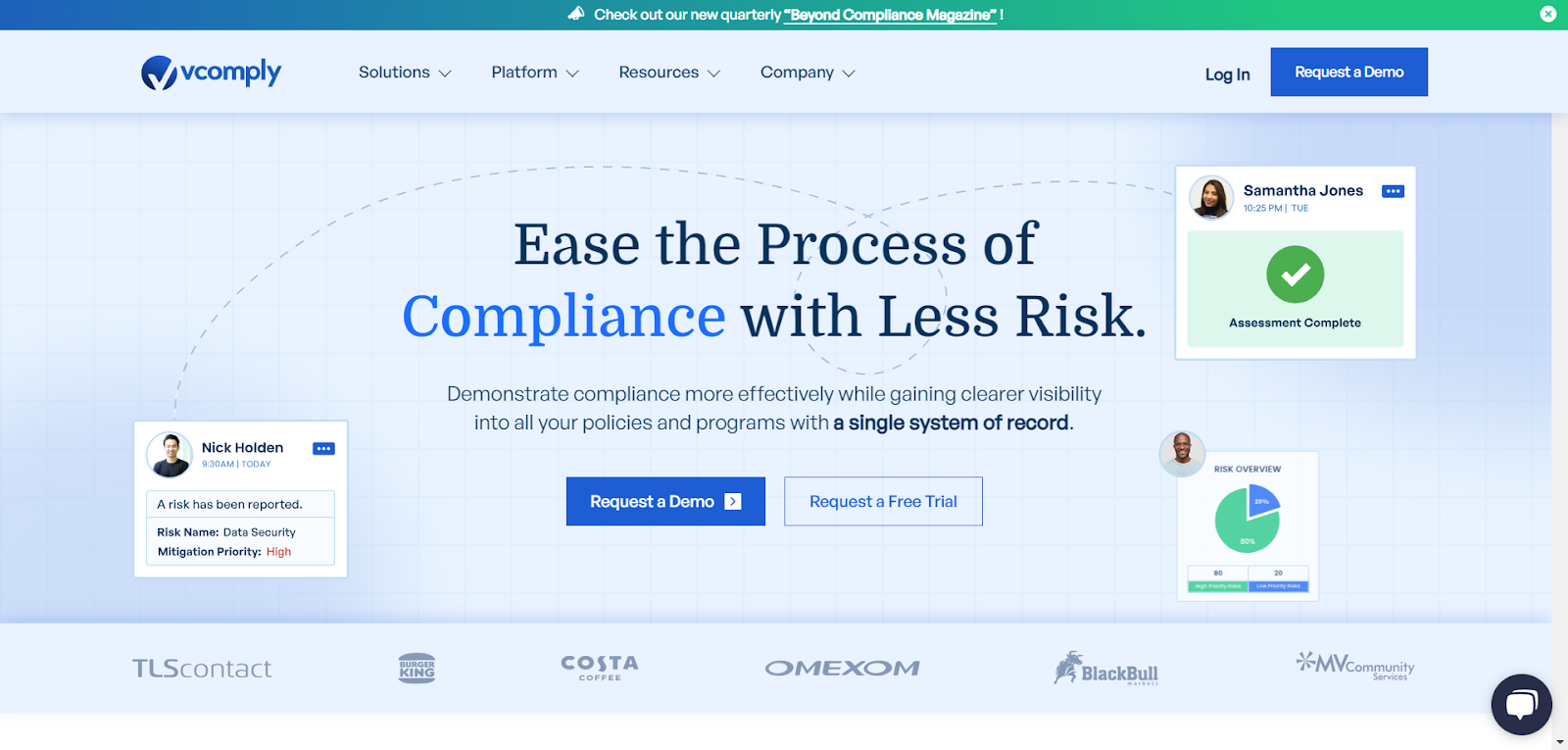
VComply is a leading ethics and compliance software designed to help organizations ensure regulatory adherence and promote ethical practices. Known for its user-friendly interface and robust features, VComply streamlines compliance management and boosts operational efficiency.
Features
- Centralized Compliance Management: Integrates all compliance activities on a single platform, making it easier to track and manage compliance tasks across the organization.
- Automated Workflows: Streamlines processes by automating routine compliance tasks, reducing manual errors, and ensuring timely completion.
- Multi-Framework Compatibility: Designed for seamless integration with diverse governance, risk management, and compliance (GRC) frameworks, this feature offers unmatched flexibility. It’s essential for organizations managing multiple regulations and standards, providing a unified solution for comprehensive compliance management across all operational dimensions.
- Detailed Reporting and Analytics: Provides comprehensive insights through detailed reports and analytics, aiding in better decision-making and risk management.
- Audit Readiness: Maintains comprehensive records and documentation to simplify the audit process, ensuring your organization is always prepared.
- Customizable Dashboards: Offers tailored views and dashboards that meet specific needs, allowing users to focus on the most relevant data.
- Security Measures: Ensures the protection of sensitive data and compliance with relevant regulations, safeguarding your organization’s information.
- Scalability: Grows with your business, accommodating an expanding compliance network and evolving needs.
- Employee Training Tools: Provides interactive training modules that educate employees about regulatory requirements and ethical standards, including quizzes and progress tracking to ensure effective learning.
- Incident Reporting and Management Systems: Allows employees to report incidents of misconduct anonymously, facilitating thorough investigation and resolution while encouraging a culture of accountability and transparency.
Advantages
- User-friendly interface
- Comprehensive compliance management
- Real-time updates and detailed analytics
- Strong data security measures
- Customizable to fit specific business needs
Disadvantages
- Initial setup requires some time
Pricing:
VComply offers pricing starting at $1,199 per month for the Starter GRC Suite and $1,999 per month for the Pro GRC Suite. The Enterprise GRC Suite has custom pricing based on specific business needs.
2. Ethisphere
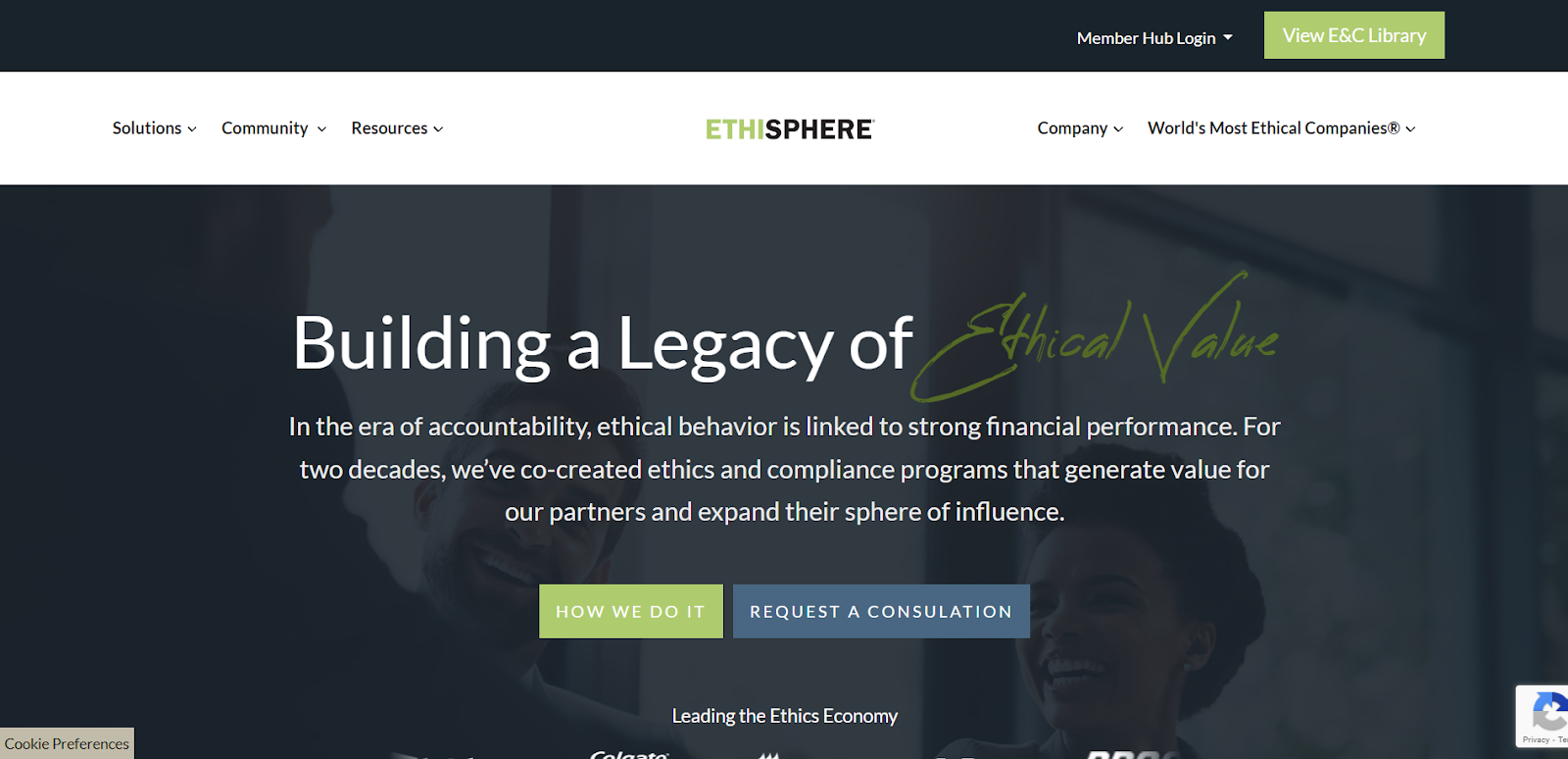
Ethisphere is renowned for its solutions that drive business integrity and ethical growth. Their tools and resources are designed to measure, benchmark, and improve ethics and compliance programs across various industries.
Features
- Program Assessments: Evaluate and improve ethics and compliance programs.
- Culture Assessments: Measures and elevates organizational ethical culture.
- Risk Assessments: Identifies and manages key risks.
- Benchmarking Tools: Compares your integrity program against industry standards.
- Educational Resources: Provides access to a wealth of compliance-related research and training materials.
Advantages
- Comprehensive assessment tools
- Strong focus on benchmarking and improvement
- Access to extensive educational resources
- Advanced risk management capabilities
- Supports ethical culture development
Disadvantages
- It may be costly for small businesses
- Requires time for thorough assessments
Pricing
Ethisphere does not publicly disclose specific pricing information. Prospective customers should contact Ethisphere directly for a personalized quote based on their unique requirements.
3. Ethico
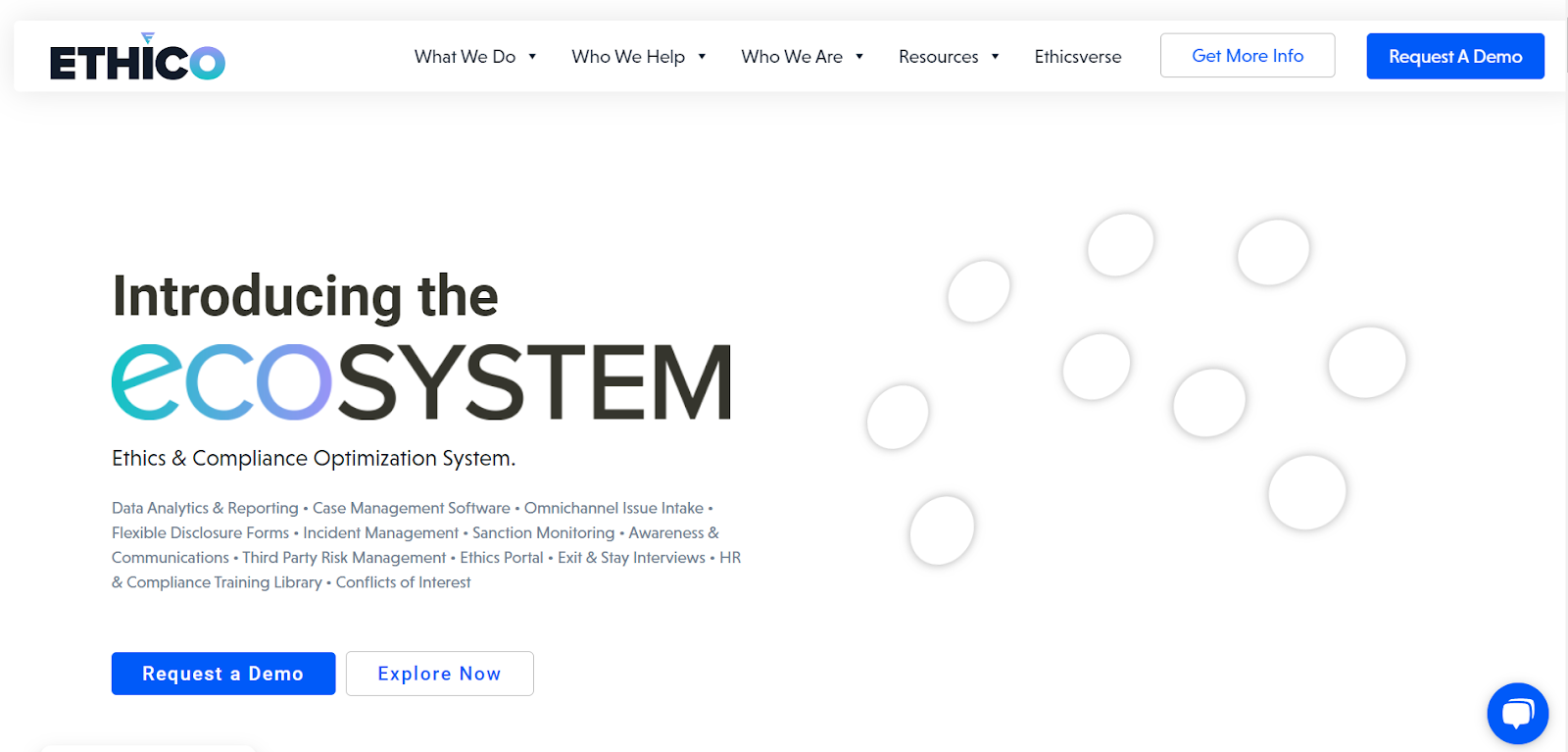
Ethico provides comprehensive ethics and compliance solutions that enhance organizational integrity and ensure regulatory compliance. Their tools are tailored to improve risk management, streamline processes, and foster a culture of ethics.
Features
- Case Management Software: Consolidates reports and manages investigations effectively.
- Omnichannel Intake: Allows reporting of sensitive issues through various channels.
- Sanction Monitoring: Accesses multiple databases to ensure compliance with sanctions.
- Training Programs: Engages employees with interactive and real-life scenarios.
- Data Analytics & Reporting: Provides detailed insights and reports for better decision-making.
Advantages
- Flexible and comprehensive reporting tools
- Strong focus on training and engagement
- Advanced analytics for improved insights
- Robust case management capabilities
- Effective sanction monitoring
Disadvantages
- It may require significant setup time
- Pricing not publicly disclosed
Pricing
Ethico does not publicly disclose specific pricing information. Prospective customers should contact Ethico directly for a personalized quote based on their unique requirements.
4. GAN Integrity
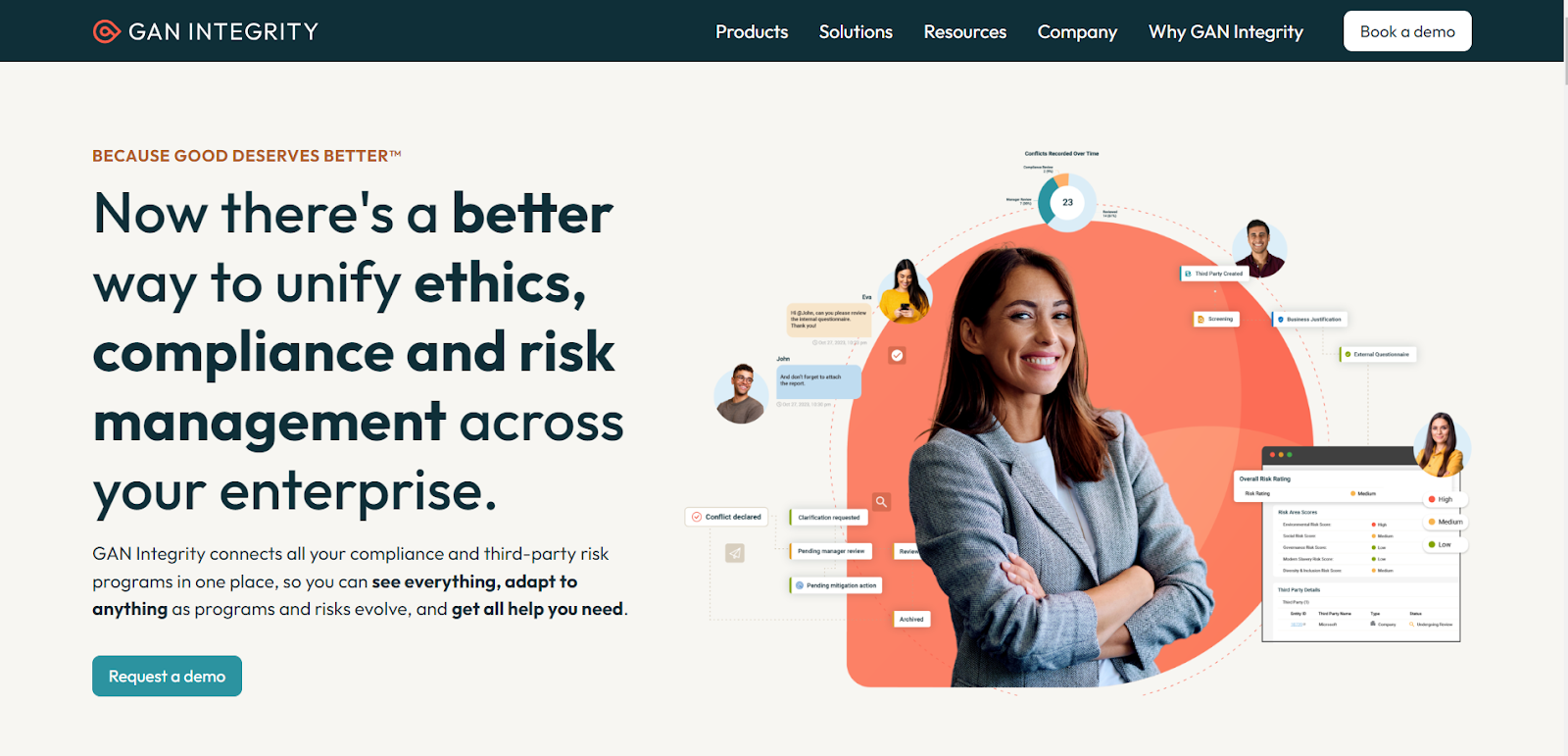
GAN Integrity offers a comprehensive platform for managing ethics and compliance, providing robust tools to streamline processes and enhance organizational integrity.
Features
- Incident Management: Streamlines the process of reporting and resolving compliance issues.
- Third-Party Risk Management: Automates risk assessment and monitoring of third-party relationships.
- Conflict of Interest Management: Centralizes and simplifies the process of managing conflicts of interest.
- Training & Policy Management: Provides tools for policy distribution and compliance training.
- Advanced Analytics & Reporting: Offers detailed insights and reports to support compliance decisions.
Advantages
- Comprehensive and integrated platform
- Strong focus on third-party risk management
- User-friendly interface
- Advanced analytics for better decision-making
- Scalable to meet growing business needs
Disadvantages
- It may require significant setup time
- Pricing not publicly disclosed
Pricing
GAN Integrity does not publicly disclose specific pricing information. Prospective customers should contact GAN Integrity directly for a personalized quote.
5. Ethical by Upright
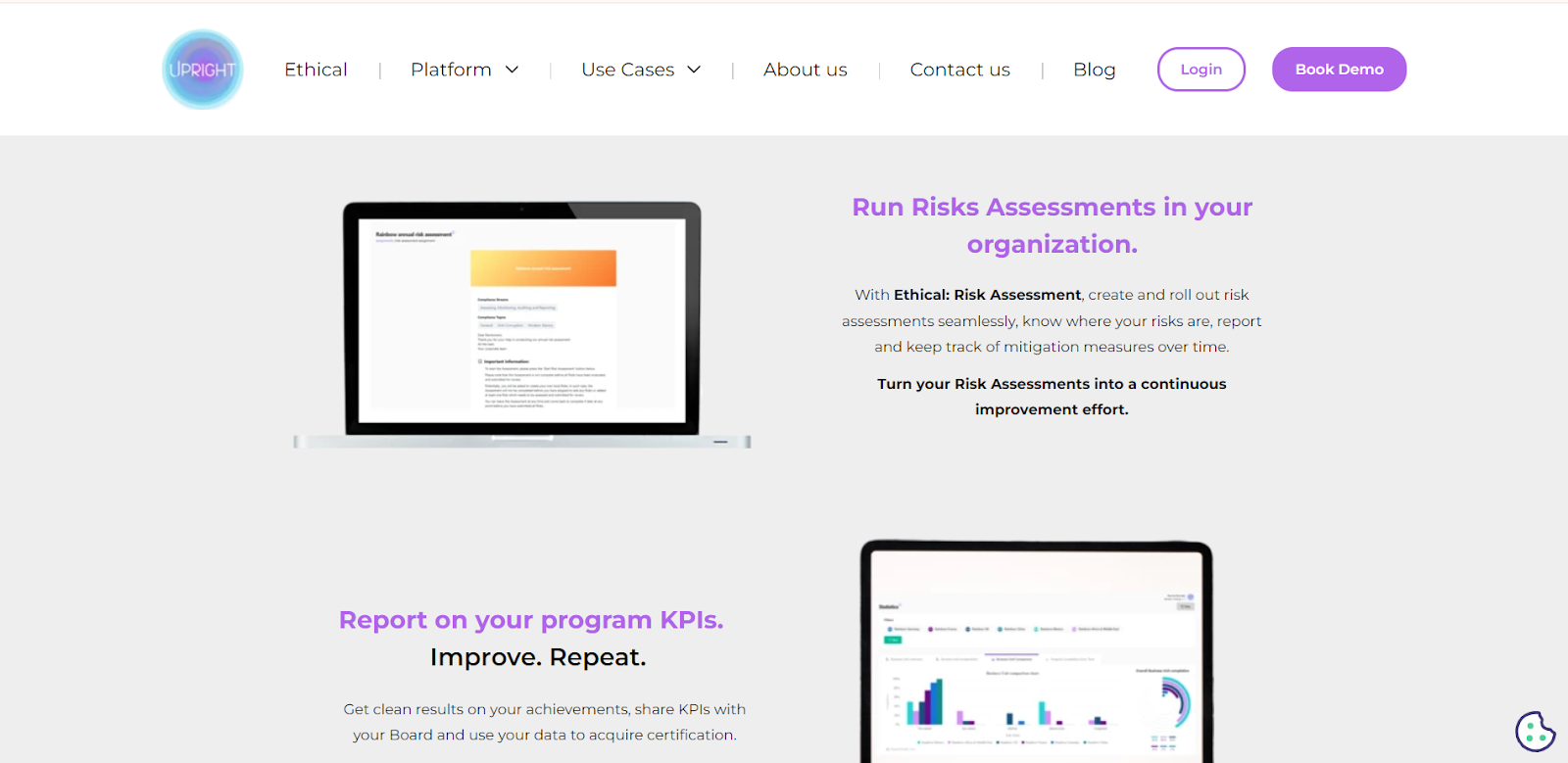
Ethical by Upright is a comprehensive ethics and compliance tool designed to streamline the deployment and management of compliance strategies globally. Its robust features make it an effective tool for enhancing organizational integrity and ensuring regulatory compliance.
Features:
- Program Management: Draft, assign, and track tasks and assessments globally.
- Risk Assessments: Conduct and manage risk assessments seamlessly.
- Matters Management: Report and manage compliance deviations and gaps.
- Global Reporting: Generate comprehensive compliance reports quickly.
- Collaboration Tools: Facilitate seamless collaboration across global teams.
Advantages
- Simplifies global compliance management
- Strong focus on risk and matters management
- User-friendly interface
- Comprehensive reporting capabilities
- Enhances collaboration across teams
Disadvantages
- It may require significant setup time
- Pricing not publicly disclosed
Pricing
Ethical by Upright does not publicly disclose specific pricing information. Prospective customers should contact Upright directly for a personalized quote based on their unique requirements.
Benefits of Ethics and Compliance Software
In this section, we’ll explore how ethics and compliance software can serve as a backbone for maintaining a robust, transparent, and ethically driven company. From reducing operational costs to enhancing workplace integrity, the advantages of integrating such systems are numerous and impactful.
Key Benefits:
- Enhanced Regulatory Awareness: Stay ahead of the curve with constant updates and insights into changing regulations that could impact your business, ensuring you’re always compliant.
- Improved Risk Management: Pinpoint potential risks early with advanced analytics, helping you to avert issues that could lead to legal troubles or tarnish your reputation.
- Streamlined Compliance Processes: Automate and organize compliance tasks to reduce manual errors and free up your team to focus on other critical areas of your business.
- Fostering a Culture of Integrity: Promote a workplace environment that values honesty and transparency, building trust both within your team and with your clients and partners.
- Cost Reduction: Decrease the likelihood of fines and litigation costs by maintaining compliance and nip compliance-related issues in the bud with proactive management.
- Training and Development: Equip your staff with the knowledge they need to meet compliance standards through engaging, up-to-date training modules tailored to your industry.
- Detailed Reporting and Analytics: Make informed decisions with comprehensive reports that highlight trends, track progress, and measure the effectiveness of your compliance efforts.
- Increased Accountability: Encourage responsible behavior with systems that track and manage compliance, ensuring all team members uphold your company’s ethical standards.
Implementing ethics and compliance software isn’t just about following laws—it’s about creating a proactive, informed, and ethical workplace. These tools offer significant advantages that can lead to more informed decisions, a more committed workforce, and ultimately, a more successful business.
Practical Applications of Compliance Software
Compliance software provides valuable tools and features to help organizations meet various regulatory requirements effectively. Here, we explore its practical applications in ensuring FLSA and I-9 compliance.
1. FLSA Compliance
The U.S. Department of Labor’s Field Assistance Bulletin (FAB No. 2020-5) guides employers on adhering to the Fair Labor Standards Act (FLSA) in remote work settings.
According to FLSA, employers must compensate employees for scheduled hours and overtime while preventing non-work-related tasks during compensated hours.
Non-compliance results in hefty fines, making it crucial for HR teams to follow FLSA guidelines meticulously. Compliance software ensures adherence to these regulations, minimizing the risk of costly mistakes.
2. I-9 Compliance
Companies must have new employees complete the I-9 Form by their first workday. Non-compliance can result in significant penalties from Immigration and Customs Enforcement (ICE).
Compliance tools notify HR teams about I-9 form completion, retention, and tracking. SaaS-based solutions also offer integrations to convert paper forms into digital documents and provide E-Verify integration to verify employees’ work authorization in the U.S. quickly.
Compliance software helps organizations adhere to essential regulations, minimizing the risk of penalties and improving overall operational efficiency.
Conclusion
In today’s regulatory landscape, ethics and compliance tools are indispensable for maintaining legal adherence and promoting a culture of integrity. These tools streamline compliance processes, manage risks, and ensure that organizations meet their ethical obligations. We explored key components, practical applications, and additional resources to enhance your compliance efforts.
VComply stands out as the best platform for ethics and compliance management due to its comprehensive features, user-friendly interface, and robust security measures. It offers real-time regulatory updates, detailed analytics, and customizable dashboards, making it an invaluable asset for any organization striving to uphold high ethical standards.
Take the next step towards seamless compliance management and transform your organizational integrity with VComply. Schedule a free demo today!
Frequently Asked Questions (FAQ)
What is ethics and compliance software?
Ethics and compliance software helps organizations manage regulatory requirements, streamline policy oversight, support ethical conduct, and reduce the risk of legal or reputational issues through automated workflows and reporting.
Why is ethics and compliance software important for businesses?
It reduces legal and financial risks, strengthens internal controls, ensures policy adherence, and promotes a culture of integrity—making ethical compliance a strategic advantage rather than just an obligation.
What key features should I look for in ethics and compliance software?
Essential features include policy management, incident reporting, risk assessments, audit tracking, automated alerts, training tools, analytics, and integrations with systems like HRMS or ERP.
How does compliance software help reduce risks?
The software identifies vulnerabilities, flags non-compliance issues, enables anonymous reporting, and provides real-time insights—helping organizations address risks before they escalate.
Which ethics and compliance tools are best for 2026?
Leading platforms include VComply, Ethisphere, Ethico, GAN Integrity, and Ethical by Upright—each offering robust tools for compliance oversight, reporting, training, and risk management.
How does ethics and compliance software support a strong ethical culture?
By centralizing policies, enabling transparent reporting, and reinforcing training and accountability, the software helps embed ethical behavior into everyday decision-making and workflows.