

Compliance Case Management: Workflow, Examples, and Best Practices
Compliance Case Management is the structured process of tracking, investigating, and resolving compliance issues to ensure regulatory adherence and policy enforcement. A well-organized system enhances transparency, accountability, and risk mitigation by ensuring every case is handled efficiently and consistently.

Compliance case management is the process of receiving, assessing, investigating, and resolving concerns about regulatory obligations or internal policies. It keeps the report, evidence, decisions, and follow-up actions in a controlled record so an organization can explain how each matter was handled.
A policy violation, an employee complaint, or an audit finding can involve several departments. The initial report may reach HR, the evidence may sit with operations, and the corrective action may belong to a site manager. Without a defined process, it becomes difficult to see who owns the response and whether the issue has been resolved.
This guide explains how to build a compliance case management workflow, what to document, and which software capabilities help teams carry a concern through to verified closure.
Key Takeaways (TL;DR)
-
Learn how a structured compliance case management system streamlines investigations and ensures regulatory accountability.
-
Understand the five key stages of compliance case management—from intake to ongoing monitoring.
-
Discover how automation, audit trails, and role-based access controls enhance transparency and efficiency.
-
See how advanced tools like AI, analytics, and cloud solutions are reshaping modern compliance operations.
-
Explore best practices for selecting, implementing, and scaling compliance case management software to reduce risk and prevent fraud.
What is Compliance Case Management?
Compliance case management gives an organization a consistent way to handle matters that need review, investigation, or corrective action. Each case has an accountable owner, an appropriate level of access, a record of the work completed, and a documented outcome.
Cases can originate from employee reports, customer complaints, internal audits, management reviews, or monitoring systems. Some require a formal investigation. Others can be resolved through a documented assessment and correction.
The process should reflect the nature of the concern. A safety incident, a conflict-of-interest disclosure, and a suspected privacy breach need different expertise, decisions, and escalation paths. Reporting, retention, and notification obligations also depend on the applicable requirements.
Software supports this process by organizing records and coordinating work. The organization remains responsible for assessing the facts, deciding what obligations apply, and approving the response.
What types of issues become compliance cases?
| Case type | Example trigger | Questions the case should address |
|---|---|---|
| Policy violation | A required approval was bypassed | What happened, which policy applied, and how will the gap be corrected? |
| Ethics concern | A potential conflict of interest is reported | Who should review it independently, and what evidence supports the finding? |
| Workplace complaint | An employee reports inappropriate conduct | How will the concern be assessed, sensitive information protected, and follow-up handled? |
| Safety incident | A site reports a hazardous condition | Is immediate protection needed, and what corrective work must be verified? |
| Audit finding | Testing identifies an ineffective control | Who owns remediation, what is due, and how will effectiveness be retested? |
| Privacy concern | Information may have been shared inappropriately | What information was involved, who needs to assess it, and which response requirements apply? |
| Fraud allegation | A report raises concerns about expense claims | What records need examination, and who has authority to decide the next steps? |
AML and financial-crime case management apply similar recordkeeping principles to specialist activities such as transaction monitoring and screening. This article focuses on broader organizational compliance cases rather than prescribing an AML investigation process.
Compliance case management vs. incident management and investigations
The terms overlap, but each describes a different part of the response.
| Activity | Main purpose | Typical output |
|---|---|---|
| Incident management | Respond to an event and address its immediate effects | Response record, containment actions, and recovery updates |
| Investigation | Examine the facts and evaluate a concern | Evidence assessment and documented findings |
| Compliance case management | Coordinate the full handling of a compliance matter | A record connecting intake, ownership, investigation, decisions, and corrective action |
An incident can lead to a compliance case, and an investigation can be one stage within that case. A case may also begin with an audit finding or disclosure that requires assessment without an incident response.
How does a compliance case management workflow work?
A practical workflow moves a concern from receipt to an approved outcome and verified follow-up. The seven stages below can be adapted to your case types and operating requirements.
1. Receive and record the concern
Give people clear reporting channels, such as a secure form, an appropriate hotline, or a designated contact. Capture the information available without making a reporter prove the allegation before it can be reviewed.
Create a case identifier and record when the concern was received, the source, the reported event, relevant locations, and available attachments. Separate a reported allegation from an established fact.
Stage output: a traceable intake record with an initial confidentiality classification.
2. Assess urgency and determine the response
Assess immediate risks, the potential impact, and whether specialist review is needed. Urgent protection or containment may need to happen before an investigation is complete.
Check for conflicts of interest. A person named in a concern should not determine how that concern is handled. Where notification or reporting duties may apply, involve the appropriate internal specialist to assess the requirements and timing.
Stage output: a documented priority, response path, and immediate actions.
3. Assign ownership and control access
Name a case owner and identify investigators, reviewers, and action owners. Define who can see sensitive details and who can approve decisions.
Set review dates and escalation rules appropriate to severity. When several departments are involved, make one person accountable for coordinating the case so handoffs do not leave work unassigned.
Stage output: clear ownership, access permissions, and a review schedule.
4. Investigate and preserve the evidence
Define the questions the investigation needs to answer. Collect relevant documents, records, interview notes, and other evidence with enough context to understand their source and significance.
Preserve original material according to your evidence-handling procedures. Record when it was collected and distinguish source evidence from an investigator’s interpretation. Restrict access to information that the wider case team does not need.
Stage output: an evidence record and findings that explain what is supported, disputed, or still unknown.
5. Record and approve the decision
Document the conclusion and its basis. The record should explain which evidence was considered, what finding was reached, and who approved the outcome.
An inconclusive result still needs a reasoned explanation. A concern that is not substantiated should retain a record of the assessment and the decision to close or monitor it.
Stage output: an approved outcome with a documented rationale.
6. Assign and verify corrective action
Translate findings into specific actions. Each action needs an owner, a due date, an expected result, and a way to verify completion.
For example, “improve training” is difficult to evaluate. “Update the access-approval procedure, brief the affected team, and test a sample of approvals” provides clearer completion criteria.
Stage output: corrective work with evidence of completion and a verification result.
7. Close the case and review recurring themes
Define closure criteria before the case reaches this stage. Check that the decision is recorded, required approvals are complete, and follow-up work is either verified or governed through an explicitly linked action record.
Apply the relevant retention schedule and any preservation requirements. Review recurring issues by location, process, policy, or control to identify where a broader change may be needed.
Stage output: an approved closure record and any continuing monitoring commitments.
What should a compliance case record contain?
A useful case record lets an authorized reviewer understand what happened without reconstructing the story from separate inboxes.
| Record component | What to capture |
|---|---|
| Intake | Case ID, received date, reporting channel, concern, and relevant entity or location |
| Classification | Case type, severity, confidentiality, and potentially relevant policies or obligations |
| People and ownership | Case owner, subjects, investigators, reviewers, action owners, and conflict checks |
| Evidence | Source, collection date, attachments, notes, and evidence-handling history where required |
| Work history | Tasks, interviews, updates, escalation, and material changes |
| Findings and decision | Evidence considered, rationale, outcome, and approval |
| Corrective action | Owner, deadline, expected result, completion evidence, and verification |
| Closure | Closure approval, date, retention requirements, and linked follow-up work |
Collect information that is relevant to the case and protect sensitive material. More personal data does not automatically make an investigation more complete.
Example: managing a policy violation across multiple sites
Consider an illustrative organization that requires approval before a vendor receives production access. An internal review finds that one site activated access before approval was recorded.
The compliance team opens a case, identifies the relevant policy, and asks the security team to assess whether immediate action is needed. An independent owner reviews the access logs, approval records, and the site’s onboarding process.
The review finds that staff used an outdated procedure. The case decision records that finding and assigns two corrective actions: replace the local procedure and check recent vendor access requests for the same gap. Each action has a named owner and a deadline.
Before closure, a reviewer checks that the updated procedure is in use and examines a sample of new approvals. The team then reviews other sites for the outdated version.
The completed record explains the initial concern, the evidence, the decision, the correction, and how the correction was tested. It also gives the organization a basis for checking whether the issue was isolated or more widespread.
A structured case management process helps organizations systematically address compliance violations and fraud risks while maintaining regulatory integrity. The right compliance case management system and fraud case management software enhance efficiency, automate tracking, and support proactive risk management.
Explore the Importance and Types of Incident Reporting to strengthen compliance and risk management.
How Compliance Case Management Helps Employers and Employees
A well-structured compliance case management system is not just about avoiding fines or meeting regulatory requirements. It creates a more efficient, transparent, and accountable workplace for both employers and employees. The table below outlines how it benefits both sides.
| Aspect | How It Helps Employers | How It Helps Employees |
| Case Visibility | Provides a clear view of ongoing and past compliance cases, reducing oversight and ensuring accountability. | Ensures reported issues are not ignored and are handled fairly and transparently. |
| Automated Workflows | Reduces manual effort in tracking and resolving compliance cases, saving time and resources. | Speeds up the resolution of workplace issues, reducing frustration and uncertainty. |
| Risk Reduction | Helps prevent legal and financial penalties by ensuring timely action on compliance matters. | Creates a safer and more ethical work environment by enforcing policies effectively. |
| Audit Trails | Maintains detailed records of compliance cases, making audits and internal reviews easier. | Protects employees by ensuring there is documented proof of compliance-related actions. |
| Consistent Policy Enforcement | Ensures that rules and regulations are applied uniformly across all cases, minimizing bias. | Gives employees confidence that compliance cases are handled fairly, regardless of position or department. |
| Regulatory Readiness | Prepares the organization for regulatory audits and investigations by maintaining organized case records. | Provides employees with clear processes to follow if they face compliance-related concerns. |
By integrating compliance case management, businesses create a more structured approach to handling workplace issues. This benefits both leadership and employees in terms of efficiency, fairness, and risk management.
Read: Workplace Incident Management: Key Steps and Tools

Best practices for compliance case management
Standardize the essentials and adapt the workflow
Use consistent intake fields, case classifications, and decision records. Adjust investigation steps and approvals to the case type. A minor administrative exception and a serious misconduct allegation should receive proportionate handling.
Protect confidentiality throughout the case
Define access at intake and review it when people join the case. Consider what appears in email notifications, exports, and dashboards as well as the case record itself. Provide reporting channels and follow-up procedures that support the organization’s non-retaliation commitments.
Document handoffs and decisions
Record why a case moved to another team, why its priority changed, and why an outcome was selected. Status labels alone do not explain whether the underlying concern was assessed adequately.
Separate closure from corrective-action verification
Decide whether corrective actions must be verified before closure or can continue in a linked, controlled process. Make that distinction visible so a closed case does not conceal unfinished remediation.
Use automation for coordination
Routing, reminders, overdue alerts, and reporting can reduce administrative work. Keep investigation findings and material decisions subject to appropriate human review. Automated workflow completion is not proof that a corrective action worked.
Which compliance case management software features matter?
Evaluate software against the way your team handles sensitive cases, cross-functional work, and follow-up. Ask vendors to demonstrate a complete example rather than isolated screens.
| Capability | What to test in a demonstration |
|---|---|
| Secure intake | Can you capture required information and support the reporting channels you need? |
| Configurable workflows | Can different case types use different stages, owners, reviews, and escalation rules? |
| Access controls | Can you restrict case details, attachments, and sensitive participant information? |
| Evidence and activity history | Can a reviewer trace the evidence, updates, findings, and approvals? |
| Task and corrective-action tracking | Can you assign work, follow deadlines, and record verification? |
| Reporting | Can you see aging cases, overdue actions, recurring themes, and status by location? |
| Connected records | Can cases be associated with relevant policies, risks, obligations, or controls? |
| Data management | Can the system support your export, retention, and preservation needs? |
For a practical test, submit a sample concern, change the investigator, add evidence, escalate a missed task, approve the outcome, and verify the correction. Check what each role can see throughout the process.
How to implement a compliance case management process
Start with one representative case type. Define the intake requirements, severity levels, decision authority, permissions, and closure criteria before configuring the workflow.
Run a pilot using realistic sample cases. Include incomplete reports, anonymous concerns, an investigator conflict, and overdue corrective work. Check whether the process handles these situations clearly.
Train the people who receive reports, investigate cases, approve outcomes, and complete corrective actions. Give employees simple guidance on how to report a concern and what follow-up to expect.
Expand after the pilot shows that ownership, evidence, decisions, and verification remain connected. Review the process periodically as case types and organizational requirements change.
How to measure whether the process is working
Track the measures that reveal delays and incomplete follow-through:
- Time from receipt to initial assessment.
- Time from assessment to assignment.
- Open cases by age, severity, and stage.
- Overdue investigation tasks and corrective actions.
- Time to verified corrective-action completion.
- Reopened cases and recurring issues by process or location.
Interpret results by case type and complexity. A faster closure time may reflect simpler cases or premature closure. An increase in reports may reflect greater confidence in reporting. Review the underlying evidence before drawing conclusions.
How VComply CaseOps supports compliance case management
VComply CaseOps supports secure intake, configurable routing and workflows, controlled access, investigation records, corrective actions, and case reporting. Teams can keep evidence, tasks, findings, and decisions together as a case moves toward closure.
CaseOps can also connect cases with obligations and controls in ComplianceOps, policies in PolicyOps, and risks in RiskOps. This helps teams review the wider context of an issue and follow through on the work it creates.
For guidance on designing the process, explore Effective Case Management: A Practical Handbook. To evaluate the software, request a CaseOps demo using one of your own reporting and investigation scenarios.
Types of Compliance Management Software and Their Role in Case Management
Compliance management software helps organizations enforce regulations, track policy adherence, and handle case investigations efficiently. While compliance tools cover a broad range of needs, some specialize in compliance case management, ensuring that violations, fraud, and other risks are addressed properly. Below are the key types of compliance management software and how they support case handling.
1. Compliance Case Management Software
Purpose: Manages compliance-related incidents, investigations, and resolutions in a structured manner.
How It Helps:
- Centralizes all compliance cases in one platform for better visibility and tracking.
- Assigns cases to the right teams, ensuring accountability and timely action.
- Maintains detailed case records for internal audits and regulatory reviews.
A financial institution uses compliance case management software to track and resolve insider trading allegations, ensuring investigations follow regulatory guidelines.
2. Fraud Case Management Software
Purpose: Identifies, tracks, and investigates fraud-related incidents within an organization.
How It Helps:
- Detects fraudulent activity through automated monitoring and anomaly detection.
- Supports forensic investigations by compiling relevant transaction data.
- Links case findings to compliance requirements, ensuring regulatory obligations are met.
A bank detects unusual transactions and, through fraud case management software, automatically flags and escalates the case for further review.
3. Policy and Compliance Management Software
Purpose: Ensures that employees understand and follow company policies and regulatory requirements.
How It Helps:
- Distributes policies, tracks acknowledgments, and ensures compliance training is completed.
- Integrates with compliance case management systems to confirm whether a violation stems from a lack of policy awareness.
- Helps organizations stay compliant by updating policies in response to new regulations.
Using policy management software, a healthcare provider updates data privacy policies and ensures that all employees sign off on the new guidelines.
4. Regulatory Compliance Tracking Software
Purpose: Helps businesses stay compliant with industry regulations and governmental mandates.
How It Helps:
- Automates monitoring of new regulations and ensures organizations update their processes accordingly.
- Links compliance requirements to case management, ensuring cases align with legal obligations.
- Generates compliance reports for audits and government agencies.
A multinational corporation tracks global anti-corruption laws and integrates them into its compliance case management system to ensure investigations follow legal standards.
5. Whistleblower and Ethics Reporting Software
Provides employees and stakeholders with a secure, anonymous way to report compliance violations.
How It Helps:
- Encourages employees to report unethical behavior without fear of retaliation.
- Integrates with compliance case management software, ensuring reports are reviewed and investigated properly.
- Creates a structured, confidential process for handling sensitive cases like harassment or fraud.
Read: Implementing Effective Whistleblower and Ethics Hotline Practices
A manufacturing company uses a whistleblower platform where employees can anonymously report safety violations, which are then investigated through the compliance case management system.
Organizations need different compliance solutions depending on their industry, regulatory landscape, and risk exposure. Whether managing fraud, tracking regulatory updates, or handling misconduct cases, investing in the right compliance case management software helps businesses maintain integrity, reduce risk, and ensure compliance processes are thorough and legally sound.
The Link Between Compliance Failures and Fraud Risks
Weak compliance frameworks create vulnerabilities that fraudsters exploit. Gaps in oversight, lack of real-time detection, and inadequate enforcement mechanisms allow fraudulent activities to persist. Strengthening compliance processes is critical to mitigating both internal and external fraud risks.
How Weak Compliance Processes Contribute to Fraud Incidents
A weak compliance structure exposes organizations to various fraud risks. Without proper enforcement and monitoring, fraud can go undetected, causing financial and reputational damage.
| Compliance Weakness | Fraud Risk Created | Impact on Organization |
| Poor oversight & monitoring | Undetected fraudulent transactions | Financial losses & reputational damage |
| Lack of standardized policies | Inconsistent enforcement of rules | Increased susceptibility to insider fraud |
| Weak whistleblower protection | Fear of reporting misconduct | Fraud persists due to silence |
| Inadequate training & awareness | Employees unaware of fraud red flags | Higher risk of collusion & Negligence |
| Manual compliance checks | Delayed fraud detection | Regulatory Penalties & Legal Consequences |
The Necessity of Real-Time Monitoring in Fraud Case Management Systems
Fraud threats evolve quickly, making real-time monitoring essential for effective fraud detection. Automated tracking and AI-driven analysis can prevent fraud before it causes major losses.
| Real-Time Monitoring Benefit | Fraud Risk Addressed | Organizational Advantage |
| Instant anomaly detection | Prevents financial fraud early | Minimizes monetary losses |
| Automated risk scoring | Flags high-risk transactions | Improves fraud prevention efficiency |
| AI-driven pattern recognition | Detects unusual behavior | Reduces reliance on manual audits |
| Immediate alerts & escalation | Enables swift action | Strengthens fraud response time |
| Continuous compliance tracking | Ensures regulatory adherence | Avoids fines & legal repercussions |
Addressing Internal and External Fraud Risks Through Structured Compliance Mechanisms
A strong compliance framework safeguards organizations from both internal and external fraud. Proactive risk management strategies help detect and prevent fraudulent activities before they escalate.
| Compliance Mechanism | Internal Fraud Prevention | External Fraud Prevention |
| Strict access controls | Prevents unauthorized transactions | Blocks outsider account takeovers |
| Regular internal audits | Identifies employee misconduct | Detects vendor fraud patterns |
| Whistleblower programs | Encourages insider reporting | Exposes third-party fraud collusion |
| Data encryption & security | Protects sensitive information | Prevents phishing & cyber fraud |
| Third-party due diligence | Screens vendors & partners | Reduces exposure to external scams |
Strengthening compliance is not just a regulatory necessity—it’s a fraud deterrence strategy. Robust systems, real-time monitoring, and structured frameworks significantly reduce fraud risks, safeguarding both financial and reputational integrity.
Key Features of an Effective Compliance Case Management System
A well-structured compliance case management system is essential for organizations to efficiently track, investigate, and resolve compliance issues. The right system ensures regulatory adherence and strengthens fraud prevention and risk management. Selecting the right compliance software requires a focus on security, automation, ease of use, and integration capabilities. Below are the key elements to consider when choosing an effective compliance case management system.
1. Centralized Case Management and Documentation
A robust system consolidates all compliance cases, investigations, and documentation in a single platform. This prevents information silos and ensures that every case has a clear audit trail. Secure, centralized data storage reduces the risk of lost records and unauthorized access.
2. Role-Based Access Controls and Secure Data Management
Sensitive compliance cases require strict security controls. Role-based access ensures that only authorized personnel can view or modify specific case files. Advanced encryption and multi-factor authentication further protect confidential information from breaches or internal misuse.
3. Automated Workflows for Efficiency
Manual case handling is inefficient and prone to errors. A strong case management system automates key processes, including case assignment, escalation, reminders, and approvals. This speeds up resolution times and ensures compliance with internal policies and external regulations.
4. Task Assignment and Progress Tracking
Compliance investigations often involve multiple stakeholders. A well-designed system allows managers to assign tasks, set deadlines, and track progress in real-time. This prevents bottlenecks and ensures accountability throughout the investigation process.
5. Advanced Search and Case Linkage Capabilities
Effective case management requires quick and easy access to historical data. Advanced search features enable investigators to retrieve relevant information instantly. Additionally, a system that can identify related cases helps detect patterns, uncover fraud networks, and prevent recurring compliance violations.
6. Email and Communication Management
Compliance cases often involve extensive communication. A system that integrates email management allows users to track conversations, store evidence, and ensure that all relevant communications are attached to the correct case file. This eliminates the risk of losing critical information.
7. Mobile Accessibility for Remote Investigations
Compliance teams need the flexibility to work from anywhere. A mobile-friendly case management system ensures that investigators can access case files, update statuses, and communicate with stakeholders even when they are away from their desks. This is especially critical for organizations with geographically dispersed teams.
8. One-Click Reporting for Regulatory Compliance
Generating compliance reports manually is time-consuming and error-prone. A system with automated reporting capabilities enables organizations to generate accurate, detailed, and audit-ready reports in seconds. This not only streamlines regulatory compliance but also reduces administrative burden.
9. Integration with Other Compliance and Risk Management Tools
A compliance case management system should seamlessly integrate with other essential tools, such as fraud detection software, whistleblower hotlines, and regulatory reporting platforms. This ensures a comprehensive compliance ecosystem, reducing duplication of work and improving efficiency.
10. Continuous Monitoring and Audit Trails for Transparency
Every action taken within the system should be logged with timestamps and user details to ensure accountability and regulatory adherence. A strong audit trail helps in both internal reviews and external regulatory audits, enhancing transparency and reducing compliance risks.
Selecting the Right Compliance Case Management System
Choosing a compliance case management system is not just about checking off features—it’s about finding a solution that aligns with your organization’s needs. Prioritize security, automation, and usability. Ensure that the system can scale as your compliance demands grow. Ultimately, an effective compliance case management system should enhance transparency, improve efficiency, and strengthen risk mitigation efforts.
Selecting the Right Compliance and Case Management Software
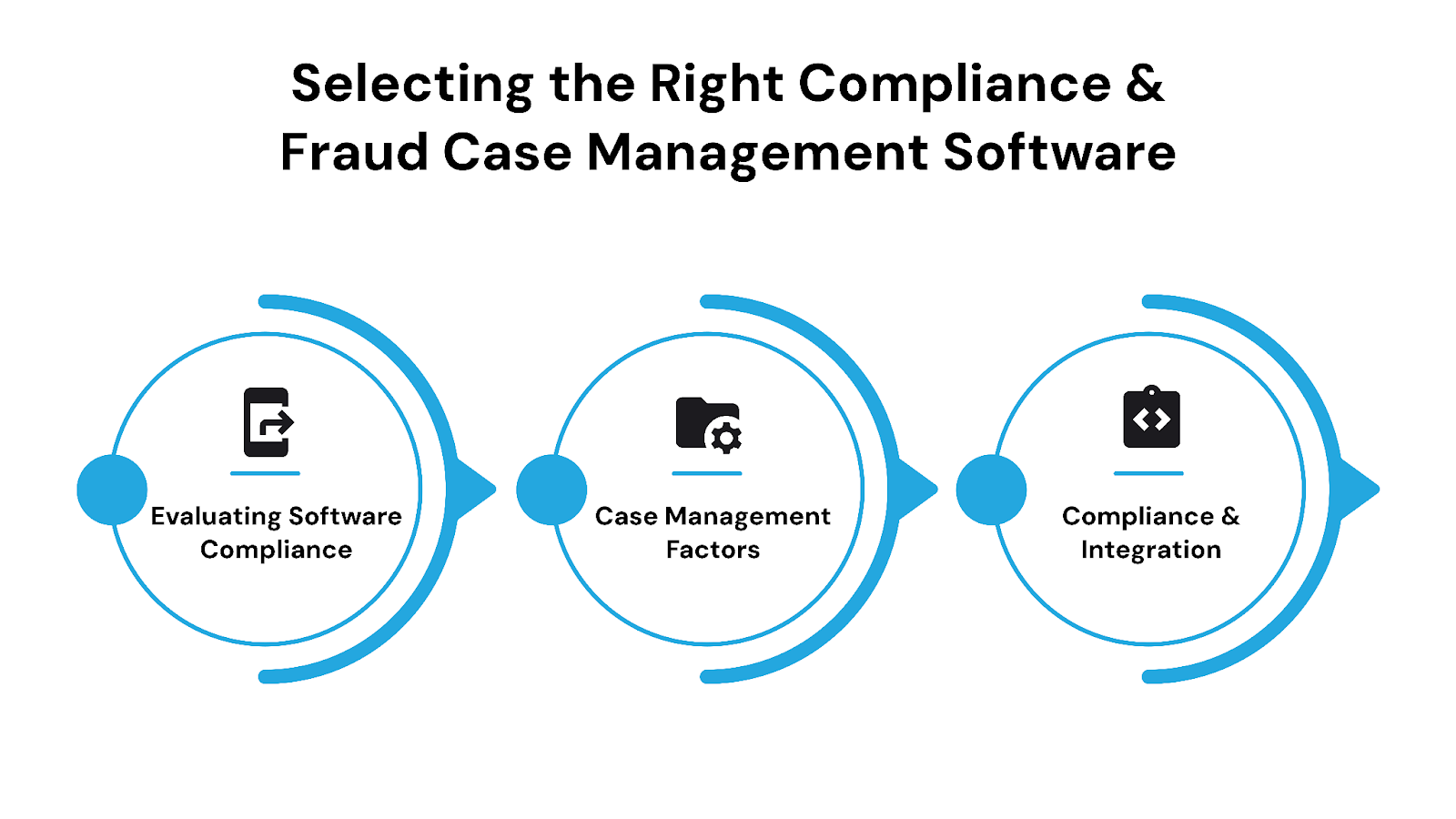
Choosing the right compliance and fraud case management software is critical for organizations seeking to strengthen their regulatory adherence and fraud prevention strategies. A well-designed system streamlines case management and enhances investigative efficiency, regulatory reporting, and risk mitigation. Below are the key factors to consider when evaluating and implementing a case management solution.
1. Evaluating Software Capabilities Based on Regulatory Needs
Regulatory compliance requirements vary across industries and jurisdictions, making it essential to choose a system that aligns with specific legal frameworks. Organizations must ensure that their case management software meets the following regulatory expectations:
✔ Compliance with Industry Standards and Regulations
- The software should support compliance with frameworks like GDPR, SOX, HIPAA, PCI-DSS, or FCPA, depending on the industry.
- Built-in features for regulatory updates ensure that the system adapts to changing laws without manual intervention.
✔ Case Evidence and Documentation Requirements
- A well-structured system ensures that every compliance or fraud investigation maintains a clear audit trail, with secure storage of evidence and related documents.
- Timestamped actions help maintain accountability and transparency for audits and legal reviews.
✔ Customizable Workflows for Regulatory Processes
- Some industries require strict investigation protocols, including multi-step approvals, external reporting, and regulatory notifications.
- The system should allow companies to customize workflows based on their specific regulatory obligations.
2. Key Considerations When Implementing a Case Management System
Deploying a compliance case management system requires more than just selecting software—it involves careful planning to ensure smooth integration and adoption. Organizations should focus on the following:
✔ Scalability and Adaptability
- The system should scale with your organization’s growth, whether you add new compliance requirements, expand to new jurisdictions, or increase case volume.
- A cloud-based or hybrid solution allows for flexibility in storage and accessibility.
✔ User Adoption and Training
- Even the most advanced software is ineffective if employees don’t know how to use it.
- Look for a system that offers intuitive navigation, minimal learning curves, and in-app guidance to speed up adoption.
- Training programs and ongoing support should be available to ensure compliance teams use the system effectively.
✔ Workflow Automation Without Over-Complication
- Automation should simplify processes, not add unnecessary complexity.
- The software should automate case assignments, approvals, alerts, and reporting while allowing human oversight where necessary.
✔ Multi-Device Accessibility
- Investigations don’t always happen in an office. Teams should be able to securely access, update, and review cases on mobile devices.
- Look for a system with mobile-responsive interfaces or dedicated mobile apps for secure on-the-go case handling.
3. Compliance Reporting and Integration with Existing Risk Management Tools
A compliance case management system should seamlessly integrate with an organization’s broader risk management ecosystem. This ensures that compliance efforts are aligned with fraud detection, audit, and governance frameworks.
✔ Seamless Data Integration with Risk and Fraud Detection Systems
- The software should be able to connect with existing fraud detection tools, financial monitoring systems, and whistleblower platforms for a holistic view of risk exposure.
- API compatibility and pre-built connectors ensure real-time data sharing across different compliance tools.
✔ Regulatory Reporting Capabilities
- A robust system should generate audit-ready reports with minimal manual effort.
- It should offer customizable templates, automated report scheduling, and real-time dashboards for compliance officers to monitor risks proactively.
✔ AI and Predictive Analytics for Risk Mitigation
- Advanced solutions now integrate AI-driven analytics to identify patterns, detect anomalies, and predict fraud risks before they escalate.
- Behavioral analysis and risk scoring help compliance teams prioritize high-risk cases efficiently. Choosing the right compliance and fraud case management software is a strategic decision that impacts regulatory adherence, fraud prevention, and efficiency. The ideal platform should be scalable, adaptable, user-friendly, and compliant with industry regulations.
Focusing on regulatory alignment, integration, automation, and data-driven insights helps businesses strengthen compliance and reduce fraud risks. A well-designed system streamlines case management enhances risk mitigation, and empowers compliance teams with real-time intelligence for long-term success.
Take Control of Your Compliance Operations with CaseOps
Today, organizations need more than just basic case tracking—they need an intelligent system that adapts to their unique compliance requirements while ensuring consistent oversight. VComply’s Case Management solution offers a structured approach to managing compliance incidents, investigations, and regulatory obligations through:
- Unified Case Intake & Routing: Streamline reporting channels and automatically direct cases to appropriate teams
- Centralized Evidence Management: Secure, organized storage of all case-related documentation and audit trails
- Real-Time Analytics & Monitoring: Track case progression, identify bottlenecks, and measure compliance effectiveness
- Automated Workflow Engine: Design and implement standardized processes that ensure consistent case handling
- Customizable Dashboards: Create role-specific views that deliver relevant insights to every stakeholder
Schedule a Free Demo to see how VComply can transform your compliance operations.
Wrapping Up
The future of compliance case management lies in automation, predictive intelligence, and cloud technology. By integrating AI-driven monitoring, predictive analytics, and cloud-based platforms, organizations can enhance oversight, streamline investigations, and more effectively prevent fraud. A structured compliance framework reduces risk exposure and strengthens an organization’s ability to stay ahead of evolving regulatory demands. Experience the benefits firsthand with VComply’s 21-day free trial—streamline compliance, automate workflows, and improve risk management today.