

Best HIPAA Compliance Software for Healthcare Organizations in 2026, A Buyers Guide
HIPAA compliance in 2026 is no longer just about maintaining privacy policies, training staff once a year, and keeping a breach response plan somewhere in a shared folder. Healthcare organizations are now operating in a more exposed environment, with ransomware, vendor access, cloud systems, telehealth, AI tools, tracking technologies, and connected applications all increasing the risk around protected health information.

HIPAA compliance software helps covered entities and business associates manage the work required to protect PHI and ePHI, including risk analysis, policies, workforce training, vendor oversight, incident response, corrective actions, and audit evidence.
What is HIPAA Compliance Software?
HIPAA compliance software is a technology solution that helps healthcare organizations and their business associates comply with the Health Insurance Portability and Accountability Act (HIPAA). It centralizes compliance activities such as policy management, risk assessments, employee training, incident tracking, audit documentation, and evidence collection to help protect protected health information (PHI) and demonstrate regulatory compliance.
The best HIPAA compliance software in 2026 should help healthcare teams move beyond static policies and spreadsheets. It should assign owners, track deadlines, document safeguards, manage BAAs, capture evidence, and provide real-time visibility into HIPAA readiness.
This guide compares the top HIPAA compliance software platforms for healthcare organizations, small practices, business associates, digital health companies, and healthcare SaaS vendors.
The comparison below is intended as a quick summary. For a more detailed breakdown of each HIPAA compliance software platform, including features, ideal users, and selection guidance, continue to the individual reviews below.
Best HIPAA Compliance Software in 2026
| Best For | Recommended Software |
|---|---|
| Best overall for healthcare compliance operations, multi site compliance, and HIPAA support | VComply |
| Best for small practices needing guided HIPAA support | Compliancy Group |
| Best for healthcare training and credentialing | MedTrainer |
| Best for BAA and vendor tracking | Accountable |
| Best for healthcare cyber risk analysis | Clearwater |
| Best for healthcare SaaS and SOC 2 + HIPAA | Vanta |
| Best for automated security evidence collection | Drata |
| Best for cloud compliance monitoring | Sprinto |
| Best for multi-framework security compliance | Secureframe |
| Best for growing healthtech teams | Scrut |
Overall recommendation: VComply is a strong choice for healthcare organizations that need HIPAA compliance management across policies, risks, incidents, corrective actions, evidence, audit readiness, and leadership reporting in one connected platform.
Key Takeaways
- HIPAA compliance in 2026 is more continuous than annual. Healthcare organizations need to manage risk assessments, policies, training, vendor oversight, incidents, corrective actions, and audit evidence throughout the year.
- Recent OCR enforcement shows strong focus on ransomware, risk analysis, breach response, and ePHI safeguards. The biggest risk is not only failing to prevent incidents, but failing to show that reasonable safeguards, reviews, and corrective actions were in place.
- The proposed HIPAA Security Rule updates signal higher cybersecurity expectations. Healthcare organizations should prepare for stronger requirements around asset inventories, access controls, encryption, multi-factor authentication, risk analysis, incident response, and documentation.
- HIPAA compliance software should do more than store policies. The best platforms help teams assign owners, track due dates, collect evidence, manage BAAs, document incidents, and report compliance status in real time.
- VComply stands out for connected compliance operations. It helps healthcare organizations manage HIPAA policies, risks, incidents, corrective actions, audit evidence, and leadership reporting in one place.
Why HIPAA Compliance Software Matters in 2026
Healthcare organizations are facing a difficult mix of operational and regulatory pressure. Patient data is spread across EHRs, billing systems, scheduling tools, lab systems, cloud platforms, third-party applications, employee devices, and vendor environments. At the same time, healthcare remains one of the most targeted sectors for cyberattacks.
The proposed HIPAA Security Rule changes show where expectations are moving. HHS has proposed stronger requirements around technology asset inventories, network maps, written risk analysis, security measures, business associate risks, workforce access, and ongoing updates when an organization’s environment changes. The Federal Register notice also states that the proposed modifications are intended to better protect the confidentiality, integrity, and availability of ePHI.
For compliance teams, this means HIPAA readiness can no longer depend on informal follow-ups and static documentation. Organizations need a system that can answer basic but critical questions:
Are risk assessments current?
Are policies updated and acknowledged?
Do we know which vendors touch PHI?
Are incidents documented and escalated?
Are corrective actions tracked to closure?
Can we prove compliance when OCR, auditors, clients, payers, or leadership ask?
HIPAA compliance software helps answer these questions by giving organizations one place to manage the moving parts of privacy, security, documentation, accountability, and evidence.
Recent HIPAA Penalties Show What OCR Is Watching
Recent enforcement actions show that OCR is paying close attention to ransomware, risk analysis, breach reporting, business associate responsibilities, and the ability to protect ePHI in practice.
In August 2025, OCR announced a settlement with BST & Co. CPAs, LLP, a business associate that received financial information containing PHI from a covered entity. OCR said the case marked its 15th ransomware enforcement action and 10th enforcement action under its Risk Analysis Initiative. The settlement followed a ransomware incident and OCR’s finding that BST failed to conduct an accurate and thorough risk analysis. BST agreed to a two-year corrective action plan and paid $175,000.
In March 2026, OCR announced a settlement with MMG Fusion involving a breach affecting 15 million individuals. OCR said the investigation began after a complaint about an unreported security incident and PHI posted on the dark web. OCR’s investigation found that an unauthorized actor had accessed PHI including names, phone numbers, mailing addresses, email addresses, dates of birth, and appointment information.
In April 2026, OCR settled four separate HIPAA Security Rule ransomware investigations. The settlements involved breaches that collectively affected more than 427,000 individuals and exposed unsecured ePHI, including demographic data, Social Security numbers, financial information, lab results, medications, and diagnoses or conditions. The covered entities agreed to two-year corrective action plans and paid a total of $1.165 million to OCR.
HHS also adjusted civil monetary penalties for inflation effective January 28, 2026. The Federal Register notice explains that annual inflation adjustments are required to maintain the deterrent effect of civil monetary penalties, and the updated amounts apply to penalties assessed on or after publication when the violation occurred on or after November 2, 2015.
The lesson for healthcare organizations is practical. OCR is not only looking at whether a policy exists. It is looking at whether risk analysis was actually performed, whether risks were addressed, whether systems were protected, whether incidents were reported, and whether the organization can show evidence of reasonable safeguards.
What Is HIPAA Compliance Software?
HIPAA compliance software helps covered entities and business associates manage the operational requirements needed to protect PHI and ePHI. It supports privacy, security, breach response, documentation, employee training, vendor oversight, and audit readiness.
A strong HIPAA compliance platform should help organizations manage:
| Capability | Why It Matters |
|---|---|
| HIPAA risk analysis | Helps identify threats and vulnerabilities to ePHI |
| Risk management plans | Turns risk findings into assigned remediation actions |
| Policy management | Keeps privacy, security, breach, and access policies current |
| Training and attestations | Proves workforce members received and acknowledged training |
| Vendor and BAA tracking | Helps manage business associate risk |
| Incident response | Tracks privacy incidents, investigations, escalation, and closure |
| Evidence management | Stores documentation needed for audits or investigations |
| Corrective action tracking | Ensures identified issues are resolved |
| Dashboards and reporting | Gives leadership visibility into compliance status |
| Audit readiness | Keeps records organized and defensible |
In 2026, HIPAA software should also support the cybersecurity side of compliance. That means helping teams document access reviews, risk analysis, MFA adoption, encryption status, incident response activities, backup and recovery processes, business associate oversight, and system-level safeguards.
How to Choose HIPAA Compliance Software in 2026
The best HIPAA compliance software depends on the type of organization. A small dental practice, behavioral health clinic, hospital system, health plan, digital health startup, and healthcare SaaS vendor will not all need the same platform.
However, every organization should evaluate HIPAA compliance software across a few core criteria.
First, look for risk analysis and remediation tracking. OCR enforcement continues to show that incomplete or outdated risk analysis is a serious compliance weakness. Your software should help document risks, assign mitigation actions, and track closure.
Second, look for policy lifecycle management. HIPAA policies need owners, review dates, approval workflows, version history, and employee acknowledgment tracking. A policy stored in a folder is not enough.
Third, look for incident and breach workflows. HIPAA incidents need structured intake, investigation, risk assessment, escalation, notification review, documentation, and corrective action.
Fourth, look for vendor and BAA management. Healthcare organizations need to know which vendors touch PHI, whether BAAs are in place, and whether vendor risks are being reviewed.
Fifth, look for evidence and reporting. The platform should make it easy to show what was done, who completed it, when it happened, what evidence supports it, and which issues remain open.
| Software | Best For | HIPAA Risk Analysis | Core Compliance Coverage | Best Fit |
|---|---|---|---|---|
| VComply | Healthcare compliance operations and GRC | Yes | Policies, training, vendors, incidents, evidence | Multi-site healthcare, clinics, hospitals, and compliance teams |
| Compliancy Group | Guided HIPAA compliance | Yes | Policies, training, BAAs, evidence | Small practices |
| MedTrainer | Workforce compliance | Limited | Policies, training, incidents | Clinics and healthcare groups |
| Accountable | HIPAA-focused compliance | Yes | Policies, training, vendors, incidents, evidence | Small and mid-sized providers |
| Clearwater | Cyber risk and advisory | Yes | Vendor risk, incidents, evidence | Hospitals, payers, and complex healthcare organizations |
| Vanta | Security compliance automation | Yes | Policies, controls, evidence | Healthtech, SaaS, and business associates |
| Sprinto | Cloud control monitoring | Yes | Policies, controls, evidence | SaaS and cloud-first businesses |
| Secureframe | Multi-framework compliance | Yes | Policies, controls, evidence | Healthcare SaaS vendors |
| Drata | Continuous control monitoring | Yes | Policies, controls, evidence | Technical security teams |
| Scrut | Framework mapping and automation | Yes | Policies, controls, evidence | Growing healthtech teams |
Also Read: Understanding How Internal Audits Work

Best HIPAA Compliance Software in 2026
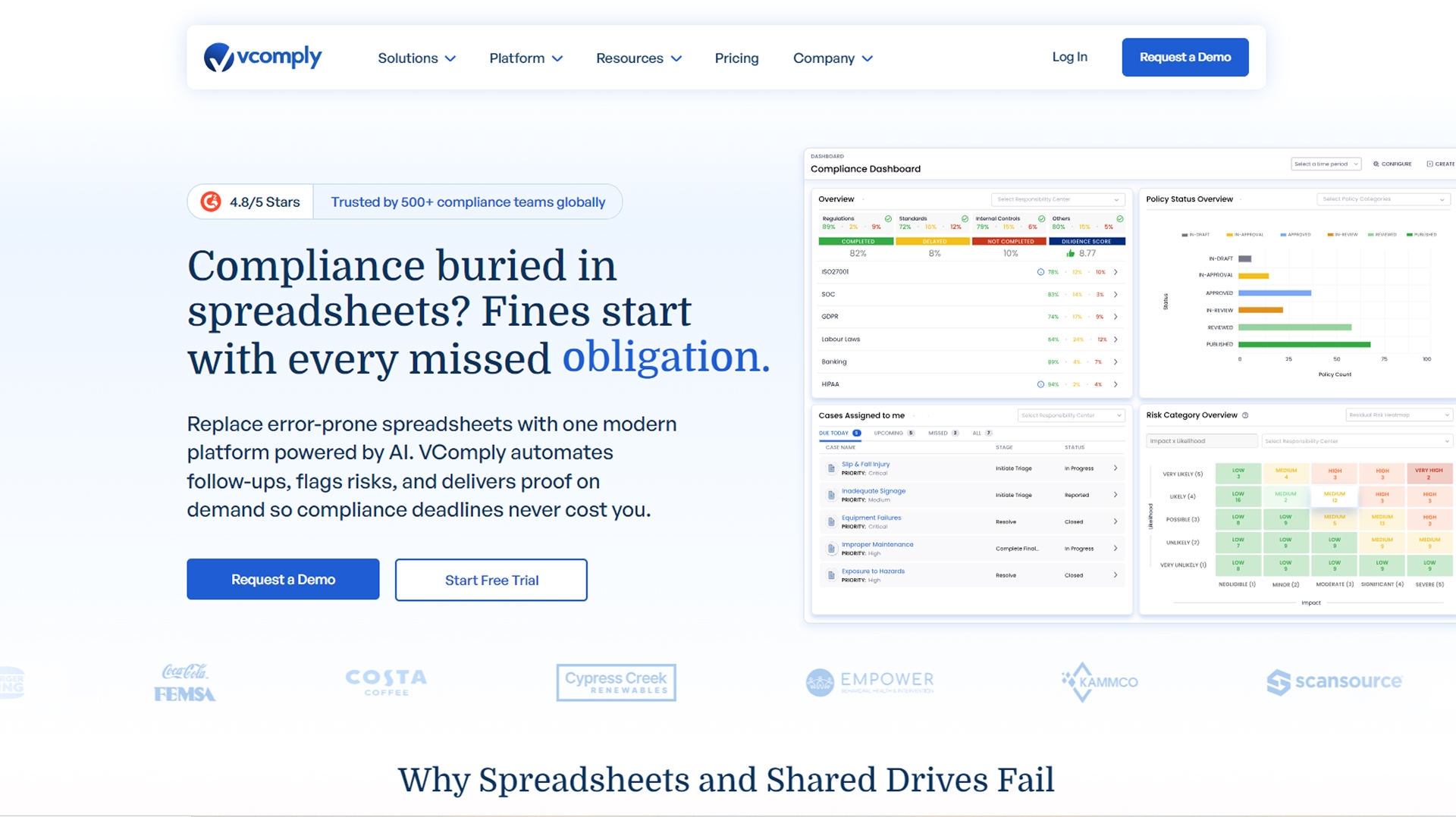
Internal audit leaders consistently tell us their biggest pain points are manual evidence collection, delayed remediation, and proving audit readiness to executives and regulators. VComply’s ComplianceOps directly addresses these challenges by powering end-to-end audit management with automated workflows for planning, evidence collection, task assignments, and remediation tracking, all integrated with your risk and policy programs.
Why VComply Is a Strong Choice for HIPAA Compliance in 2026
VComply is built for healthcare organizations that need more than a checklist. HIPAA compliance involves many recurring activities: policies must be reviewed, employees must be trained, risks must be assessed, vendors must be monitored, incidents must be documented, corrective actions must be closed, and leadership must be able to see where the organization stands.
VComply helps bring these activities into one connected platform.
With VComply, healthcare organizations can:
- Centralize HIPAA policies, procedures, and compliance documents
- Assign owners for privacy, security, and compliance tasks
- Track recurring HIPAA obligations and due dates
- Manage policy reviews, approvals, and acknowledgments
- Document incidents, investigations, and corrective actions
- Capture audit-ready evidence as work happens
- Monitor risks and remediation plans
- Improve visibility across departments and locations
- Generate reports for leadership, audits, and reviews
This is especially important in 2026 because OCR enforcement is showing continued focus on ransomware, risk analysis, breach response, and ePHI safeguards. Healthcare teams need to prove that compliance work is not only planned, but actually completed, documented, and monitored.
VComply’s value is that it helps healthcare compliance teams move from reactive HIPAA management to continuous compliance operations. Instead of relying on spreadsheets, shared drives, and manual reminders, teams can work from a centralized system with clear ownership, evidence, dashboards, and accountability.
For healthcare organizations that want to stay ready for audits, reduce manual work, strengthen visibility, and manage HIPAA as part of a broader compliance program, VComply is a strong platform to consider.
Compliance leaders in US organizations use ComplianceOps to stay continuously audit-ready, eliminate repeat findings, and prove SOX/HIPAA controls with clear ownership and real-time dashboards. Start a 21-day free trial to experience streamlined audit execution hands-on.
Final Thoughts
Choosing healthcare compliance software should not be based only on the longest feature list. The right platform should match your organization’s compliance maturity, regulatory exposure, team structure, and daily workflows.
Before choosing a platform, ask:
- Does it support HIPAA compliance management?
- Can it manage policies, risks, incidents, and audits together?
- Does it support business associate and vendor oversight?
- Can teams assign owners and deadlines?
- Does it track evidence automatically?
- Can leadership see compliance status in real time?
- Does it support multiple departments and locations?
- Is it easy for non-technical users?
- Can it scale as the organization grows?
- Does it reduce manual follow-up?
The best healthcare compliance software should help your organization move from scattered documentation to documented execution.
Book a free demo to see how it transforms your audit lifecycle and gives your team the control they need.
Frequently Asked Questions