

Ultimate Guide to Asset Risk Management for Compliance & Risk Leaders
Asset risk management directly affects regulatory outcomes, operational uptime, and audit readiness. Assets such as energy infrastructure, manufacturing equipment, or financial systems carry risks that evolve across their lifecycle and under increasing regulatory scrutiny.

Many teams still track these risks across spreadsheets, emails, and disconnected tools. That fragmentation makes it hard to see which assets pose the highest compliance or operational risk at any given time, especially as regulations like SOX, ISO 55001, and environmental mandates change.
Effective asset risk management requires centralized visibility, clear ownership, and alignment between operational risk signals and compliance oversight. This article explores how regulated organizations can strengthen asset risk management and how platforms like VComply help scale that effort without increasing complexity.
Key Takeaways
- Asset risk management connects asset health, operational risk, and compliance requirements into a single risk view.
- Fragmented tracking across spreadsheets and emails increases regulatory and operational exposure.
- Real-time asset risk visibility improves prioritization of maintenance, controls, and mitigation efforts.
- Integrated risk registers help align bottom-up operational risks with top-down compliance oversight.
- Solutions like VComply RiskOps enable consistent, audit-ready asset risk management across teams and assets.
What Is Asset Risk Management?
In regulated, asset-heavy organizations, asset risk management focuses on how asset failures or degradation create regulatory, operational, and financial exposure. It is not about maintenance performance; it is about risk prioritization and defensibility.;
For compliance and risk teams, it answers three practical questions:
- Which assets could trigger regulatory or contractual impact?
- How do asset risks link to controls, policies, and obligations?
- Where should limited mitigation resources be applied first?
Unlike maintenance teams that optimise for uptime, compliance teams must prove due diligence. Asset risk management bridges this gap by translating asset condition and lifecycle into compliance-relevant risk.
The regulatory impact varies by industry, such as environmental and safety exposure in energy, quality and worker safety in manufacturing, and system reliability and SOX controls in financial services.
A mature approach connects asset condition directly to a central risk register and evaluates risk based on likelihood and regulatory impact, not as isolated operational issues.
What Most Teams Miss in Day-to-Day Asset Risk Management
As asset portfolios scale, risk visibility becomes fragmented. Operational insights, compliance assessments, and incident data often live in separate systems, making it difficult to see current exposure across assets in one place.
A gap also forms between daily operations and periodic compliance reviews. Risks identified on the ground are not always reflected in formal risk assessments until audits or incidents surface them.
Regulatory pressure adds complexity. Asset-heavy organizations must maintain consistent oversight across the asset lifecycle while meeting environmental, safety, and industry mandates.
Without a unified view of asset risk:
- Prioritization becomes inconsistent
- Resources are harder to allocate effectively
- Remediation is delayed
These challenges point to the need for connected asset, risk, and compliance management rather than isolated tracking.
Core Components Of Effective Asset Risk Management
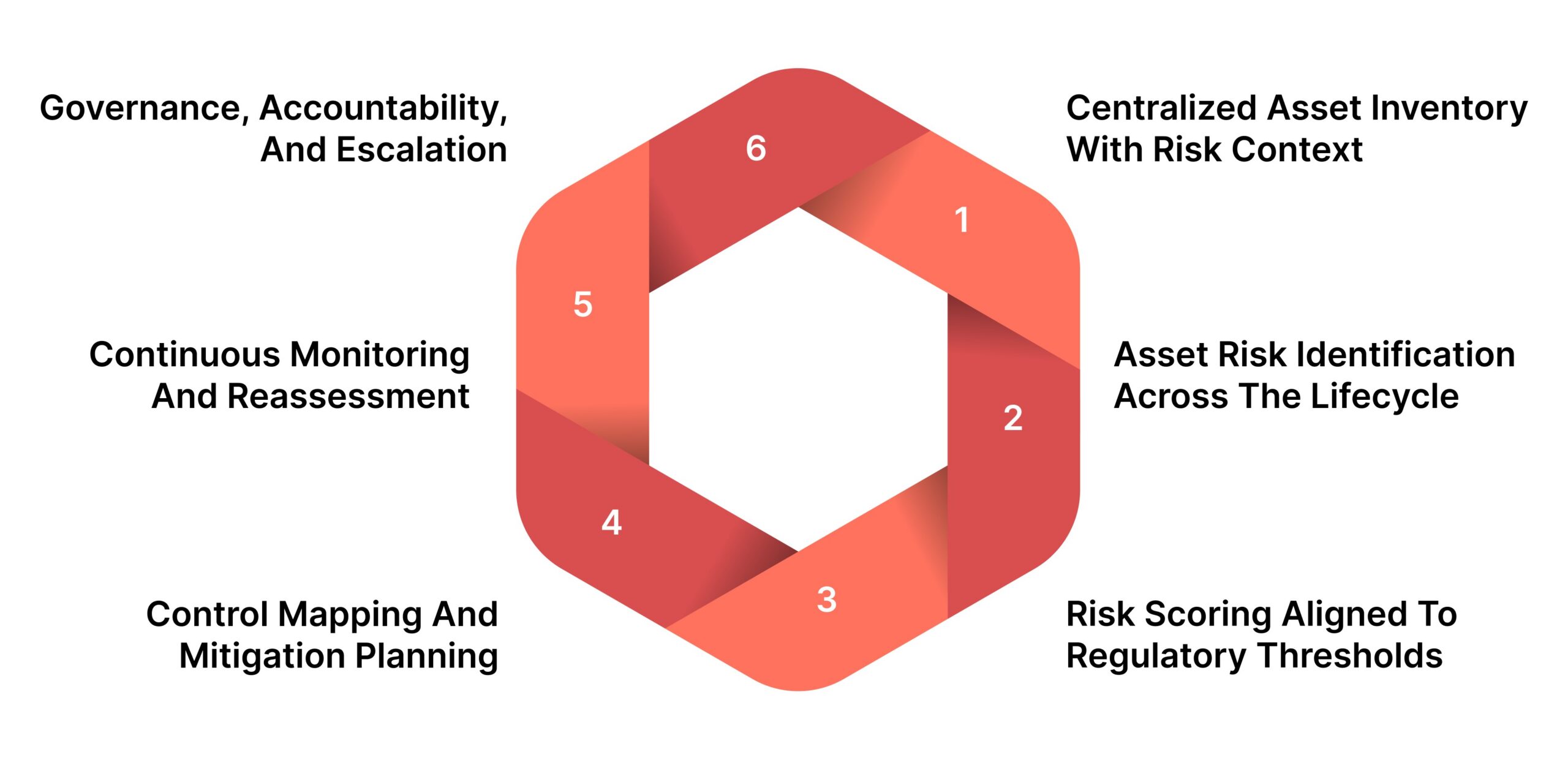
Effective asset risk management depends on execution, not theory. The components below reflect what risk and compliance managers need in place to manage asset risks at scale and withstand regulatory scrutiny in asset-heavy environments.
1. Centralized Asset Inventory With Risk Context
Asset risk management starts with a complete, centralized view of assets that includes more than basic identification details. Each asset must be tied to ownership, business criticality, and regulatory relevance. Without this context, risk assessments remain fragmented and inconsistent across teams.
A centralized inventory allows risk managers to understand which assets matter most from a compliance and operational standpoint. It also creates a shared reference point between operations, engineering, and compliance, reducing gaps caused by siloed records or informal tracking.
2. Asset Risk Identification Across The Lifecycle
Asset risks are not static. They evolve as assets move through different lifecycle stages, from operation and maintenance to modification and eventual decommissioning. Effective asset risk management accounts for this continuous change rather than relying on periodic reviews.
Risk identification should occur whenever asset conditions change, new controls are introduced, or operating environments shift. This ensures that emerging risks are captured early and assessed in context, rather than discovered during audits or after incidents occur.
3. Risk Scoring Aligned To Regulatory Thresholds
Not all asset failures carry the same consequences. Risk scoring must reflect regulatory and compliance impact in addition to likelihood. Assets with a low probability of failure may still represent high risk if failure would trigger regulatory violations, safety issues, or reporting obligations.
Aligning risk scoring with regulatory thresholds allows teams to prioritize mitigation efforts based on real exposure. This approach supports defensible decision-making and provides clarity during audits when regulators question why certain risks received more attention than others.
4. Control Mapping And Mitigation Planning
Identifying asset risks is only useful if those risks are tied to concrete controls and mitigation actions. Asset risk management programs often fail when risks are documented but not operationalized.
Effective programs link each risk to preventive or detective controls, assign clear ownership for mitigation activities, and track progress centrally. This connection ensures that risk treatment is visible, accountable, and auditable rather than dependent on informal follow-ups.
5. Continuous Monitoring And Reassessment
Asset risk profiles change as operating conditions, usage patterns, and external factors evolve. Continuous monitoring is essential to ensure that risk assessments remain accurate and relevant over time.
Monitoring mechanisms should surface changes in asset condition, incidents, or control performance early enough to allow corrective action. Regular reassessment prevents outdated assumptions from driving decisions and helps teams respond proactively instead of reactively.
Also Read: Master 2026 Compliance With Risk Management and Governance Practices
6. Governance, Accountability, And Escalation
Strong governance ensures that asset risks are owned, reviewed, and escalated appropriately. Without clear accountability, even well-documented risks can stall, increasing exposure during audits or regulatory reviews.
Effective governance defines who is responsible for each asset risk, how decisions are approved, and when escalation is required. It also ensures that risk-related actions and decisions are documented in an audit-ready manner.
Platforms like RiskOps support these components by centralizing asset risk registers, linking risks to controls, and providing real-time dashboards that help teams prioritize and act before issues escalate.
Bridging Bottom-Up And Top-Down Asset Risk Assessment
One of the hardest challenges in asset risk management is aligning how risk is seen on the ground with how it is evaluated at the compliance and enterprise level. Both perspectives are valid, but when they operate separately, critical risks are missed or escalated too late.
| Aspect | Bottom-Up Risk Assessment (Operations-Led) | Top-Down Risk Assessment (Compliance-Led) | Integrated Asset Risk Management |
| Primary Owners | Engineering, maintenance, site teams | Compliance, audit, risk leadership | Shared across operations and compliance |
| Risk Signals | Equipment degradation, incidents, work orders, near misses | Regulatory exposure, audit scope, risk appetite | Combined operational signals with regulatory impact |
| Timing | Continuous, real-time | Periodic, review-based | Continuous with structured oversight |
| Data Sources | Maintenance logs, operational systems, informal reporting | Risk assessments, audits, compliance reviews | Centralized asset risk register |
| Visibility | Localized to teams or sites | High-level, often static | Real-time, organization-wide |
| Escalation | Often informal or delayed | Triggered during audits or reviews | Risk-based, proactive escalation |
| Decision Impact | Tactical fixes and maintenance | Strategic planning and reporting | Prioritized mitigation and investment decisions |
| Audit Readiness | Limited documentation | Strong documentation, limited context | Defensible, traceable, audit-ready |
Technology’s Role In Asset Risk Management In 2026
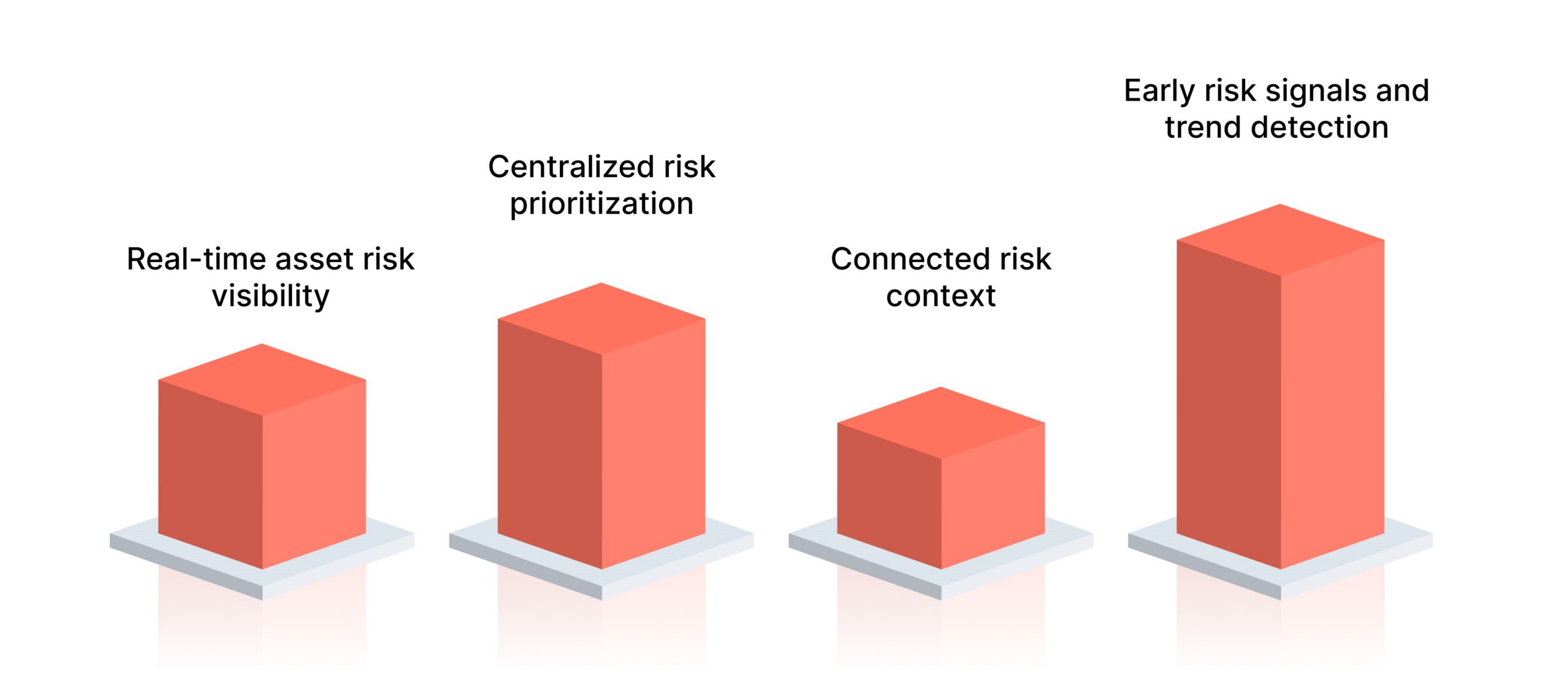
In asset-heavy, regulated environments, technology determines whether asset risk management is proactive or reactive.
By 2026, effective platforms must support:
- Real-time asset risk visibility
Static spreadsheets cannot reflect changing asset conditions, incidents, or regulatory exposure. Live risk registers provide an always-current view. - Centralized risk prioritization
Asset risks need to be ranked by likelihood and regulatory impact, not reviewed in isolation or by team. - Connected risk context
Asset risks must link to controls, incidents, policies, and compliance obligations to support audit-ready decision-making. - Early risk signals and trend detection
Technology should surface recurring failures, delayed mitigation, or control weaknesses before they trigger audits or downtime.
In 2026, asset risk technology is less about documentation and more about making risk visible, comparable, and actionable.
How RiskOps Enables Scalable Asset Risk Management
Stop asset risk spreadsheets from killing your audit prep. RiskOps delivers centralized asset risk management that compliance leaders in energy, manufacturing, and financial services rely on to prove oversight when regulators demand evidence.
RiskOps transforms chaos into audit-ready execution:
- Centralized Asset Risk Register: Every asset risk lives in one place; ownership assigned, regulatory impact scored, and linked to controls and obligations instantly.
- Risk-to-Execution Workflows: Connects asset failures directly to remediation tasks, incidents, and compliance frameworks; no more manual mapping during crunch time.
- Built-in Accountability: Auto-assigned owners, time-bound mitigation, escalation triggers, nothing slips through cracks before board reviews.
- Executive Dashboards: Real-time RAG status shows your CRO exactly which high-impact assets need attention, no PowerPoint marathons.
Book a free demo with VComply to see how centralized asset risk management works in practice.

Final Thoughts
Asset risk management has become a core compliance capability for asset-heavy, regulated organizations. As portfolios grow and regulations tighten, fragmented tracking and reactive assessments no longer provide defensible oversight.
Effective asset risk management requires centralized visibility, consistent prioritization, and clear accountability across the asset lifecycle. When asset risks are linked to controls, incidents, and compliance obligations in real time, risk managers can act earlier, allocate resources more effectively, and demonstrate continuous oversight to auditors and regulators.
Platforms like VComply help organizations move from static risk documentation to operational, audit-ready asset risk management that scales with complexity.
Start a 21-day free trial to see how centralized asset risk registers, real-time dashboards, and integrated compliance workflows help you manage asset risk with confidence.
FAQs
Asset risk management is the process of identifying, assessing, and mitigating risks associated with physical and digital assets, with a focus on regulatory, operational, and financial impact across the asset lifecycle.
It provides documented, real-time visibility into asset risks, linked controls, and mitigation actions. This makes it easier to demonstrate due diligence, prioritization, and ongoing oversight during audits.
Common regulations include SOX, ISO 55001, environmental and safety regulations, and industry-specific mandates in sectors like energy, manufacturing, and financial services.
Spreadsheets are static, hard to scale, and difficult to audit. They lack real-time updates, centralized ownership, and integration with controls, incidents, and compliance requirements.
VComply RiskOps centralizes asset risks, links them to controls and compliance frameworks, enforces accountability, and provides real-time dashboards that support proactive, audit-ready risk management.