

7 Roles and Responsibilities of an AML Compliance Officer
As organizations in sectors like financial services, healthcare, higher education, energy, and manufacturing increasingly prioritize regulatory adherence, the role of an AML Compliance Officer becomes more important.

AML Compliance Managers are responsible for ensuring that businesses adhere to anti-money laundering (AML) regulations, safeguarding against financial crimes such as money laundering and terrorist financing. With nearly 10% of global AML events stemming from compliance failures, the role of the AML Compliance Manager is more vital than ever as financial systems grow increasingly complex.
This guide provides insights into their key responsibilities, required traits, and the selection criteria, along with the specific regulatory frameworks they must follow.
Key Takeaways
- AML Compliance Officers safeguard against financial crimes by ensuring adherence to AML laws, mitigating risks, and protecting the company’s reputation and finances.
- Designing tailored risk assessment frameworks helps AML officers identify and manage money laundering risks specific to their organization’s needs and regulatory environment.
- Ongoing monitoring and timely reporting of suspicious transactions ensure compliance and enable proactive action to prevent money laundering and terrorist financing.
- Training employees on AML regulations ensures compliance and equips staff to recognize and report suspicious activities, strengthening the company’s defenses.
- Advanced AML compliance software tools streamline transaction monitoring and reporting, enabling AML officers to manage compliance and mitigate potential risks efficiently.
What is an AML Compliance Officer?
An AML Compliance Officer is responsible for ensuring that a company adheres to anti-money laundering regulations designed to prevent financial crimes like money laundering and terrorist financing. The officer designs and implements internal policies, conducts customer transaction screenings, and reports suspicious activities in line with regulatory requirements such as the Bank Secrecy Act (BSA), FATF Recommendations, and the USA PATRIOT Act.
AML compliance managers must also stay updated on global regulations like the EU’s Anti-Money Laundering Directives (AMLD), the Foreign Account Tax Compliance Act (FATCA), and OFAC guidelines. They play a pivotal role in reducing operational, reputational, and legal risks and ensuring that their organization is not exposed to financial crimes.
Also Read: Understanding Regulatory Compliance Management in the U.S.
To better understand the critical responsibilities involved, let’s explore the role of an AML Compliance Officer and how they contribute to safeguarding financial systems.

What are the 7 Roles and Responsibilities of an AML Compliance Officer?
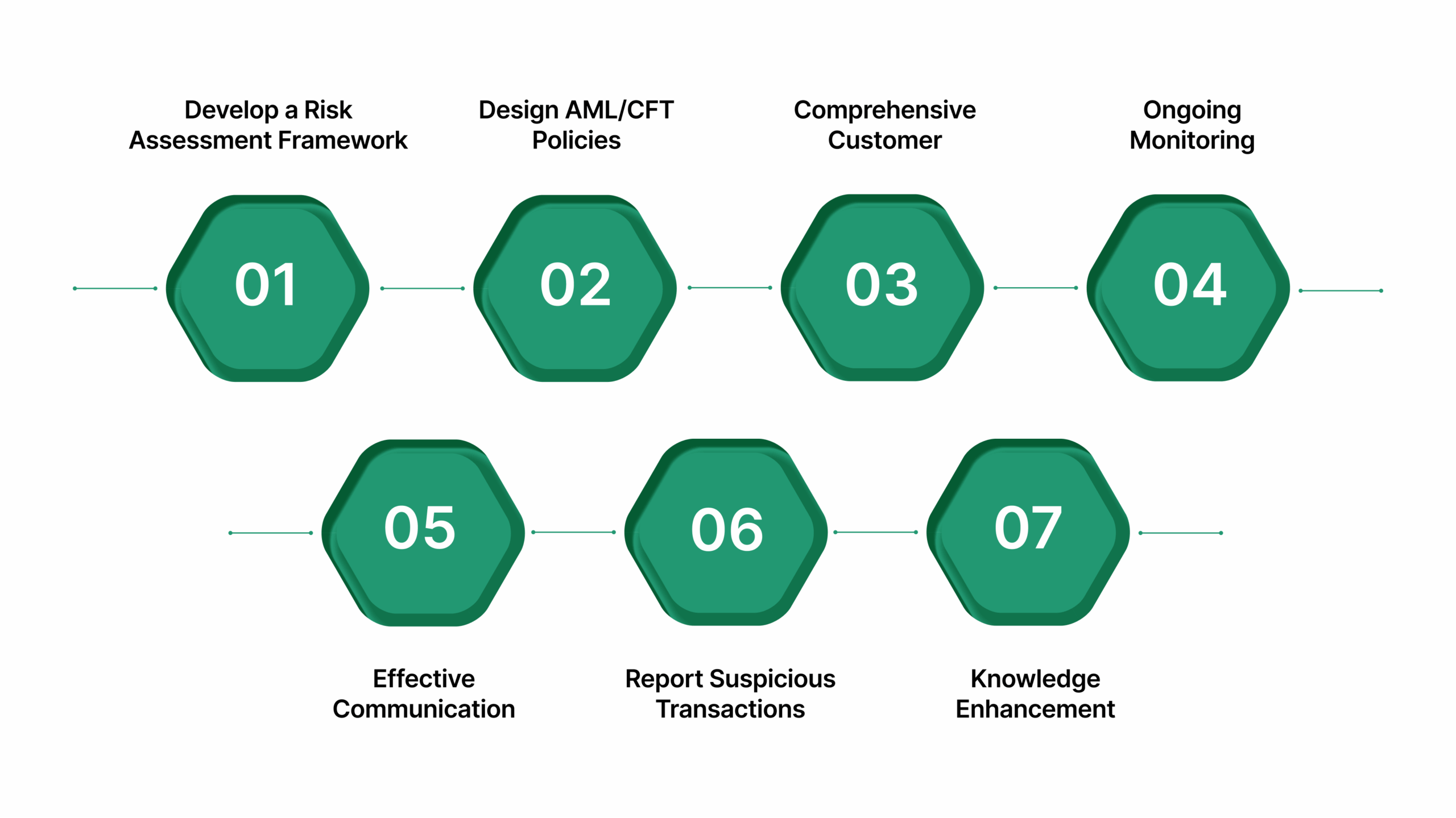
The role of an AML Compliance Officer is key to ensuring an organization complies with anti-money laundering regulations. Here are the key responsibilities that define their role.
1. Develop a Risk Assessment Framework Tailored to Company Threats
AML Compliance Officers are responsible for developing a comprehensive risk framework that identifies the company’s unique threats. This framework should be flexible to accommodate evolving threats and changing regulations like the AML/CFT regulations and FATF recommendations.
By evaluating both internal and external risks, including third-party vendors, sanctions lists, and emerging financial crime tactics, AML officers ensure the company stays ahead of risks and remains compliant with applicable regulations.
Check out the free Anti-Money Laundering (AML) Policy template
2. Design AML/CFT Policies Based on Risk Appetite
AML policies must reflect the company’s exposure to risk and regulatory obligations. Officers ensure that the policies are customized to meet the firm’s risk appetite, aligning with FATF guidelines and AML/CFT frameworks. For instance, high-risk customers and transactions must be monitored more closely, while low-risk entities may require less frequent checks.
AML officers tailor these policies to fit industry-specific regulations, such as financial services regulations or healthcare-specific laws like HIPAA, balancing compliance with business needs.
3. Comprehensive Customer and Transaction Screening
AML Compliance Officers implement robust customer and transaction screening protocols, checking for Politically Exposed Persons (PEPs), sanctions, and adverse media mentions. This screening ensures that the organization’s operations do not inadvertently support criminal activities.
By using software tools, they monitor transactions for signs of suspicious activity and flag potentially risky transactions in accordance with EU AML regulations and other relevant standards. This proactive screening process is key to avoiding involvement with illicit financial activities.
4. Ongoing Monitoring with Advanced AML Software
With financial crimes becoming increasingly sophisticated, AML officers rely on real-time software tools to monitor transactions and activities continuously. This allows them to detect suspicious patterns, track high-risk customers, and ensure that transactions comply with local and international regulations.
Advanced AML software tools allow real-time monitoring and integrate with OFAC, FATCA, and AML/CFT policies, providing the flexibility to manage large volumes of transactions while staying compliant.
5. Effective Communication with Management and Authorities
AML Compliance Officers regularly communicate with internal management and external regulatory bodies. They report on AML program activities, including compliance audits, suspicious activity reports (SARs), and updates on policy adherence.
The role requires clear and concise communication to ensure transparency in how risks are managed. CTOs and CEOs need regular updates to ensure alignment between compliance initiatives and business goals, while authorities such as the Financial Intelligence Units (FIUs) rely on detailed reporting.
6. Report Suspicious Transactions to Financial Intelligence Units (FIUs)
A key responsibility of AML officers is to ensure that any suspicious transactions are promptly reported to the relevant Financial Intelligence Units (FIUs). These reports are critical in helping authorities detect money laundering and terrorist financing activities.
AML officers file Suspicious Activity Reports (SARs) or Suspicious Transaction Reports (STRs) with regulatory bodies, complying with both national and international reporting standards. Failure to do so can expose the organization to regulatory penalties.
7. Training and Knowledge Enhancement for Staff
AML officers are responsible for educating and training staff across the organization to recognize suspicious activities and adhere to internal policies. Regular training helps employees identify potential financial crimes and ensures adherence to evolving regulatory guidelines.
For example, regular training on AML regulations, including updates from FATF or changes in OFAC sanctions, ensures staff are prepared to handle financial transactions in compliance with the latest standards.
As an AML Compliance Officer in industries like financial services, healthcare, and education, ensuring compliance with regulations like the BSA and FATCA is essential. VComply’s ComplianceOps simplifies regulatory compliance management by automating tasks like field audits, tracking compliance statuses, and generating reports, reducing manual errors and ensuring timely adherence to AML regulations.
Also Read: Your Guide to Major Life Science Compliance Risks
Next, let’s look at how to select an AML officer for your organization effectively.
How to Select an AML Compliance Officer

Businesses need to consider a number of important aspects when choosing an AML compliance officer to make sure the right person is selected:
- Experience in Compliance and Financial Services: The ideal candidate should have significant experience in banking, law enforcement, or regulatory compliance. Experience in industries like financial services, healthcare, and manufacturing is valuable, as each sector comes with unique regulatory requirements.
- Strong Educational Background: While there are no specific educational requirements, candidates with a degree in finance, law, or a related field are preferred. Certifications like CAMS (Certified Anti-Money Laundering Specialist) can significantly enhance an applicant’s credentials.
- Expertise in AML Regulations: Candidates must have expertise in relevant AML laws and international regulations like the EU AMLD, FATF recommendations, andthe USA PATRIOT Act to ensure full compliance with global standards.
- Analytical and Communication Skills: Analytical skills are essential for detecting suspicious activities. In addition, AML officers must possess excellent communication skills to report findings to management and regulatory bodies clearly and effectively.
Also Read: ADA Compliance Real Estate Guide To Avoid Penalties
Now that we know how to select an AML officer, let’s explore the traits they must possess.
Important Traits of an AML Compliance Officer

The role of an AML Compliance Officer requires a combination of technical and interpersonal skills. Here are the traits that make a great AML officer:
1. Strong Knowledge of AML Laws and Regulations
AML officers must be well-versed in global regulatory frameworks like the FATF recommendations, OFAC guidelines, and AML/CFT regulations to ensure compliance with national and international standards.
2. Attention to Detail
Given the vast amount of data they need to review, AML officers must have a keen eye for detail. This helps in spotting inconsistencies and suspicious patterns in transactions.
3. Analytical Skills
AML officers must possess a sharp analytical mind to identify trends, anomalies, and red flags in financial data. This trait is vital for detecting potential money laundering activities.
4. Communication Skills
They must communicate effectively with internal teams and external regulators. AML officers regularly produce reports, including SARs and STRs, and must clearly explain their findings to stakeholders.
5. Ethical Behavior
AML officers must exhibit integrity and professionalism in all aspects of their role. They need to act ethically and responsibly while ensuring compliance with the organization’s anti-money laundering policies.
Also Read: How to Map U.S. Regulations to Internal Controls, A Comprehensive Guide and Checklist for 2026
Having the right traits is crucial; let’s now look into the EBA’s guidelines for AML officers.
EBA Guidelines on AML/CFT Compliance Officer
The European Banking Authority (EBA) issued guidelines on the role and responsibilities of AML/CFT compliance officers for credit and financial institutions (FIs) on June 14th, 2022. These guidelines outline key considerations for businesses when hiring and defining the role of the compliance officer.
- Organizational Complexity: The credentials and duties of the AML/CFT compliance officer should be determined by the size and operational complexity of the financial institution.
- Expertise and Knowledge: The AML/CFT officer must possess strong knowledge of relevant regulations and the ability to implement them effectively within the institution’s operations.
- Conflicts of Interest: The officer must be free from conflicts of interest, ensuring impartial and transparent decision-making.
- Accessibility to FIUs: Compliance officers must maintain direct communication with the relevant Financial Intelligence Units (FIUs) for timely information exchange and compliance reporting.
- Clearly Define Responsibilities: Businesses are required to explicitly define and document the roles and duties of their AML/CFT compliance officer, ensuring alignment with regulatory standards and the institution’s risk management framework.
- Criminal Risk Susceptibility: Institutions must assess their exposure to criminal risk and ensure the compliance officer is equipped to mitigate those risks effectively.
For risk managers and CTOs in sectors like energy and manufacturing, VComply’s RiskOps allows you to seamlessly automate risk assessments, quantify potential threats, and scale your risk programs. This helps proactively mitigate AML risks, make data-driven decisions, and ensure adherence to regulatory frameworks like the EU’s 5AMLD and OFAC requirements, enhancing operational efficiency across departments.
Also Read: Understanding SB 553: California’s Workplace Violence Prevention Law
Now, let’s examine the common challenges AML officers face in their role.
Challenges Faced by AML Officers
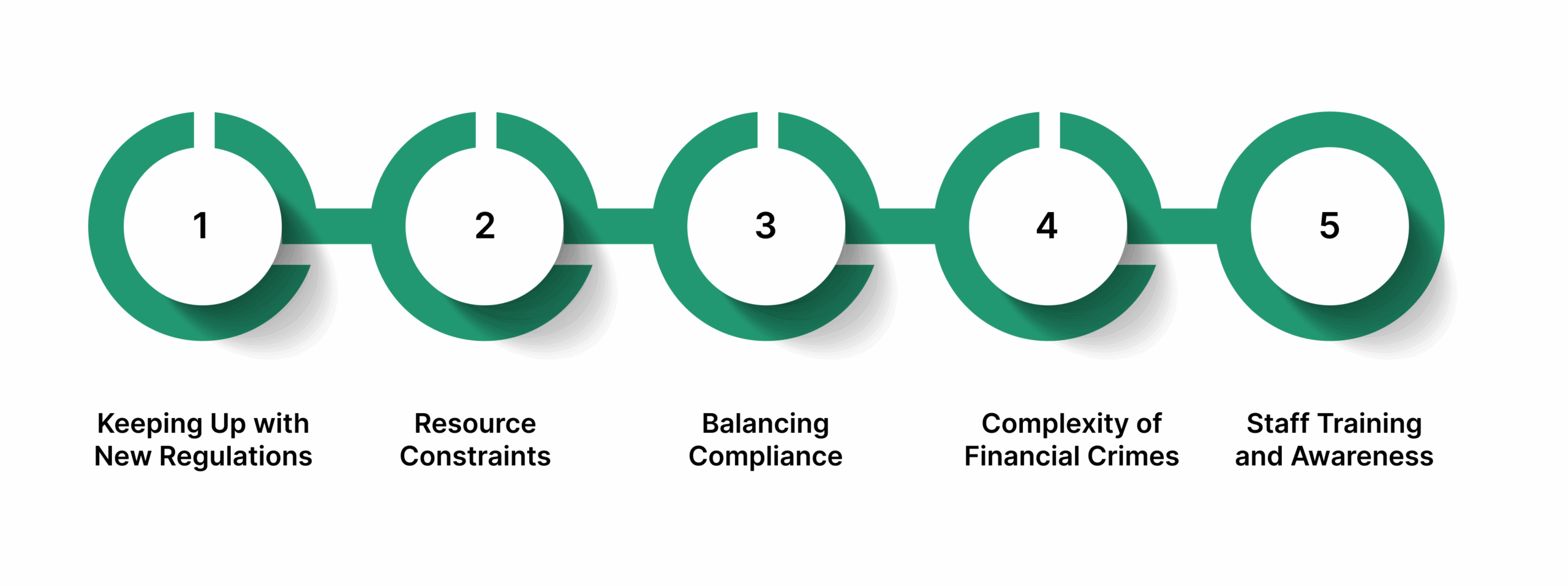
While the role of AML compliance officers is important, they face several challenges in their daily work:
1. Keeping Up with New Regulations
AML regulations evolve frequently, requiring constant updates to internal processes. Officers must stay informed about changes in laws like AML/CFT regulations and sanctions lists.
2. Resource Constraints
Many smaller institutions face resource constraints, which hinder the implementation of comprehensive AML programs. AML officers in these organizations often work with limited budgets and staff.
3. Balancing Compliance with Business Objectives
AML officers must ensure that compliance requirements don’t impede the organization’s ability to function efficiently. Balancing business objectives with regulatory compliance is an ongoing challenge.
Download the Free eBook on The Trends Transforming Compliance in 2026
4. The Complexity of Financial Crimes
Financial crime is becoming more sophisticated, with money laundering techniques constantly evolving. Officers must adapt their monitoring tools and risk management strategies to address these emerging threats.
5. Staff Training and Awareness
Ensuring that all staff members understand AML policies and are vigilant in spotting suspicious activities requires continuous training. Maintaining a culture of compliance within the organization is essential.
Also Read: Understanding the Purpose of a Policy Summary
To manage these challenges, let’s discuss how VComply can support AML compliance officers in their efforts.
Stay Ahead of AML Compliance with VComply’s Tools
Managing the role of an AML Compliance Officer requires efficient systems and timely actions. VComply’s AI-powered platform makes managing compliance seamless and stress-free. Here’s how VComply helps streamline your AML compliance efforts:
- Designing and Implementing AML Programs: AML Compliance Officers develop and implement AML programs tailored to their organization’s needs. VComply’s ComplianceOps feature automates setting up regulatory programs and controls, ensuring alignment with regulatory requirements.
- Regulatory Awareness and Compliance: Staying up-to-date with AML regulations is critical. VComply’s Pre-built Regulatory Framework ensures compliance with industry standards, making it easier to manage compliance at scale.
- Conducting Risk Assessments: AML Compliance Officers perform ongoing risk assessments to identify vulnerabilities. VComply’s RiskOps automates risk assessment, helping manage and scale risk programs efficiently.
- Case Management and Reporting: Monitoring and reporting suspicious activities are key responsibilities. VComply’s CaseOps streamlines case reporting and management, ensuring efficient tracking and resolution of suspicious activities.
- Creating AML Policies and Procedures: Developing comprehensive AML policies is essential. VComply’s PolicyOps streamlines policy creation, review, and approval, ensuring all employees follow consistent compliance procedures.
- Ongoing Training and Culture Building: Maintaining an AML-compliant culture requires continuous training. VComply’s Workflow Automation schedules and tracks employee training, ensuring everyone is up to date with AML policies.
- Evidence Management and Audit-Readiness: An AML Compliance Officer must maintain thorough records. VComply’s Evidence Management centralizes and secures compliance documentation, ensuring the organization is always audit-ready.
- Stakeholder Communication and Reporting: Regular communication with management is essential. VComply’s dashboards and analytics provide real-time, transparent reports, ensuring stakeholders stay informed about compliance efforts.
- Adapting to Changing Regulatory Environments: Adapting to new regulations is vital. VComply’s smooth integrations allow seamless updates to compliance systems, ensuring the organization remains compliant as regulations change.
- Monitor Compliance and Manage GRC Activities: VComply’s GRCOps Suite provides real-time visibility into all GRC activities, tracking compliance, identifying gaps, and implementing corrective actions to ensure continuous regulatory adherence.
Request a free demo to see how VComply automates follow-ups, flags risks in real-time, and generates proof on demand, eliminating spreadsheet errors and boosting your AML compliance.

Wrapping up
The responsibilities of AML Compliance Managers span developing solid policies, monitoring transactions, training staff, and ensuring compliance with both local and global regulations.
Despite the challenges, they are indispensable in mitigating risks for financial institutions. By cultivating a culture of compliance, staying informed on regulations, and utilizing advanced technology, these professionals can ensure that their businesses remain resilient to money laundering risks.
In industries prioritizing regulatory adherence, VComply’s GRCOps provides real-time visibility into policies, controls, and risks. With ComplianceOps, RiskOps, and PolicyOps, AML officers can track every stage of compliance and risk management, ensuring full audit readiness and continuous compliance with regulations such as the USA PATRIOT Act.
Start your free trial with VComply’s ComplianceOps to streamline your AML compliance process with our AI-powered GRC suite.
FAQs
AML Compliance Officers typically require a degree in finance or law, along with relevant experience in banking, regulatory compliance, or law enforcement roles.
AML Officers monitor transactions, flag suspicious activities, report them to FIUs, and ensure that appropriate action is taken according to regulatory guidelines and internal policies.
AML officers must regularly review industry updates, regulatory changes, and best practices through webinars, training, and compliance associations to ensure ongoing compliance.
AML Officers design training programs to educate employees about anti-money laundering laws, company policies, and how to spot and report suspicious activities effectively.
An AML compliance officer should have strong knowledge of regulations, attention to detail, analytical skills, and the ability to communicate compliance risks effectively.