

NAVEX PolicyTech Alternative: Why Organizations Are Switching to VComply in 2026
In the absence of well-defined policies and procedures, organizations often face inconsistency in decision-making and behavior, leading to confusion, inefficiencies, and potential compliance risks. Policies establish a clear framework that outlines expectations, ensures accountability, and provides guidance for employees to align their actions with organizational goals.

Policy management in 2026 is no longer just about storing documents and collecting signatures. Organizations now need to prove that policies are current, acknowledged, accessible, tied to training, connected to compliance workflows, and continuously audit-ready. Guidance from organizations such as the National Institute of Standards and Technology (NIST) and ISACA Governance Resources continues to highlight the growing importance of governance, AI oversight, cybersecurity policy management, and operational accountability across modern enterprises.
At the same time, compliance teams are managing growing pressure around:
- AI governance
- Cybersecurity policies
- Data privacy requirements
- Employee attestations
- Multi-framework compliance
- Faster audit response expectations
- Distributed workforces
- Real-time reporting
However, the process of managing policies manually or using legacy tools can be both time-consuming and error-prone. Creating multiple policies, securing approvals from various stakeholders, and collecting attestations require significant effort, especially when done manually. Managing document versions, ensuring accurate routing, and making policies accessible to the right audience can add to the complexity. These challenges often result in delays, outdated information, and non-compliance risks. Automated policy management solutions address these issues by streamlining workflows, ensuring version control, and facilitating efficient communication and attestation processes, enabling organizations to maintain consistency and compliance with ease.
Many organizations using legacy policy management tools are now looking for platforms that provide:
- Better usability
- Faster implementation
- AI-assisted policy management
- Flexible workflows
- Stronger reporting
- Modern employee experience
- Better value and scalability
That is why more organizations are evaluating modern NAVEX PolicyTech alternatives like VComply PolicyOps.
VComply helps organizations centralize policy management, automate approvals, manage attestations, improve employee engagement, and maintain continuous compliance readiness through a modern AI-powered platform built for today’s governance and compliance needs.
Key Takeaways (TL;DR)
-
Discover how VComply PolicyOps and PolicyTech share core policy management features like automation, tracking, and reporting.
-
Learn why VComply stands out with its intuitive interface, flexibility, and exceptional user experience.
-
Understand how VComply offers affordable, scalable, and innovation-driven policy management designed for modern organizations.
Why Organizations Are Moving Away From Legacy Policy Management Systems
| Common Legacy Policy Management Challenges | Operational Impact |
|---|---|
| Complex user experience | Lower employee adoption |
| Heavy administrative overhead | More manual follow-up |
| Slow policy updates | Delayed compliance response |
| Limited AI capabilities | Employees struggle to find answers |
| Weak employee engagement | Poor acknowledgment rates |
| Disconnected compliance workflows | Policy silos |
| Limited visibility into attestations | Audit gaps |
| High total cost of ownership | Budget concerns |
Similarities Between VComply PolicyOps and PolicyTech
PolicyOps is a user-friendly solution that can be customized to your ideal, structured process for drafting, approvals, employee acknowledgment, and version control—without the gaps of legacy systems.
When evaluating VComply alongside other policy management solutions, it’s clear that many core features are industry standards. These shared capabilities include:
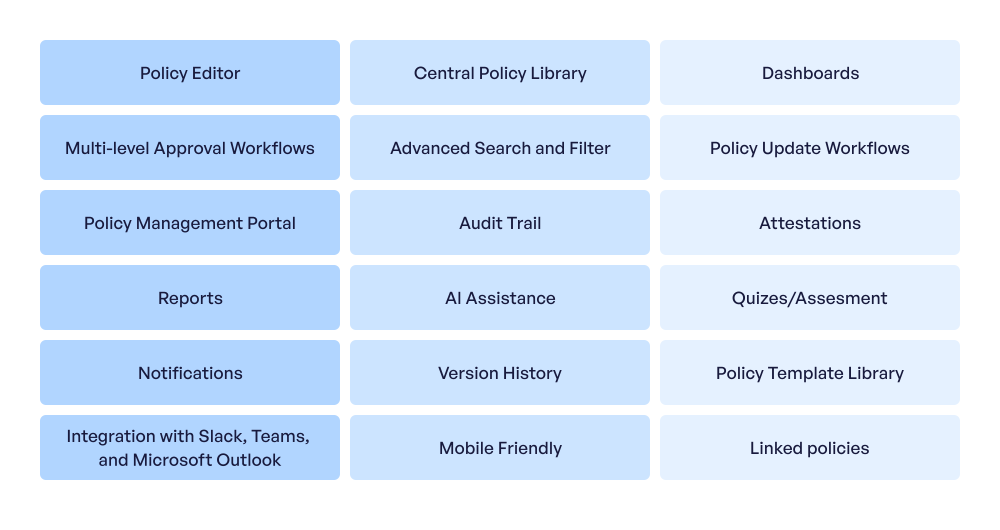
- A Unified Policy Hub: Centralized storage ensures all policies are easily accessible and consistently managed.
- User Access & Control: Role-based permissions and search functionality help teams find and interact with policies efficiently.
- Digital Acknowledgments: Electronic signatures provide a clear audit trail of policy reviews and approvals.
- Automated Workflows: Streamlined policy drafting, approval, and distribution processes enhance collaboration.
- Policy Lifecycle Tracking: Full visibility into policy updates, reviews, and compliance status.
- Comprehensive Reporting: Built-in analytics help track compliance trends and identify gaps.
- Mobile-Friendly Access: Employees can review and acknowledge policies anytime, anywhere.
- Seamless Integrations: Compatibility with other business systems strengthens compliance oversight.
However, having a checklist of features isn’t enough. What truly sets a policy management solution apart is usability and support. A cluttered interface can make even the most powerful tools frustrating, while responsive customer service can mean the difference between smooth adoption and constant roadblocks. VComply stands out by combining robust functionality with an intuitive experience and dedicated customer support—helping organizations manage compliance with confidence.
Why VComply PolicyOps Is a Strong NAVEX PolicyTech Alternative
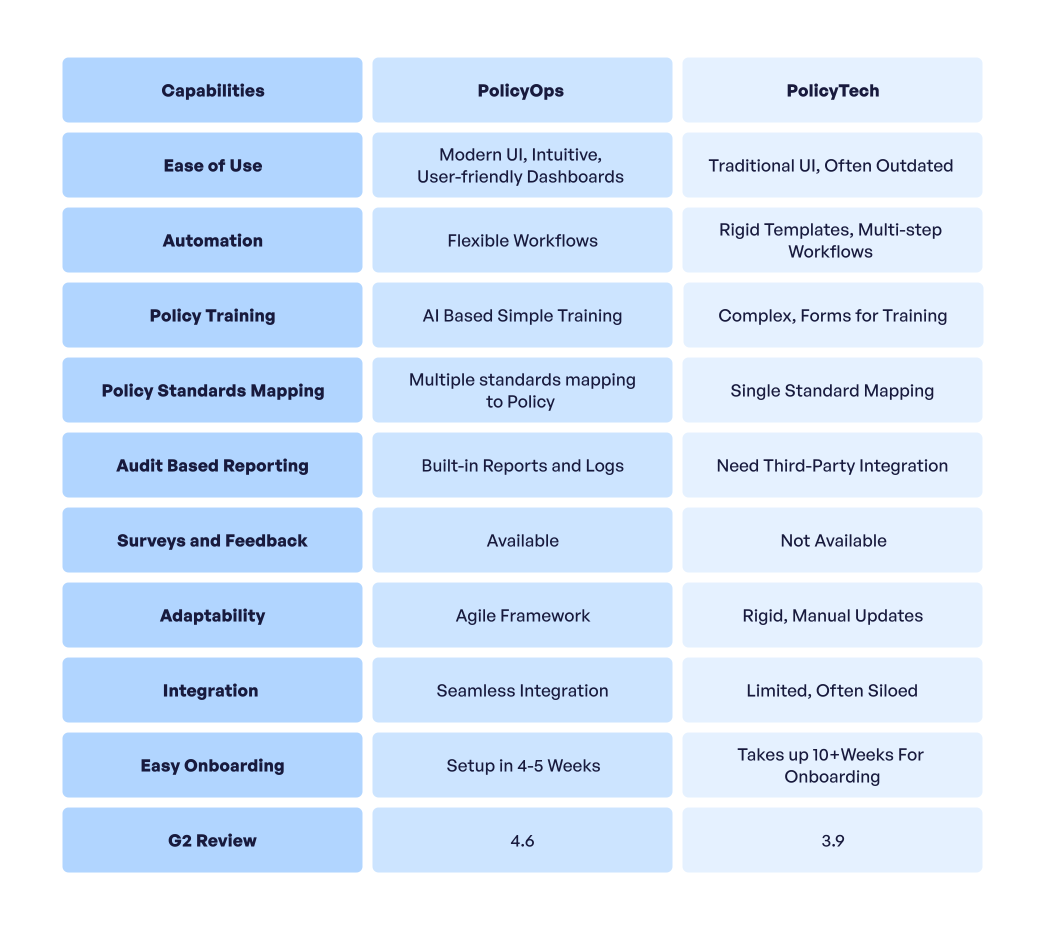
1. A Modern and Intuitive User Experience
Policy management tools are only effective when people actually use them. If the platform feels heavy, confusing, or difficult to navigate, adoption suffers. Policy owners may delay updates. Employees may ignore acknowledgments. Admins may spend too much time helping users complete basic tasks.
VComply PolicyOps is designed with simplicity and usability in mind. It gives administrators, policy owners, reviewers, approvers, and employees a clean experience that supports quick adoption. Instead of making policy management feel like a complex back-office process, VComply makes it easier for teams to create, review, distribute, and acknowledge policies.
For employees, this matters because they do not want to search through long folders or outdated documents. They need clear access to the right policy at the right time. For admins, this matters because they need visibility into what is pending, overdue, approved, distributed, and acknowledged.
A modern interface reduces friction across the entire policy lifecycle.
2. Flexible Policy and Procedure Management
Every organization has a different policy governance process. Some policies require a simple review and approval flow. Others need multiple reviewers, legal sign-off, department-level approval, executive approval, or board review. A policy management system should support that complexity without making the process frustrating.
VComply PolicyOps allows organizations to create structured workflows that match their own policy lifecycle. Teams can define who drafts, reviews, edits, approves, publishes, and acknowledges each policy.
This flexibility is useful for:
- HR policies
- Code of conduct policies
- Information security policies
- Data privacy policies
- Healthcare compliance policies
- Financial controls policies
- Safety policies
- Anti-bribery and anti-corruption policies
- Vendor management policies
- AI usage policies
- Regulatory compliance procedures
With VComply, teams can manage policies according to their internal governance model instead of forcing every policy into a rigid workflow.
3. Multi-Level Drafting and Approvals
Policy drafting rarely happens in isolation. Most policies need input from several teams, such as compliance, legal, HR, IT, risk, operations, or leadership. Without a structured approval process, drafts can become stuck in email threads, edits may be missed, and final approvals may be hard to prove.
VComply supports multi-level drafting and approval workflows so teams can collaborate in a controlled way. Organizations can define review steps, approval responsibilities, escalation paths, and publishing rules.
This helps ensure that:
- The right people review the policy.
- Edits and approvals are documented.
- Policies are not published before approval.
- Approval history is retained.
- Stakeholders know what is pending.
- Teams can avoid version confusion.
For regulated organizations, this is especially important because auditors may ask who approved a policy, when it was approved, what changed, and which version was active at a specific time.
4. Audit-Ready Version History and Document Control
Version control is one of the most important parts of policy governance. When multiple versions of a policy exist across folders, email attachments, and PDFs, employees may follow outdated guidance without realizing it.
VComply helps solve this by maintaining a controlled version history for every policy. Each update, review, approval, and published version is tracked. This gives organizations a clear audit trail and helps ensure employees are always working from the latest approved policy.
Strong version control helps answer questions such as:
- What is the current approved version?
- Who reviewed the policy?
- Who approved the policy?
- When was the policy last updated?
- What changed between versions?
- Which employees acknowledged the latest version?
- Which policies are due for review?
This makes policy management more defensible during audits, investigations, regulatory reviews, or internal governance checks.
5. AI-Assisted Policy Guidance With Paula C.
One of the biggest policy management problems is that employees often cannot find the answer they need quickly. Even when policies are available, they may be long, complex, or written in formal language. Employees may not know which policy applies to their situation.
VComply’s AI assistant, Paula C., helps address this problem by allowing employees to ask policy-related questions and receive quick guidance based on company policies. Instead of searching through multiple documents, employees can ask a practical question and get a clear answer.
For example, employees may ask:
- Can I accept a gift from a vendor?
- What is the approval process for a new supplier?
- How do I report a conflict of interest?
- What is the company’s AI usage policy?
- Who approves access to customer data?
- What should I do if I suspect a policy violation?
This makes policy guidance more accessible and helps employees make better decisions in daily work. It also supports compliance teams by reducing repetitive policy questions and improving policy engagement.
6. AI-Generated Training and Attestation
Policies are more effective when employees understand them. Simply asking employees to acknowledge a long PDF does not always create real awareness. In 2026, organizations need more engaging ways to communicate key policy expectations.
VComply supports AI-driven training and attestation by helping teams turn written policies into interactive training experiences. Employees can watch AI-generated policy training videos, complete quizzes, answer attestation questions, and formally acknowledge policies within the same system.
This helps organizations move beyond passive acknowledgment and create stronger proof of policy understanding.
For compliance teams, this means they can track:
- Who received the policy
- Who completed training
- Who passed related quizzes
- Who acknowledged the policy
- Who still needs follow-up
- Which departments have low completion rates
This is valuable for areas such as code of conduct, cybersecurity, data privacy, anti-harassment, workplace safety, conflict of interest, and healthcare compliance policies.
7. Embedded Acknowledgment and Attestation Tracking
Policy acknowledgment is not just an administrative step. It is evidence that employees were informed of the organization’s expectations. During audits, investigations, or compliance reviews, organizations may need to prove that employees received and acknowledged specific policies.
VComply allows organizations to embed acknowledgment workflows directly into the policy lifecycle. Employees can be assigned policies based on role, department, location, or business unit. Every acknowledgment is logged and tracked.
This helps compliance teams see:
- Which policies have been distributed
- Which employees have acknowledged them
- Which acknowledgments are overdue
- Which departments require follow-up
- Whether a policy needs additional training
- Whether acknowledgment rates are improving
This level of visibility helps organizations reduce manual follow-up and maintain stronger evidence of policy communication.
8. Secure and Always-Accessible Policy Library
Employees should not have to search through emails, outdated folders, or old PDFs to find the right policy. VComply provides a secure, centralized policy library where employees can access current policies from desktop, mobile, or tablet.
This is especially useful for organizations with:
- Remote employees
- Frontline workers
- Multi-location teams
- Field staff
- Employees without regular company email access
- Regional or department-specific policies
- Policies that require frequent updates
A secure and accessible policy library reduces confusion and helps employees follow current guidance. It also improves consistency across the organization because everyone works from the same source of truth.
9. Policy Analytics and Real-Time Oversight
One of the weaknesses of manual policy management is limited visibility. Compliance teams may not know which policies are overdue for review, which employees have not acknowledged policies, or which departments are falling behind.
VComply provides dashboards and analytics to help teams monitor policy performance in real time.
Teams can track:
- Policy review status
- Pending approvals
- Acknowledgment completion rates
- Overdue attestations
- Policy engagement
- Department-level gaps
- Location-level completion
- Upcoming review deadlines
- Policy lifecycle progress
This helps compliance leaders move from reactive follow-up to proactive oversight.
10. Holistic Policy Compliance Across GRC
Policy management should not sit in isolation. Policies are connected to compliance obligations, risks, controls, incidents, training, audits, and corrective actions. A data privacy policy, for example, may connect to privacy regulations, access controls, employee training, vendor reviews, and incident response procedures.
VComply can operate as a standalone policy management solution or connect with broader VComply modules for compliance, risk, audit, and case management. This creates a more complete governance view.
This interconnected approach helps organizations:
- Link policies to compliance requirements
- Connect policies to risks and controls
- Track policy-related incidents
- Assign corrective actions
- Maintain audit-ready evidence
- Report policy compliance to leadership
- Reduce duplication across compliance teams
For organizations that want policy management to support broader governance, risk, and compliance efforts, this is a major advantage.
11. Strong Searchability
A policy library is only useful if employees can find what they need. Poor search creates frustration and increases the chance that employees will rely on memory, informal advice, or outdated documents.
VComply provides strong search and filtering capabilities so users can quickly locate policies, procedures, versions, acknowledgments, and related documents. Employees can find relevant information faster, while admins can manage large policy libraries more effectively.
Searchability is especially important for organizations with hundreds of policies across departments, locations, functions, and regulatory areas.
12. Flexible and Mobile-Friendly Access
Policy management needs to work for different types of employees. Some sit at desks. Others work in the field. Some are frontline workers. Others may not use a corporate laptop every day.
VComply supports flexible and mobile-friendly access, helping employees review and acknowledge policies from different devices. Teams can also bookmark important policies, share policies with relevant groups, link related policies, and use quizzes during attestation.
This flexibility helps organizations improve participation and reduce missed acknowledgments.
13. Price-Conscious and Scalable
Many organizations want stronger policy management but do not want the complexity or high cost often associated with legacy enterprise tools. VComply is designed to provide strong policy management capabilities with a more flexible and scalable pricing approach.
This makes it a strong option for mid-sized organizations and growing enterprises that need modern policy governance without unnecessary overhead.
VComply’s value comes from combining:
- Policy lifecycle automation
- AI-assisted policy guidance
- AI-generated training
- Attestation tracking
- Version control
- Real-time dashboards
- Mobile access
- Strong usability
- Broader GRC alignment
For organizations looking for a practical, feature-rich, and cost-conscious NAVEX PolicyTech alternative, VComply is a strong fit.
14. Product Roadmap Built for Modern Policy Governance
Policy management is changing quickly. Organizations need tools that can adapt to new requirements around AI usage, privacy, cybersecurity, workplace expectations, global regulations, employee training, and audit evidence.
VComply’s product roadmap is designed around innovation, customer feedback, scalability, and practical compliance needs. The platform continues to evolve with AI-enabled features, improved automation, better user experience, and stronger support for real-world policy governance challenges.
This matters because organizations do not want a policy tool that only solves yesterday’s problems. They need a platform that continues to evolve with their compliance environment.
Why Use VComply for Policy Management?
Unlike traditional policy management tools, PolicyOps is easy to use, fully customizable, and built for organizations that need equal amounts of flexibility and assurance—without sacrificing structure. Efficiently manage organizational policies and compliance across diverse departments, locations, and regions, all from a single platform. Experience simplified workflows and enhanced coordination—discover how VComply can transform your policy management by scheduling a demo today!
Conclusion
Policy management in 2026 is no longer just about storing documents. Organizations need to ensure that policies are current, approved, accessible, understood, acknowledged, and tied to evidence. They also need tools that employees can actually use.
NAVEX PolicyTech remains a recognized name in policy management, but many organizations are looking for modern alternatives that offer stronger usability, AI-enabled guidance, flexible workflows, and better value. VComply PolicyOps is built for that need.
With multi-level approvals, version control, embedded attestations, AI-assisted policy guidance, AI-generated training, mobile access, analytics, and broader GRC connectivity, VComply helps organizations turn policy management from a manual administrative process into a structured, measurable, and audit-ready program.
For organizations seeking a flexible, intuitive, and future-ready NAVEX PolicyTech alternative, VComply PolicyOps is a strong choice.
Frequently Asked Questions
Many organizations evaluating alternatives to NAVEX PolicyTech are looking for platforms that offer easier usability, AI-assisted policy management, stronger workflow flexibility, better employee engagement, and broader GRC connectivity. VComply PolicyOps is increasingly being evaluated by organizations that want modern policy governance with centralized policy management, attestations, AI-driven training, analytics, and audit-ready tracking.
Organizations are reevaluating legacy policy management systems because policy governance expectations have changed significantly. Teams now need faster policy updates, AI-assisted guidance, better reporting, real-time visibility into acknowledgments, stronger employee engagement, and easier administration across distributed teams.
Common reasons organizations explore alternatives include:
Complex administration
Lower employee adoption
Limited AI capabilities
Manual follow-ups
Fragmented workflows
Limited reporting visibility
Policy silos
High total cost of ownership
Modern policy management software should support:
Policy lifecycle management
Multi-level approvals
AI-assisted policy guidance
Employee attestations
Version control
Real-time dashboards
Mobile access
Automated reminders
Policy analytics
Audit-ready evidence tracking
AI-generated training
Broader GRC integration
Organizations increasingly want policy management connected to compliance, risk, audit, incidents, and corrective actions.
AI helps improve policy management by making policies easier to understand, search, update, and operationalize. AI-assisted policy tools can help employees find answers quickly, generate policy training content, improve policy accessibility, and reduce repetitive questions sent to compliance or HR teams.
AI is becoming especially important for organizations managing fast-changing requirements around cybersecurity, AI usage, privacy, vendor risk, and employee conduct.
AI-assisted policy guidance allows employees to ask natural-language questions about company policies and receive quick answers based on approved documents. Instead of searching through multiple PDFs or folders, employees can ask practical questions related to gifts, conflicts of interest, AI usage, reporting concerns, approvals, or workplace conduct.
This improves employee understanding and reduces policy confusion.