Renewable Energy NERC Compliance: A Practical Guide for Solar, Wind and Battery Operators
Renewable energy NERC compliance is becoming a central responsibility for solar, wind, battery storage and hybrid generation owners across North America.

Under NERC’s revised registration criteria, entities that own or operate certain non-Bulk Electric System inverter-based resources must now register as Category 2 Generator Owners or Generator Operators. The criteria cover resources with an aggregate nameplate capacity of at least 20 MVA that connect through a system designed primarily to deliver that capacity to a common point of connection at 60 kV or higher.
For renewable energy businesses, this means NERC compliance can no longer be evaluated only at the portfolio level or left until a facility exceeds the traditional 75 MVA and 100 kV Bulk Electric System thresholds.
Asset owners must determine which facilities are subject to NERC registration, which Reliability Standards apply, who owns each obligation, what evidence must be maintained and when new requirements become enforceable.
This guide explains how NERC compliance applies to renewable energy, the difference between Category 1 and Category 2 resources, which standards matter most, how to prepare for monitoring activities and how renewable operators can build a repeatable compliance program across multiple facilities.
Key Highlights
- Renewable energy is not automatically subject to NERC regulation simply because it generates electricity. Applicability depends on registration criteria, facility configuration, connection voltage, capacity, functional responsibility and individual Reliability Standards.
- Utility-scale solar photovoltaic facilities, Type 3 and Type 4 wind facilities, battery energy storage systems and fuel-cell facilities may qualify as inverter-based resources.
- Existing Bulk Electric System renewable facilities generally remain Category 1 Generator Owners or Generator Operators.
- Beginning May 15, 2026, qualifying non-BES inverter-based resources must register as Category 2 Generator Owners or Generator Operators.
- The Category 2 threshold generally covers non-BES inverter-based resources aggregating to at least 20 MVA and connecting at 60 kV or higher through a system designed primarily to deliver their output to a common point of connection.
- Category 2 registration does not automatically make every NERC Reliability Standard applicable.
- As of July 2026, NERC states that many standards, including the current CIP family, require modification before they can apply to Category 2 IBRs.
- Applicable requirements may address operational data, system models, voltage and reactive power, protection systems, disturbance monitoring, ride-through performance and unexpected output changes.
- PRC-029-1 and PRC-030-1 are scheduled for enforcement beginning October 1, 2026, subject to their implementation plans.
- Strong renewable energy NERC compliance depends on accurate asset data, clear ownership, controlled plant settings, reliable models, complete evidence and continuous monitoring.
What Is Renewable Energy NERC Compliance?
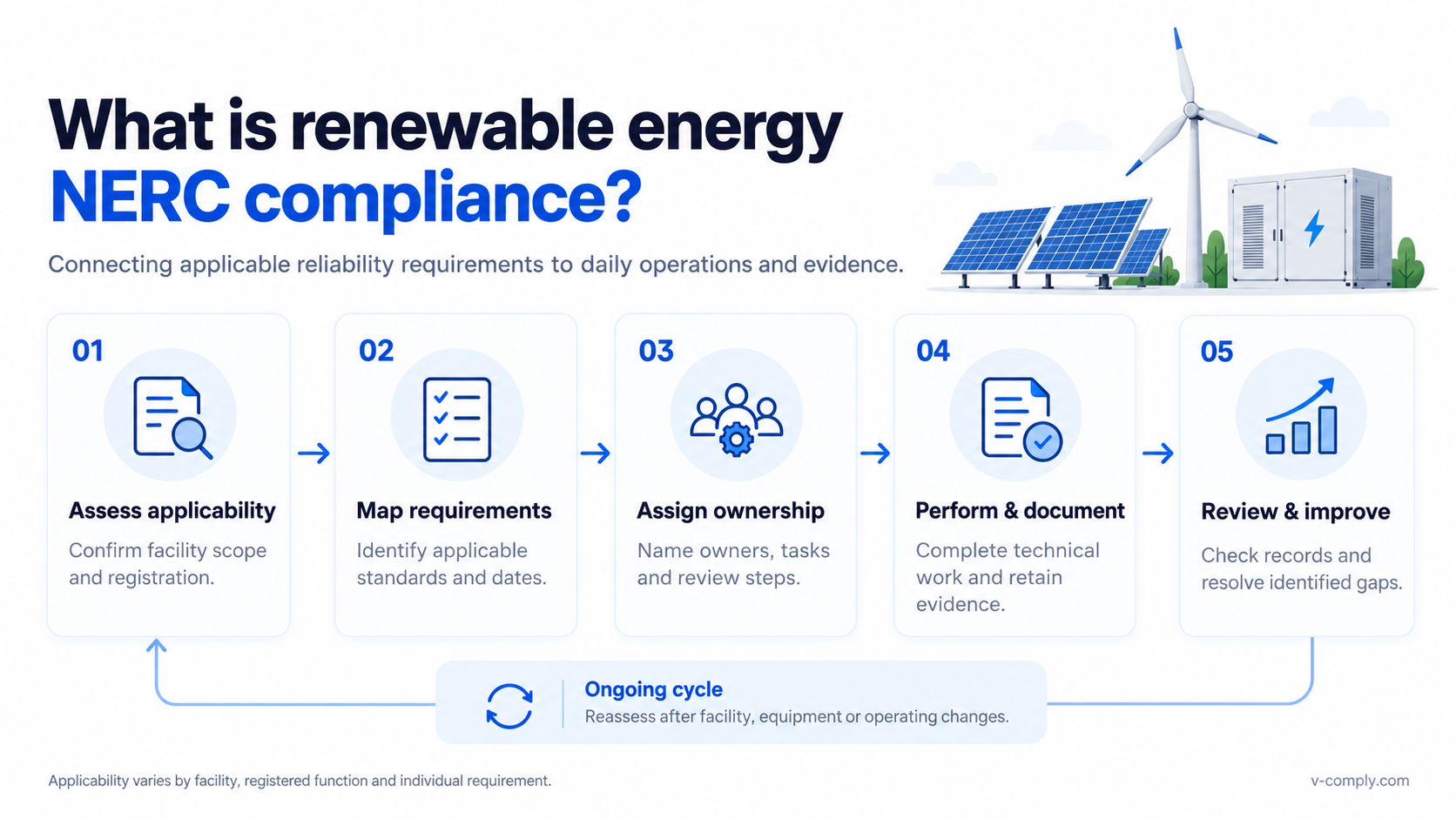
Renewable energy NERC compliance is the process through which applicable renewable generation owners and operators meet mandatory Reliability Standards developed by the North American Electric Reliability Corporation.
NERC is responsible for developing and enforcing Reliability Standards intended to support the reliability and security of the North American Bulk Power System. In the United States, the Federal Energy Regulatory Commission reviews proposed standards before they become mandatory and enforceable.
For renewable energy operators, compliance may involve:
- Registering the correct legal entities and facilities
- Providing accurate planning and operating data
- Maintaining validated system models
- Supporting voltage and reactive power requirements
- Configuring protective and control systems correctly
- Maintaining ride-through capability
- Recording and reporting disturbance data
- Investigating unexpected changes in plant output
- Responding to instructions from Balancing Authorities and Transmission Operators
- Managing applicable cybersecurity requirements
- Retaining evidence for audits and other compliance-monitoring activities
NERC compliance is different from environmental permitting, market registration, interconnection compliance or FERC commercial reporting, although the same organization may need to manage all of these obligations.
A renewable facility can satisfy its environmental and interconnection requirements while still having unresolved NERC registration, modeling or operational obligations.
Why NERC Is Increasing Its Focus on Renewable Energy
The North American generation mix is changing rapidly. A growing share of new generation connects to the grid through inverters rather than conventional synchronous machines.
NERC defines an inverter-based resource as a plant or facility consisting of devices capable of exporting real power through a power-electronic interface, such as an inverter or converter, and operated together as one resource at a common point of interconnection.
Examples include:
- Solar photovoltaic facilities
- Type 3 wind facilities
- Type 4 wind facilities
- Battery energy storage systems
- Fuel-cell facilities
- Hybrid facilities combining renewable generation and storage
Inverter-based resources respond differently from conventional synchronous generation during voltage disturbances, frequency events and changes in grid conditions. Their behavior depends substantially on inverter controls, protection settings, plant controllers, firmware, equipment configuration and the accuracy of the models used in planning studies.
NERC reported that it had analyzed 10 significant Bulk Power System disturbances since 2016 involving widespread and unexpected reductions in IBR output. Those events represented nearly 15,000 MW of unexpected output reduction, with approximately 10,000 MW occurring from 2020 through 2024. NERC identified inaccurate modeling and inadequate study practices as contributing reliability concerns.
This does not mean renewable technology is inherently unreliable. It means grid planners and operators need accurate data, realistic models, predictable settings and clearly defined performance from facilities that increasingly influence system-wide conditions.
Category 1 vs. Category 2 Renewable Energy Resources
One of the most important steps in renewable energy NERC compliance is determining whether a resource is Category 1, Category 2 or outside the applicable registration criteria.
Category 1 Generator Owners and Operators
Category 1 generally includes entities that own or operate generating resources already included within the NERC definition of the Bulk Electric System.
For dispersed power-producing resources, such as solar, wind or storage, BES Inclusion I4 generally considers resources that aggregate to more than 75 MVA and connect through a system designed primarily to deliver the capacity to a common point of connection at 100 kV or higher.
Category 1 resources may be subject to a wider range of Reliability Standards depending on the registered functions, facility characteristics and the applicability language of each standard.
These may include standards from areas such as:
- Critical Infrastructure Protection
- Modeling and data
- Protection and control
- Voltage and reactive power
- Transmission operations
- Emergency preparedness
- Facilities design and ratings
- Communications
- Personnel performance
A Category 1 renewable facility should not assume that every standard applies. It must maintain a requirement-level applicability assessment.
Category 2 Generator Owners and Operators
Category 2 was introduced to close a reliability gap involving inverter-based resources connected to the Bulk Power System that did not fall within the existing BES registration criteria.
Effective May 15, 2026, Category 2 registration applies to entities that own or operate non-BES inverter-based generating resources that:
- Have or contribute to an aggregate nameplate capacity of at least 20 MVA
- Connect through a system designed primarily to deliver that capacity to a common point of connection
- Connect at a voltage of at least 60 kV
For example, a 30 MVA solar facility connected at 69 kV may fall within Category 2 even if it was previously outside direct Generator Owner or Generator Operator registration.
Aggregation matters. Several inverter units or generating facilities connected through a shared collector system may collectively meet the threshold even where no individual inverter approaches 20 MVA.
The registration analysis should therefore evaluate the complete facility configuration, including:
- Inverter nameplate capacity
- Wind turbine nameplate capacity
- Battery discharge capability
- Shared collector systems
- Common points of interconnection
- Connection voltage
- Hybrid configurations
- Ownership structure
- Operating responsibility
Does Category 2 Registration Make Every Standard Applicable?
No.
This is one of the most important distinctions for renewable operators.
Registration establishes that an entity is part of the NERC Compliance Registry for a defined function. It does not automatically make every standard written for a Generator Owner or Generator Operator applicable.
NERC reviewed the Reliability Standards and determined that many existing standards contain applicability language tied specifically to the Bulk Electric System or other defined terms that exclude Category 2 non-BES resources.
As of NERC’s April 2026 supplemental guidance, many standards would require modification through the standards-development process before they could become applicable and enforceable for Category 2 resources.
This includes the current standards within the CIP family.
Therefore, it would be inaccurate to state that every newly registered Category 2 solar, wind or storage facility automatically became subject to all NERC CIP requirements on May 15, 2026.
Some Category 1 renewable facilities may be subject to CIP based on their BES Cyber System categorization. However, NERC’s April 2026 Category 2 compliance guide lists CIP-002 through CIP-013 and CIP-015 as requiring modification before applicability to Category 2 resources.
Renewable operators should maintain three separate records:
- The organization’s registered functions
- The facilities covered by those registrations
- The individual requirements applicable to each facility
NERC Standards Relevant to Renewable Energy Operators
The precise standards depend on the resource category, region, registration and facility. The following areas are among the most relevant for renewable generation.
1. Registration and Facility Classification
The compliance program begins with accurate registration.
Renewable organizations should determine:
- Which legal entity owns each facility
- Which entity operates each facility
- Whether third parties perform operating functions
- Whether facilities are BES resources
- Whether facilities meet Category 2 criteria
- Which Regional Entity has jurisdiction
- Whether facilities cross Regional Entity boundaries
- Whether ownership or operating agreements affect registration
NERC and the Regional Entities processed Category 2 registrations in phases through April 2026 in preparation for the May 15, 2026 registration requirement. NERC advised entities to work directly with the appropriate Regional Entity and provide facility, interconnection and nameplate data needed for the assessment.
Registration information should be reviewed after acquisitions, divestitures, repowering, facility expansion, battery additions or changes in operating responsibility.
2. Modeling and Data Requirements
Accurate models are central to reliable renewable integration.
Planning authorities, Transmission Planners and operating entities use models to evaluate:
- Voltage performance
- Frequency response
- Transient stability
- Reactive power behavior
- Protection response
- Plant control behavior
- Disturbance performance
- Transmission limitations
NERC has repeatedly identified differences between expected model behavior and actual IBR performance. Causes can include outdated parameters, equipment substitutions, plant-controller changes, firmware updates and insufficient model verification during commissioning.
MOD-026-2
MOD-026-2 addresses verification and validation of dynamic models and related data. Its purpose is to help ensure that models used in reliability assessments accurately represent in-service equipment, including applicable inverter-based generating facilities.
Renewable Generator Owners may need to maintain:
- Plant-specific model files
- Inverter parameters
- Power plant controller settings
- Protection settings
- Equipment design information
- Model-verification records
- Model-validation results
- Submissions to the Transmission Planner
- Records of material equipment or setting changes
MOD-032 and MOD-033
MOD-032 addresses the data needed for power-system modeling and analysis. MOD-033 covers validation of steady-state and dynamic system models.
For Category 2 resources, NERC’s April 2026 compliance-date document identifies MOD-032-2 as applicable beginning May 15, 2026, while MOD-033-3 has implementation requirements governed by its applicable effective date and plan.
Model compliance should not be treated as a one-time engineering deliverable. Models should remain aligned with the facility that is actually operating.
3. Frequency and Voltage Ride-Through
Ride-through refers to a resource remaining connected and supporting the grid during defined voltage or frequency disturbances instead of disconnecting prematurely.
Unexpected simultaneous tripping across multiple renewable facilities can increase the severity of a disturbance. This is why NERC and FERC have placed significant attention on inverter protection and control settings.
FERC approved new IBR standards in July 2025 requiring applicable resources to remain connected during defined voltage and frequency excursions. The action was part of the implementation of FERC Order No. 901.
PRC-029-1
PRC-029-1 establishes frequency and voltage ride-through requirements for applicable inverter-based resources. Its purpose is to ensure that IBRs remain connected and support the Bulk Power System during and after defined excursions.
The standard is scheduled for enforcement beginning October 1, 2026, with phased implementation requirements.
Preparation may involve:
- Reviewing inverter protection settings
- Reviewing plant-controller settings
- Comparing settings with ride-through criteria
- Identifying equipment limitations
- Coordinating with inverter manufacturers
- Documenting exceptions
- Planning required modifications
- Retaining testing and engineering evidence
Renewable operators should avoid waiting until the effective date to request settings or technical support from vendors. Model updates, firmware changes, testing and OEM approvals may require significant lead time.
4. Disturbance Monitoring and Reporting
Grid operators need reliable event data to understand how renewable facilities behave during disturbances.
PRC-028-1
PRC-028-1 establishes disturbance monitoring and reporting requirements for inverter-based resources. Its purpose is to ensure that adequate data is available to evaluate ride-through performance and support model validation.
Depending on applicability and implementation timing, facilities may need capabilities such as:
- High-resolution oscillography
- Plant-level SCADA data
- Sequence-of-events records
- Inverter-level event information
- Accurate timestamps
- Data retention
- Timely data retrieval
- Submission processes
A common implementation problem is assuming that existing SCADA data is automatically sufficient. The facility should compare its recording resolution, channels, synchronization, retention and retrieval capability with the actual requirement.
5. Unexpected IBR Event Mitigation
A renewable facility may remain operational while still behaving differently from its approved model or expected settings.
Examples include:
- Unexpected plant-level power reduction
- Multiple inverter trips
- Incorrect voltage response
- Control-mode errors
- Firmware-related behavior
- Protection misoperations
- Unexplained curtailment
- Oscillatory response
PRC-030-1
PRC-030-1 requires applicable Generator Owners to identify, analyze and mitigate unexpected changes in IBR power output.
Its implementation framework requires processes for identifying qualifying events, analyzing them and developing a corrective action plan or documented technical justification where appropriate.
The standard is scheduled for enforcement beginning October 1, 2026, subject to its implementation plan.
Renewable operators should establish a workflow connecting:
- Event detection
- Engineering analysis
- Vendor involvement
- Root-cause determination
- Corrective action
- Setting or model updates
- Evidence review
- Formal closure
Without structured ownership, event investigations can remain open for months while responsibilities move between the asset owner, operator, OEM, engineering consultant and plant-service provider.
6. Voltage and Reactive Power
Renewable facilities may be required to operate within specified voltage schedules, power-factor requirements or reactive-power instructions.
Relevant standards may include VAR-001 and VAR-002, depending on the registered function and applicability.
NERC’s April 2026 Category 2 compliance guidance identifies VAR-001-5 and VAR-002-4.1 among the standards with Category 2 compliance dates beginning May 15, 2026.
Compliance activities may include:
- Receiving voltage or reactive-power instructions
- Maintaining plant-controller modes
- Operating within voltage schedules
- Reporting equipment limitations
- Documenting exemptions
- Retaining operational logs
- Verifying automatic voltage-regulation capability
- Escalating unavailable reactive resources
Plant owners should ensure the commercial operating strategy does not conflict with reliability instructions or approved controller settings.
7. Protection and Control
Protection systems determine when renewable equipment should remain connected and when it must disconnect to protect equipment and the grid.
Relevant requirements may address:
- Relay settings
- Protection-system coordination
- Misoperation identification
- Remedial action schemes
- Underfrequency and undervoltage load shedding
- Ride-through settings
- Setting-change approvals
- Maintenance and testing
NERC’s Category 2 guidance identifies PRC-012-2 and PRC-017-1 among the standards applicable to Category 2 entities from May 15, 2026. Other protection standards may require modification before applying to Category 2 resources.
A facility should maintain clear control over who can change inverter, relay and plant-controller settings. Vendor access does not remove the Generator Owner’s responsibility for approved settings and evidence.
8. Operational Data and Coordination
Renewable Generator Operators may need to provide operating information to entities such as:
- Balancing Authorities
- Transmission Operators
- Reliability Coordinators
- Transmission Planners
- Planning Coordinators
Relevant standards can include IRO-010 and TOP-003.
NERC identifies IRO-010-5 and TOP-003-6.1 among the standards applicable to Category 2 entities beginning May 15, 2026.
Compliance depends on more than submitting data once. The organization should establish:
- Data owners
- Submission formats
- Validation reviews
- Recurring deadlines
- Change-notification procedures
- Backup contacts
- Evidence retention
- Escalation for incomplete data
Multi-site operators should avoid relying on different local spreadsheets or individual engineering inboxes for mandatory data requests.
Does NERC CIP Apply to Renewable Energy?
NERC CIP can apply to renewable energy facilities, but the answer depends on the resource’s registration and BES Cyber System categorization.
A Category 1 renewable Generator Owner or Generator Operator may be subject to applicable CIP requirements if it has in-scope BES Cyber Systems or assets containing low-impact BES Cyber Systems.
Potentially relevant systems may include:
- Plant control systems
- SCADA systems
- Remote-access systems
- Networking equipment
- Authentication services
- Physical-access systems
- Supporting cyber assets
- Vendor-connected operational systems
However, Category 2 registration alone does not currently trigger the entire CIP framework.
As of NERC’s April 2026 Category 2 compliance guidance, CIP-002 through CIP-013 and CIP-015 require modification before they can become applicable and enforceable for Category 2 resources.
Renewable organizations should therefore avoid two extremes:
- Assuming that every Category 2 facility is immediately subject to all CIP requirements
- Assuming that no cybersecurity controls are needed because CIP is not currently applicable
Even where a standard is not enforceable, cybersecurity may still be required through interconnection agreements, contracts, insurance requirements, state rules, corporate policies or prudent operational risk management.
The organization should clearly distinguish mandatory NERC requirements from voluntary security practices and contractual obligations.
A Renewable Energy NERC Compliance Program
A strong compliance program should convert applicable standards into recurring operating activities.
Step 1: Establish a Facility Register
Create a complete inventory of:
- Solar facilities
- Wind facilities
- Battery storage facilities
- Hybrid facilities
- Shared collector systems
- Interconnection voltages
- Nameplate capacities
- Common points of connection
- Commercial-operation dates
- Owners
- Operators
- Regional Entities
- NERC registrations
The register should be updated after acquisitions, repowering, expansion or ownership changes.
Step 2: Determine Registration
For every facility, determine whether it is:
- Category 1
- Category 2
- Outside GO/GOP registration criteria
- Under review
- Covered through another registration arrangement
Document the analysis and retain the technical data supporting it.
Step 3: Build an Applicability Matrix
For each facility and registered function, record:
- Reliability Standard
- Requirement
- Applicability decision
- Effective date
- Implementation phase
- Requirement owner
- Evidence owner
- Supporting procedure
- Evidence location
- Current status
Do not use one generic NERC checklist for every renewable site.
Step 4: Assign Accountable Owners
Distinguish between:
- Regulatory owner
- Engineering owner
- Operational performer
- Evidence provider
- Reviewer
- Approver
- Escalation authority
Shared responsibility should not become unclear responsibility.
Step 5: Control Technical Changes
Create a compliance-impact review for changes involving:
- Inverters
- Firmware
- Plant controllers
- Protection settings
- Relay settings
- SCADA systems
- Communications
- Remote access
- Batteries
- Transformer configurations
- Reactive equipment
- Control modes
- Operating procedures
A technically successful change may still create a compliance problem if models, evidence or notifications are not updated.
Step 6: Maintain Vendor Accountability
Renewable operators rely heavily on:
- Original equipment manufacturers
- Operations and maintenance providers
- Engineering consultants
- NERC consultants
- Remote-monitoring providers
- Asset managers
- Model-development specialists
Contracts should define:
- Data ownership
- Evidence obligations
- Response times
- Setting-change authority
- Incident notification
- Model-update responsibilities
- Record retention
- Audit support
- Access termination
The registered entity remains accountable even where a vendor performs the work.
Step 7: Capture Evidence as Work Occurs
Evidence may include:
- Registration records
- Applicability assessments
- Data submissions
- Model files
- Model-verification reports
- Controller settings
- Relay settings
- Disturbance records
- Operating logs
- Vendor reports
- Approvals
- Corrective actions
- Training records
- Communications with reliability entities
Evidence should be linked to the requirement it supports rather than stored only by facility or department.
Step 8: Conduct Internal Readiness Reviews
Review a sample of requirements and ask:
- Is the applicability decision current?
- Does the procedure match actual practice?
- Is the owner still correct?
- Does the evidence cover the required period?
- Are technical settings consistent with documentation?
- Have facility changes been evaluated?
- Are open issues being tracked?
- Can subject matter experts explain the process?
Test Evidence Retrieval Before a Compliance Request
Maintaining evidence and retrieving a complete, explainable record are different tasks. Periodically select an applicable requirement at one facility and ask the responsible team to assemble the supporting records as if responding to a compliance-monitoring request.
Check whether the evidence identifies the facility, covers the relevant period, reflects the equipment configuration in service, and includes necessary reviews or approvals. Have someone outside the activity assess whether the records explain what was done.
Record missing documents, inconsistent versions, and vendor dependencies as assigned actions. This exercise helps expose retrieval problems while there is still time to resolve them.
Common Renewable Energy NERC Compliance Challenges
Portfolio growth
Acquisitions can introduce facilities with inconsistent records, models and compliance processes.
Split ownership and operation
The asset owner, operator, O&M provider and engineering consultant may each hold different parts of the evidence.
Inaccurate models
Final field settings may differ from the parameters used in planning studies.
Vendor dependence
Critical knowledge may sit with an OEM or consultant whose contract does not require timely compliance support.
Distributed evidence
Documents may be spread across data rooms, engineering drives, email, vendor portals and site systems.
Settings changes without compliance review
Firmware or controller changes may alter performance without triggering model or documentation updates.
Different standards by site
A Category 1 facility and a Category 2 facility within the same portfolio may have different requirements.
Preparing only for audits
Evidence reconstructed months later may be incomplete or inconsistent with the actual operating record.
Use Site Findings to Improve the Wider Portfolio
A gap identified at one renewable facility can reveal a shared weakness elsewhere. An outdated model file, incomplete vendor handover, or undocumented controller change may affect other sites using the same equipment, service provider, or procedure.
When a finding is confirmed, identify which facilities share the relevant conditions. Assign targeted checks at those sites and document whether the same issue exists. Keep local applicability and technical differences visible rather than applying one corrective action everywhere.
Feed the results into procedures, vendor expectations, and readiness reviews. This turns an individual finding into a focused portfolio improvement without repeating a full assessment at every facility.
Renewable Energy NERC Compliance Checklist
- Maintain a current inventory of renewable and storage facilities.
- Record capacity, connection voltage and common points of connection.
- Confirm the owner and operator of each facility.
- Determine Category 1 or Category 2 registration.
- Document requirement-level applicability.
- Confirm effective dates and implementation phases.
- Assign requirement and evidence owners.
- Maintain current operating and planning data.
- Verify plant and inverter models.
- Control firmware, setting and controller changes.
- Review voltage and reactive-power obligations.
- Evaluate ride-through settings.
- Maintain disturbance-monitoring capability.
- Define unexpected-event investigation workflows.
- Document communications with BAs, TOPs and RCs.
- Establish vendor evidence obligations.
- Track identified gaps and corrective actions.
- Conduct periodic readiness reviews.
- Retain requirement-level evidence.
- Report material compliance risks to leadership.
Start your 21-day free trial and see how VComply helps your team bring structure, accountability, and visibility to your compliance operations
How Compliance Software Supports Renewable Energy NERC Compliance
Technical tools perform important functions such as SCADA monitoring, protection-system management, disturbance recording, model development and cybersecurity detection.
Compliance management software performs a different role.
It helps renewable operators connect:
- Facilities
- Registrations
- Standards
- Requirements
- Internal controls
- Owners
- Deadlines
- Evidence
- Risks
- Findings
- Corrective actions
This is particularly valuable for portfolios managing dozens or hundreds of geographically distributed renewable facilities.
A compliance platform should help teams:
- Maintain facility-specific applicability
- Schedule recurring obligations
- Assign work to internal and external owners
- Automate reminders
- Collect evidence
- Route evidence for review
- Escalate overdue activities
- Track event investigations
- Manage corrective actions
- Prepare audit records
- Report portfolio-level compliance status
Manage Renewable Energy NERC Compliance Workflows with VComply
Renewable portfolios need visibility into which obligations apply at each facility, who owns the work, and whether the supporting evidence has been reviewed. VComply helps teams organize these responsibilities in a connected compliance program.
| Compliance Need | How VComply Helps |
|---|---|
| Facility-specific obligations | Organize the requirements your team has determined apply and connect them to controls and responsibilities. |
| Recurring work | Assign owners, schedules, reminders, and escalation rules for compliance activities. |
| Requirement-level evidence | Attach supporting records to the responsibility, control, or assessment they demonstrate. |
| Readiness assessments | Use questionnaires and evidence requests to identify gaps and assign follow-up. |
| Corrective action | Track findings, responsible owners, deadlines, and supporting completion records. |
| Portfolio oversight | Review status by program and location to identify overdue work and evidence gaps. |
For example, a model-verification activity can have an engineering owner, a due date, supporting files, and a review record. Leadership can then see whether the activity is complete or awaiting evidence.
Your specialists determine applicability and technical adequacy. VComply supports the coordination, documentation, and oversight around those decisions.
Book a VComply demo using one facility’s compliance workflow to see how requirements, ownership, evidence, and follow-up can stay connected.
Final Thoughts
Renewable energy NERC compliance is entering a more demanding phase.
The May 15, 2026 Category 2 registration criteria brought a new group of solar, wind, battery and hybrid facilities into NERC’s registration framework. At the same time, new standards addressing IBR modeling, disturbance data, ride-through performance and unexpected output changes are placing greater expectations on renewable Generator Owners and Generator Operators.
The most important step is not downloading every NERC standard.
It is building an accurate map of:
- Which facilities are covered
- Which entity owns or operates them
- Which registered function applies
- Which requirements are enforceable
- Who owns each activity
- What evidence demonstrates compliance
- Which gaps still require action
Renewable operators that maintain this structure continuously will be better prepared for audits, acquisitions, regulatory changes and future IBR standards.
VComply helps connect renewable facilities, NERC obligations, owners, controls, evidence and corrective actions in one compliance system, giving teams clearer accountability across the entire portfolio.
Frequently Asked Questions
What is renewable energy NERC compliance?
Renewable energy NERC compliance is the process through which applicable solar, wind, battery storage and hybrid-resource owners and operators meet NERC registration and Reliability Standard obligations.
Do all renewable energy facilities need to register with NERC?
No. Registration depends on capacity, connection voltage, facility configuration, ownership, operating responsibility and the applicable registration criteria.
What is a Category 2 inverter-based resource?
A Category 2 IBR is generally a non-BES inverter-based resource with an aggregate nameplate capacity of at least 20 MVA that connects through a system designed primarily to deliver its capacity to a common point at 60 kV or higher.
When did Category 2 registration become effective?
The revised Category 2 GO and GOP registration criteria became effective on May 15, 2026.
Which technologies can qualify as inverter-based resources?
Examples include solar photovoltaic facilities, Type 3 and Type 4 wind facilities, battery energy storage systems and fuel-cell facilities.
Is every solar farm subject to NERC?
No. A small distribution-connected solar facility may fall outside GO or GOP registration. Each facility requires an individual assessment.
Are battery storage facilities subject to NERC?
A battery energy storage facility can be subject to NERC registration where it meets the applicable BES or Category 2 criteria. Hybrid arrangements must be evaluated based on their complete facility configuration.
Does NERC CIP apply to every Category 2 renewable facility?
No. NERC’s April 2026 guidance states that the current CIP standards require modification before becoming applicable and enforceable for Category 2 IBRs. Category 1 renewable facilities may still be subject to applicable CIP requirements.
What are the most important NERC requirements for renewable operators?
Important areas include registration, operational data, system modeling, voltage control, protection systems, disturbance monitoring, ride-through performance and investigation of unexpected output changes.
What is PRC-029-1?
PRC-029-1 establishes frequency and voltage ride-through requirements for applicable inverter-based resources.
What is PRC-030-1?
PRC-030-1 requires applicable Generator Owners to identify, analyze and mitigate unexpected changes in inverter-based resource output.
Who is responsible when a third party operates the facility?
Registration and compliance responsibility depend on the actual ownership and operating functions. Contracting operational work to a third party does not automatically transfer the registered entity’s regulatory accountability.
How should renewable operators prepare for NERC audits?
They should maintain documented applicability, clear ownership, current procedures, validated technical records, requirement-level evidence and tracked corrective actions.
Can one NERC compliance program cover an entire renewable portfolio?
An organization can use one governance framework, but facility-level applicability, controls and evidence must reflect each asset’s registration, configuration and obligations.
How does VComply help?
VComply helps renewable teams organize obligations, assign owners, schedule recurring activities, collect evidence, track issues and maintain portfolio-level audit visibility.