Regulatory Obligation Management Software: Complete Guide for 2026
Regulations are rarely the hardest part of compliance. The harder part is turning them into work that actually gets done.

A new requirement may call for a quarterly review, annual filing, inspection, policy update, risk assessment, certification, employee attestation, or documented control. Compliance understands the requirement, but the work itself may sit with IT, HR, finance, operations, security, quality, legal, or a local facility.
That is where compliance starts to become difficult.
One obligation lives in a regulatory document. Its deadline sits in a spreadsheet. The responsible employee has a calendar reminder. Evidence is somewhere in a shared drive. Compliance follows up over email. Leadership sees the status only after somebody manually updates a report.
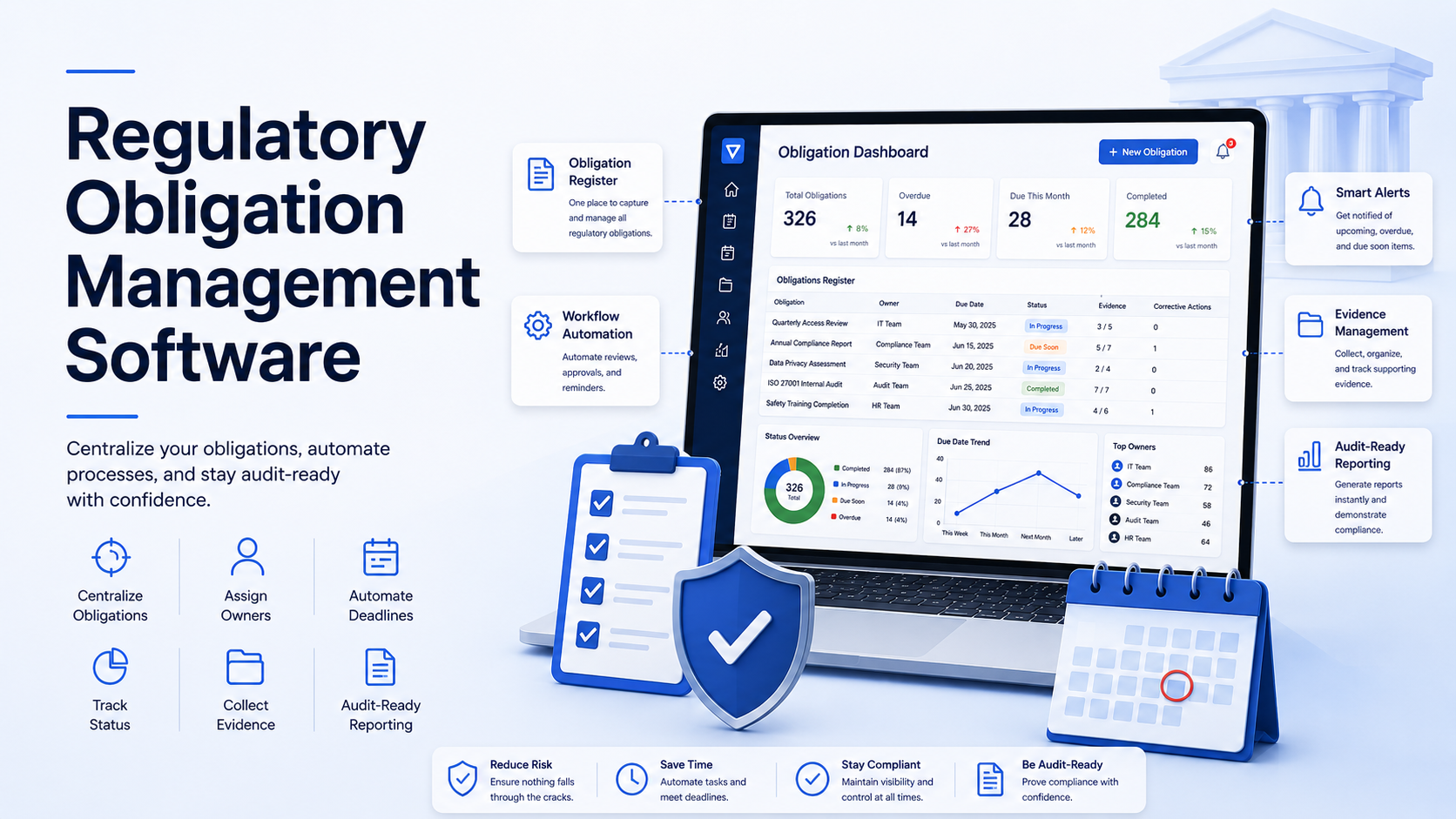
Regulatory obligation management software brings those pieces together. It helps organizations identify applicable requirements, turn them into accountable activities, assign owners, track deadlines, collect evidence, monitor exceptions, and maintain a clear record of compliance.
In simple terms, it answers six questions:
What applies to us? Who owns it? What needs to happen? When is it due? Can we prove it happened? What still needs attention?
That is the core of regulatory obligation management.
What Is Regulatory Obligation Management Software?
Regulatory obligation management software is a system that helps organizations centralize, assign, track, monitor, and document the regulatory requirements they are responsible for meeting.
It takes a requirement that may exist inside legislation, regulations, permits, licenses, standards, regulatory orders, certifications, or other commitments and converts it into something operational.
The typical relationship looks like this:
Regulation → Obligation → Policy or Control → Owner → Activity → Evidence → Review → Remediation → Reporting
That distinction matters.
A database of regulations can tell a company what a regulator has published. An obligation management system should help the company understand what it needs to do about it.
ISO 37301, the international standard for compliance management systems, specifically calls on organizations to identify compliance obligations related to their products, services, and activities, establish responsibilities and authorities, monitor compliance, audit performance, and take corrective action.
For compliance teams, this is the important shift: regulation should not stop at interpretation. It needs to become accountable work.
Highlights
What Is a Regulatory Obligation?
A regulatory obligation is a requirement an organization is expected to satisfy because of an applicable law, regulation, license, permit, regulatory decision, standard, or similar commitment.
Some obligations are simple. Submit a report by a specific date.
Others require ongoing activity. Perform a quarterly access review. Inspect equipment every six months. Review a policy annually. Maintain specified documentation. Notify a regulator following a defined event.
The same organization may have thousands of these activities across different departments, legal entities, jurisdictions, facilities, and regulatory programs.
The challenge is not simply identifying the requirement once. It is maintaining the connection between the requirement and what happens inside the business month after month and year after year.
Why Regulatory Obligations Become Hard to Manage
Regulatory obligations usually become difficult for three reasons: volume, distribution, and proof.
Volume is straightforward. As organizations grow, they encounter more regulations, more jurisdictions, more licenses, more facilities, and more internal controls. A compliance register that once contained 100 requirements can quickly become hundreds or thousands.
Distribution is harder. Compliance may interpret the obligation, but compliance rarely performs every activity required to satisfy it. An IT manager may own an access review. Operations may perform an inspection. HR may administer an employee attestation. Finance may submit a regulatory report.
The third challenge is proof. A team saying, “We completed it,” may not be enough during an audit or investigation. The organization may need to show when the activity happened, who completed it, who reviewed it, which evidence supports it, and what happened when an exception was identified.
The U.S. Department of Justice makes a similar distinction when assessing corporate compliance programs. Its guidance focuses not merely on whether policies and controls exist, but whether the program is well designed, effectively implemented, tested, documented, and working in practice.
Explore DOJ corporate compliance guidance
That is why obligation management is more than maintaining a regulatory library.
Regulatory Obligation Management vs. Regulatory Change Management
These terms are often used together, but they solve different problems.
Regulatory change management focuses on finding and assessing changes in laws, rules, standards, and regulatory guidance.
It asks: What changed? Does it affect us? Which departments are impacted? When does the change take effect?
Regulatory obligation management takes the next step.
It asks: What exactly do we now need to do? Who owns it? Which controls or policies need to change? When is the work due? What evidence must be retained? How will completion be monitored?
Think of regulatory change management as the intelligence layer and obligation management as the execution layer.
Organizations need both. Knowing that a regulation changed without implementing the change creates risk. Tracking existing obligations without monitoring regulatory change creates a different risk: executing yesterday’s requirements correctly.
How Regulatory Obligation Management Software Works
A practical obligation-management process starts with the source requirement.
The organization first records the relevant regulation, standard, permit, license, or other source. Important context may include the issuing authority, jurisdiction, effective date, citation, relevant business unit, and source documentation.
The next step is applicability. Not every requirement applies to every part of a business. A requirement may affect one legal entity, facility, region, product, or operating activity but not another. Documenting that decision becomes increasingly important for organizations operating across multiple sites or jurisdictions.
Once applicability is confirmed, the regulatory language needs to become an operational obligation.
Dense regulatory text such as several paragraphs describing access governance might become a clear recurring responsibility: “Complete and document the quarterly privileged-user access review.”
Now the organization can attach an owner, frequency, due date, reviewer, evidence expectation, and related controls.
This is where software creates practical value.
Instead of leaving that requirement inside a regulatory document, the platform turns it into something the business can execute.
The obligation can then be mapped to relevant controls, policies, risks, audits, or procedures. A privacy requirement might connect to a privacy policy and several operational controls. A safety requirement may connect to inspections, training, and corrective actions.
Next comes ownership.
Every important obligation should have someone accountable for it. “IT,” “Finance,” or “Operations” is usually not enough. A strong system identifies the responsible person, contributors, reviewers, and escalation path.
Recurring obligations should then recreate themselves according to their required cadence. Monthly, quarterly, semiannual, annual, or event-driven work should not depend on someone remembering to add the task again.
When the activity becomes due, the owner completes the work and provides the necessary evidence.
If something goes wrong, the workflow should continue. A rejected piece of evidence, overdue responsibility, failed control, or audit finding may need to create a corrective action with its own owner, deadline, evidence, and verification process.
Finally, compliance needs portfolio-level visibility into everything that is happening.
That full lifecycle is what separates obligation management software from a digital checklist.
What Should Regulatory Obligation Management Software Include?
The most important capability is a centralized obligation register. Compliance should have one reliable place to see applicable obligations, their regulatory sources, responsible owners, frequencies, deadlines, status, and related documentation.
The next requirement is applicability management. Organizations operating across multiple business units, subsidiaries, facilities, or jurisdictions need to know precisely where each obligation applies.
Ownership and accountability should be built into the platform. Every requirement should be connected to the people responsible for executing, reviewing, and approving the work.
Recurring workflow automation is equally important. Quarterly reviews, annual certifications, permit renewals, evidence requests, assessments, and regulatory reports should automatically return when the next cycle begins.
Evidence management needs to be part of the same workflow rather than a separate document repository. Compliance should be able to move from a requirement to the activity performed and then directly to the evidence proving completion.
The platform should also support control and policy mapping, reminders, escalation, corrective actions, dashboards, audit trails, regulatory change workflows, and multi-entity reporting.
In the current obligation-management software market, centralized registers, named ownership, due-date tracking, recurring activities, evidence, regulatory-change workflows, and audit trails consistently appear as core capabilities.
The feature list matters, but the connection between those features matters more.
A compliance platform becomes much more useful when the organization can trace one requirement all the way through to the action and evidence that demonstrate compliance.
Why Spreadsheets Eventually Stop Working
Spreadsheets are often where obligation management begins, and there is nothing inherently wrong with that.
A small compliance team may create columns for the regulation, obligation, responsible person, due date, and status. For a limited number of requirements, this can work well.
Then the program grows.
Different teams create copies. Facilities maintain their own versions. Regulatory changes need to be updated across several files. Owners change jobs. Recurring obligations need new rows. Evidence remains in email or shared drives. Compliance starts sending manual reminders.
Eventually the spreadsheet is being asked to behave like a database, workflow engine, notification system, evidence repository, reporting platform, and audit trail.
That is usually the point where things become fragile.
A missed obligation is rarely caused by one dramatic failure. More often, ownership was unclear, the reminder was missed, the spreadsheet was not updated, or nobody realized evidence had not been provided.
Regulatory obligation management software reduces that dependence on individual memory.
The Business Benefits of Obligation Management
The first benefit is clearer accountability.
Compliance can immediately see who owns a requirement and whether the work has been completed. Business owners can see what is expected from them without searching through regulatory documentation.
The second benefit is fewer missed deadlines. Automated schedules, reminders, and escalations help recurring work happen before compliance needs to chase it manually.
The third is stronger evidence. Documentation remains connected to the obligation it supports, creating a more defensible record during audits and regulatory reviews.
The fourth is visibility. Compliance leaders can see patterns across departments, locations, and regulatory programs instead of manually consolidating multiple trackers.
The fifth is scalability. When the organization adds a facility, enters another jurisdiction, acquires a company, or becomes subject to another framework, compliance can extend an existing structure rather than starting another spreadsheet.
Perhaps most importantly, obligation management allows compliance teams to spend less time asking “Has this been done?” and more time understanding where compliance risk actually exists.
Regulatory Obligation Management and Audit Readiness
Audits expose weak obligation management quickly.
An auditor asks for evidence supporting a requirement. Compliance identifies the control, finds the owner, searches for documents, checks whether the correct period was covered, confirms who reviewed the evidence, and reconstructs the history.
That process can take hours or days when information is scattered.
With a connected obligation-management process, the audit trail is created while the work happens.
The team can move from the regulatory requirement to the responsible control, completed activity, supporting evidence, reviewer, exceptions, and corrective actions.
This is the difference between preparing for an audit and being continuously ready for one.
VComply’s compliance evidence guidance makes the same point: evidence becomes more useful when it is connected to the requirement, control, owner, reporting period, review status, and resulting corrective action.
Read the Compliance Evidence Management Software guide
Who Needs Regulatory Obligation Management Software?
The need is driven more by complexity than company size.
A business operating in one location under a small number of requirements may be able to manage obligations manually.
A business operating across 20 facilities, several jurisdictions, multiple regulatory programs, and hundreds of responsible employees faces a very different problem.
Energy and utility organizations may need to coordinate reliability, environmental, cybersecurity, safety, permits, reporting, and operational requirements across assets.
Healthcare organizations may manage privacy, accreditation, payer requirements, quality standards, licensing, corrective actions, and multiple facilities.
Financial services and insurance organizations can face requirements across regulators, jurisdictions, products, controls, and reporting cycles.
Manufacturers may need to coordinate environmental, workplace safety, quality, product, facility, and supplier requirements.
The pattern is the same across industries: regulation becomes harder to manage when the responsibility for satisfying it is distributed throughout the organization.
Regulatory Obligation Management Across Multiple Sites
Multi-site organizations have an additional challenge.
The requirement may be centralized, but execution is local.
Corporate compliance may define a quarterly obligation that applies to 25 locations. Twenty-five different employees may then need to complete the activity and provide evidence.
Managing each location separately creates duplication. Managing everything centrally without site-level accountability creates another problem.
A better model combines both.
The obligation and its underlying regulatory requirement remain centrally governed. Applicability determines which locations need to complete it. Local owners receive their responsibilities, evidence requests, and deadlines. Compliance gets one consolidated view of completion across the organization.
This makes it easier to identify patterns.
If 24 sites complete a requirement on time and one site repeatedly misses it, compliance can focus on the underlying problem instead of treating every site equally.
Start your 21-day free trial and experience how VComply helps you with your policy management and compliance maturity.
How to Choose Regulatory Obligation Management Software
Start with your operating model, not the vendor’s feature presentation.
Map how an obligation currently moves through your organization.
Where does the requirement come from? Who determines whether it applies? Where is the obligation documented? How is responsibility assigned? How are recurring deadlines managed? Where does evidence go? What happens when something becomes overdue? How are findings remediated? What does leadership see?
Then evaluate software against that process.
A useful system should make five questions easy to answer.
First, what are we required to do? You need a clear obligation register and regulatory context.
Second, who owns it? Ownership and escalation should be visible.
Third, is it happening on time? Deadlines, recurring activities, reminders, and status should be easy to monitor.
Fourth, can we prove it? Evidence should be directly connected to the activity and requirement.
Fifth, what happens when something fails? Issues and corrective actions should remain visible until they are genuinely resolved.
A system with dozens of dashboards but weak answers to those five questions will not solve the underlying compliance problem.
How VComply Helps Manage Regulatory Obligations
VComply’s ComplianceOps is built around turning compliance requirements into accountable work.
Teams can centralize regulatory frameworks and compliance activities, assign owners, automate recurring responsibilities, set alerts, collect supporting evidence, conduct assessments, monitor corrective actions, and report on compliance status from one environment. VComply also supports role-based evidence management, audits and assessments, multi-location workflows, customizable dashboards, and reporting.
Explore VComply Compliance Management Software
The value is particularly clear for organizations where regulatory responsibility sits outside the compliance team.
Instead of maintaining one regulatory register and then separately chasing departments for execution, the requirement can remain connected to the person responsible for completing the work.
Compliance can see what is coming due, what has been completed, where evidence is missing, and which responsibilities need attention without rebuilding the status manually.
VComply also connects compliance execution with policies, evidence, controls, assessments, risks, and reporting. That makes regulatory obligation management part of the wider compliance operating model rather than another isolated tracker.
For organizations moving away from spreadsheets and shared folders, the workflow becomes straightforward:
Define what is required. Assign responsibility. Automate the cadence. Collect the evidence. Review the result. Address gaps. Maintain the history.
Read VComply’s Regulatory Compliance Software Buyer Guide
Explore VComply Policy Management Software
Frequently Asked Questions (FAQs)
What is regulatory obligation management?
Regulatory obligation management is the process of identifying the regulatory requirements that apply to an organization and ensuring those requirements are translated into responsibilities, controls, deadlines, evidence, monitoring, and corrective actions.
What is regulatory obligation management software?
Regulatory obligation management software is a platform that centralizes applicable regulatory obligations and helps organizations assign owners, track deadlines, automate recurring activities, collect evidence, manage exceptions, and maintain an audit trail.
What is a compliance obligations register?
A compliance obligations register is a structured record of the legal, regulatory, statutory, contractual, or other compliance requirements that apply to an organization. It typically records the requirement, source, applicability, owner, frequency, due date, status, and supporting controls or evidence.
What is the difference between a regulatory obligation and a control?
A regulatory obligation describes what the organization is required to achieve or perform. A control describes how the organization manages or satisfies that requirement. One control may support several obligations, and one obligation may require several controls.
What is the difference between regulatory obligation management and compliance management?
Regulatory obligation management focuses specifically on identifying and operating applicable requirements. Compliance management is broader and may include policies, controls, audits, risks, incidents, investigations, third-party oversight, training, and reporting.
Can regulatory obligations be managed in Excel?
Yes. Smaller programs can successfully manage a limited obligation register in Excel. The model becomes harder to sustain when requirements become recurring, involve multiple owners or locations, require evidence and approval workflows, or need real-time reporting.
What features should regulatory obligation management software have?
The most useful capabilities include an obligation register, applicability management, ownership, recurring schedules, automated reminders, escalation, policy and control mapping, evidence management, audit trails, corrective actions, regulatory change workflows, dashboards, reporting, and multi-entity support.
How does obligation management improve audit readiness?
It keeps the requirement, responsible owner, compliance activity, supporting evidence, review history, exceptions, and remediation connected throughout the year. Auditors can therefore review the existing record instead of forcing teams to reconstruct it shortly before the audit.
Who uses regulatory obligation management software?
Typical users include compliance officers, regulatory affairs professionals, legal teams, internal auditors, control owners, risk managers, policy owners, department leaders, site managers, quality teams, EHS teams, cybersecurity teams, and other employees responsible for compliance activities.