

HITRUST vs HIPAA: Key Differences, Requirements, and When You Need Both
The U.S. Department of Health and Human Services enforces HIPAA requirements for protecting protected health information (PHI), and covered entities must be able to demonstrate how safeguards are implemented and maintained during audits or investigations.

At the same time, many healthcare providers, payers, and enterprise vendors now require HITRUST certification as part of third-party risk and vendor onboarding processes.
For compliance and security teams, this creates a defined operational requirement: meet HIPAA obligations while also responding to external demands for HITRUST validation. These are not interchangeable. HIPAA establishes legal requirements, while HITRUST provides a certifiable framework with prescriptive controls and third-party assessment.
Understanding how these two frameworks differ, and how they are applied in practice, is necessary for determining compliance scope, audit expectations, and resource allocation.
Key Takeaways
- HIPAA is a U.S. federal law, while HITRUST is a certifiable security framework.
- HIPAA establishes requirements for protecting protected health information (PHI).
- HITRUST provides a structured framework that helps organizations implement and validate those requirements.
- Healthcare organizations must comply with HIPAA, but HITRUST certification is voluntary.
- Many organizations adopt HITRUST to demonstrate stronger security and streamline audits.
What Is HIPAA?
The Health Insurance Portability and Accountability Act (HIPAA) is a U.S. federal law that establishes national standards for protecting patient health information. It governs how healthcare organizations collect, store, process, and share protected health information (PHI).
HIPAA applies to two main groups:
- Covered entities such as healthcare providers, insurers, and clearinghouses
- Business associates that process or store PHI on behalf of covered entities
The law includes several key rules:
- Privacy Rule – governs how PHI can be used and disclosed
- Security Rule – defines safeguards for electronic PHI
- Breach Notification Rule – requires notification when PHI is compromised
Failure to comply with HIPAA can result in significant civil penalties and enforcement actions from the U.S. Department of Health and Human Services.
Also Read: What is HIPAA Compliance? What is the Key to Successful HIPAA Compliance?

What Is HITRUST?
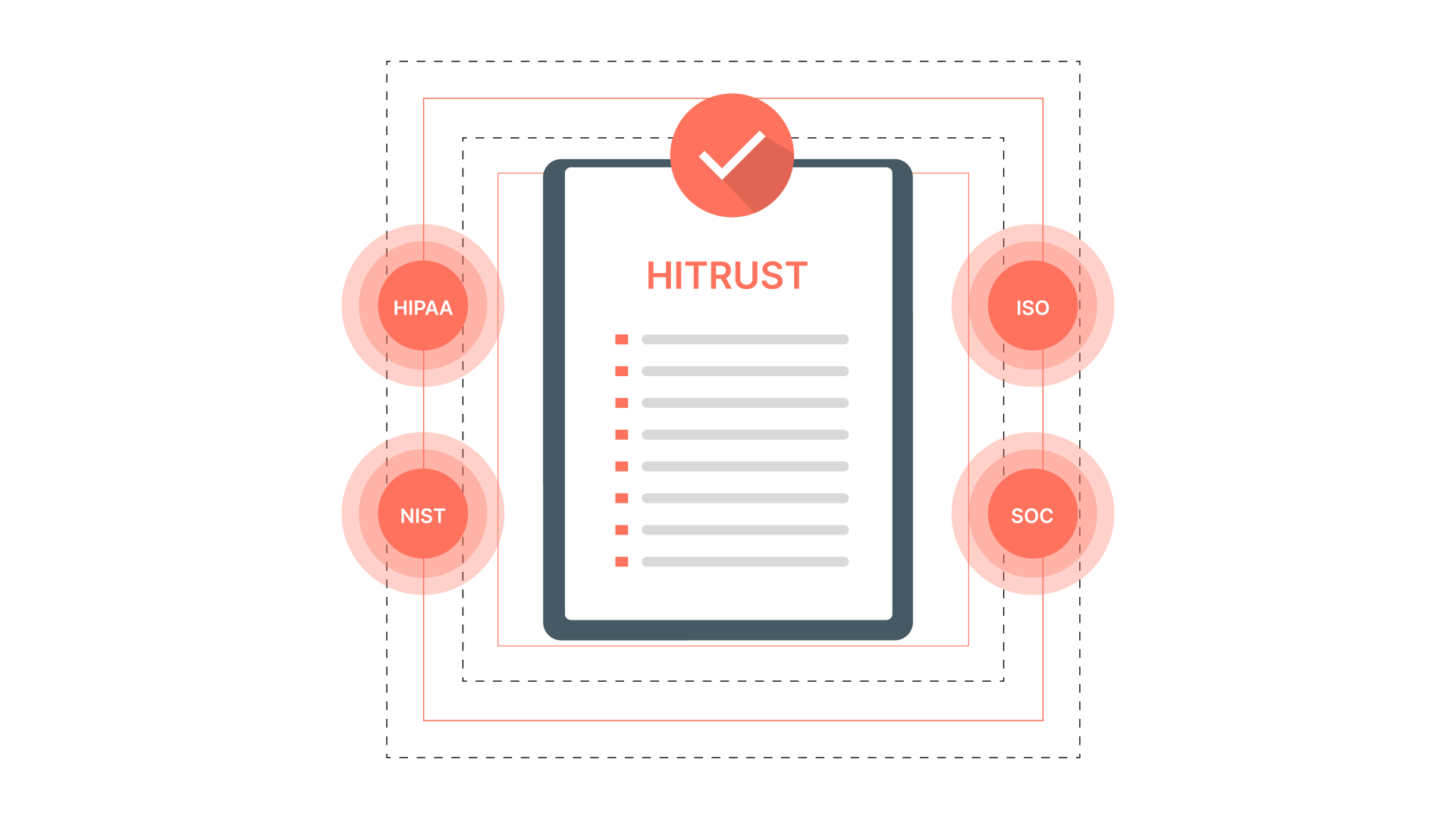
HITRUST refers to the HITRUST Common Security Framework (CSF), a certifiable cybersecurity framework created by the HITRUST Alliance.
The framework integrates security and privacy requirements from multiple standards, including HIPAA, NIST, and ISO frameworks.
Unlike HIPAA, which defines legal requirements, HITRUST provides a structured framework with prescriptive controls organizations can implement to demonstrate strong security practices.
Key characteristics of HITRUST include:
- A certification-based approach to compliance
- Integrated controls mapped to multiple regulations
- Risk-based assessments tailored to organization size and complexity
- A formal validation process conducted by third-party assessors
Many healthcare vendors pursue HITRUST certification to demonstrate their security maturity to partners and regulators.
Also Read: HITRUST: Ensuring Security and Compliance with Global Standard of Information Protection
HITRUST vs HIPAA: Key Differences
Although HIPAA and HITRUST both focus on protecting sensitive healthcare data, they serve very different purposes. Understanding how they differ helps compliance leaders determine which framework their organization must follow and how to operationalize security programs.
1. Legal Requirement vs. Voluntary Framework
The most fundamental difference is authority. HIPAA is a U.S. federal law that mandates how healthcare organizations must protect protected health information (PHI). Organizations that fail to comply can face civil and criminal penalties enforced by the U.S. Department of Health and Human Services.
HITRUST, by contrast, is a private security framework developed by the HITRUST Alliance. It provides a certifiable set of security controls designed to help organizations demonstrate compliance with multiple regulations, including HIPAA.
In simple terms:
- HIPAA tells you what must be protected.
- HITRUST helps you implement and validate how those protections work.
2. Compliance vs. Certification
Another key difference is how organizations demonstrate compliance.
HIPAA does not offer a formal certification. Organizations must continuously assess their security posture and demonstrate compliance during audits or investigations.
HITRUST, however, provides a formal certification process conducted by approved third-party assessors. Organizations can complete validated assessments and receive certification that demonstrates their security controls meet HITRUST requirements.
This certification model is why many healthcare vendors pursue HITRUST. It provides partners and regulators with clear evidence that security controls have been independently validated.
3. Prescriptive Controls vs. Flexible Requirements
HIPAA provides regulatory requirements but does not prescribe exactly how organizations must implement security controls. Instead, it allows organizations to adopt safeguards appropriate for their environment.
For example, the HIPAA Security Rule outlines administrative, technical, and physical safeguards but leaves implementation details largely flexible.
HITRUST addresses this gap by providing more prescriptive control requirements and implementation guidance. The HITRUST Common Security Framework (CSF) integrates controls from multiple standards and provides detailed guidance on how to implement them.
This makes HITRUST particularly useful for organizations seeking structured security programs rather than interpreting regulatory requirements independently.
4. Scope and Applicability
HIPAA applies specifically to the healthcare ecosystem. It governs:
- Healthcare providers
- Health insurance companies
- Healthcare clearinghouses
- Business associates handling protected health information
HITRUST has a broader scope. While originally designed for healthcare security, the framework now incorporates requirements from more than 60 regulations and standards, making it applicable across multiple industries and compliance programs.
This broader coverage allows organizations to address multiple compliance obligations within a single framework.
5. Enforcement and Penalties
HIPAA violations carry legal consequences. Organizations that fail to protect patient data can face fines, regulatory investigations, and reputational damage.
HITRUST does not impose regulatory penalties because it is not a law. Instead, organizations that fail an assessment simply do not receive certification.
However, many healthcare organizations and vendors require partners to obtain HITRUST certification, so failing to meet its requirements can impact business relationships.
HITRUST vs HIPAA: At a Glance
| Aspect | HIPAA | HITRUST |
|---|---|---|
| Type | U.S. federal law | Private security framework |
| Purpose | Defines requirements for protecting PHI | Provides a structured way to implement and validate security controls |
| Mandatory vs Voluntary | Mandatory for covered entities and business associates | Voluntary, but often required by partners |
| Compliance Model | Ongoing compliance (no formal certification) | Formal certification through validated assessments |
| Control Guidance | Flexible, non-prescriptive | Prescriptive, detailed control requirements |
| Scope | Healthcare-specific | Multi-industry (includes 60+ standards and regulations) |
| Enforcement | Enforced by HHS with civil and criminal penalties | No legal enforcement; certification may be denied |
| Business Impact | Non-compliance leads to fines and legal risk | Lack of certification can impact partnerships and trust |
| Relationship | Baseline legal requirement | Helps organizations achieve and demonstrate HIPAA compliance |
How HITRUST Helps Organizations Achieve HIPAA Compliance
One of the biggest challenges with HIPAA is that the law outlines security objectives but does not prescribe exact implementation methods.
HITRUST helps fill this gap by providing structured controls that align with HIPAA requirements.
For example, the HITRUST framework:
- Maps control directly to HIPAA security rule requirements
- Provides prescriptive implementation guidance
- Enables third-party validation of compliance practices
- Supports continuous monitoring of security controls
By adopting HITRUST, healthcare organizations gain a standardized way to demonstrate that they are protecting patient data effectively.
ComplianceOps helps structure HIPAA and HITRUST requirements by centralizing controls, evidence, and compliance workflows within a single system.
Do You Need HIPAA Compliance, HITRUST Certification, or Both?
For most healthcare organizations, HIPAA compliance is non-negotiable. Any entity that handles protected health information must comply with HIPAA regulations. However, many organizations pursue HITRUST certification for additional reasons:
- Vendor trust: Healthcare systems often require vendors to demonstrate strong security controls.
- Audit efficiency: HITRUST provides a standardized framework that simplifies audits.
- Security maturity: The framework helps organizations implement a comprehensive cybersecurity program.
While HITRUST certification is optional, it often strengthens an organization’s ability to demonstrate compliance and manage security risks.
Common Challenges When Managing HIPAA and HITRUST Programs
Managing HIPAA requirements alongside HITRUST certification introduces overlapping controls, documentation demands, and audit expectations. For compliance and security teams, the difficulty is not understanding the frameworks; it is maintaining consistent execution across systems, teams, and assessments.
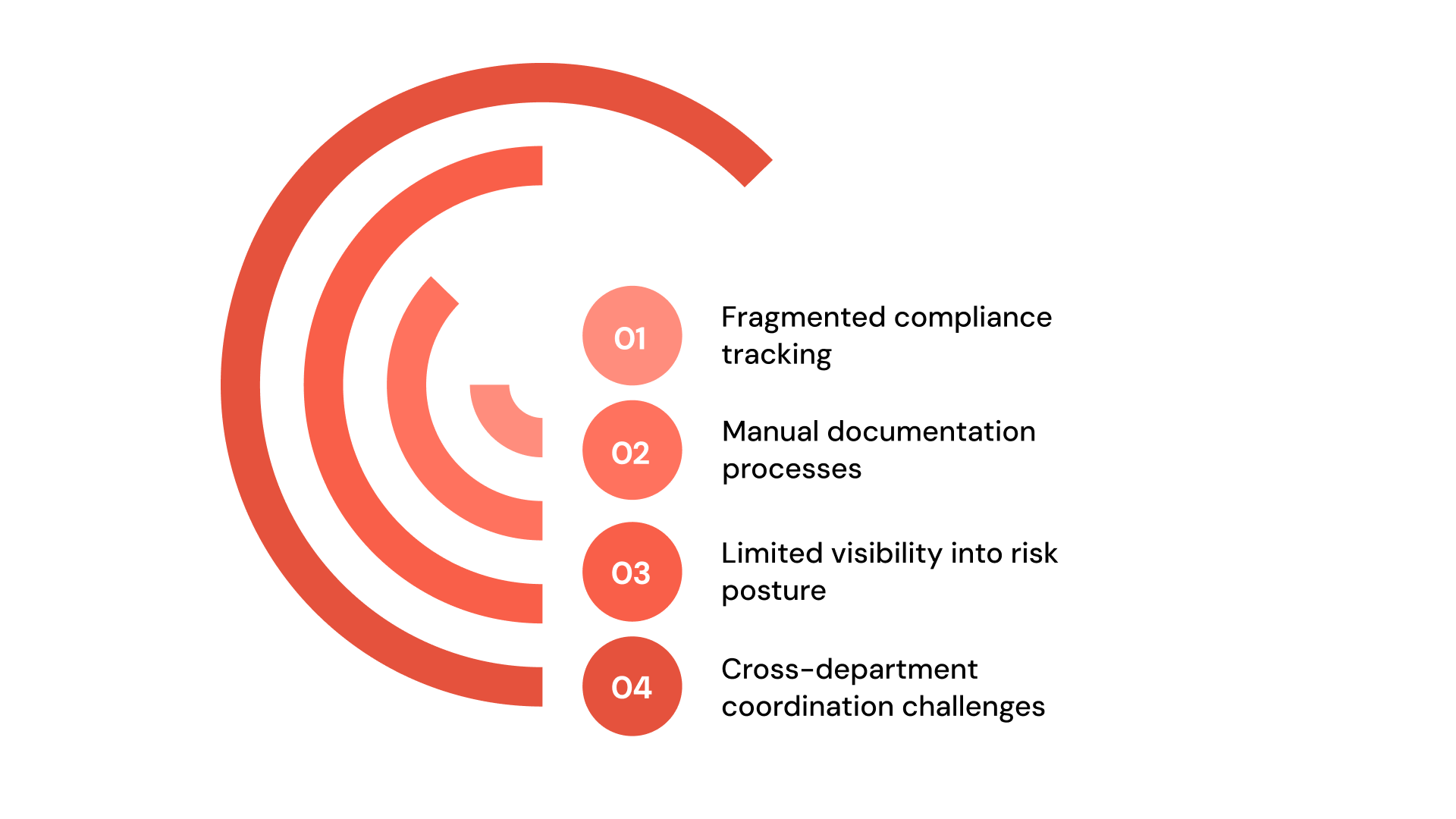
Organizations typically encounter challenges such as:
- Fragmented compliance tracking: HIPAA safeguards and HITRUST controls are often managed across separate tools, making it difficult to maintain a single, reconciled view of compliance.
- Manual documentation processes: Audit evidence for both frameworks is gathered through emails, shared drives, and spreadsheets, increasing effort and the risk of incomplete or inconsistent documentation.
- Limited visibility into risk posture: Without centralized oversight, teams lack real-time insight into which controls are implemented, overdue, or at risk.
- Cross-department coordination challenges: Compliance activities span IT, security, legal, and operations, requiring ongoing coordination that is difficult to manage without structured workflows.
As audit frequency increases and third-party requirements expand, maintaining consistent, audit-ready compliance across both frameworks becomes difficult without a centralized approach.
Structuring HIPAA and HITRUST Compliance Within a Single System
Managing HIPAA and HITRUST side by side often exposes a structural issue—controls, evidence, and assessments are handled in separate systems, while teams are expected to present a unified compliance posture. As requirements overlap and audit expectations increase, this fragmentation becomes difficult to manage.
GRC platforms address this by bringing compliance operations into a single system. Instead of tracking HIPAA safeguards and HITRUST controls independently, teams can align requirements, map controls once, and manage evidence in a consistent format.
In practice, this allows organizations to:
- Maintain a centralized view of controls across both frameworks
- Standardize how evidence is collected and validated
- Track control ownership, status, and remediation in real time
- Reduce duplication when managing overlapping requirements
The result is not just efficiency, but clearer oversight. Compliance teams can move from assembling documentation for each audit to maintaining a continuously updated record of control performance.
See how ComplianceOps helps structure healthcare compliance by connecting HIPAA requirements, HITRUST controls, and audit evidence within a single operational system. Book a 21-day free trial today.

Conclusion
Managing HIPAA and HITRUST together often creates more operational strain than clarity. Controls are duplicated across frameworks, evidence is scattered across systems, and audit preparation becomes a recurring effort rather than a controlled process. Teams spend time reconciling requirements instead of strengthening security, while leadership still expects a clear, defensible view of compliance.
The objective is not just to meet both frameworks, but to run them as a single, structured program, where controls are aligned, evidence is continuously maintained, and audit readiness is built into daily operations rather than assembled under pressure.
VComply enables this shift by bringing HIPAA and HITRUST into one operational system, connecting requirements, controls, evidence, and workflows so teams can manage compliance with consistency and visibility.
Book a demo to see how VComply helps structure healthcare compliance and maintain continuous audit readiness.
FAQs
No. HIPAA is a federal law governing patient data protection, while HITRUST is a security framework designed to help organizations implement compliance controls.
No. HIPAA compliance is mandatory, but HITRUST certification is optional.
Yes. Organizations can comply with HIPAA without HITRUST certification.
No. HITRUST certification helps demonstrate strong security practices but does not automatically guarantee HIPAA compliance.
Healthcare organizations, SaaS vendors, and service providers handling PHI often pursue HITRUST certification to demonstrate strong security controls.