

FSIS Compliance: Complete Food Safety & Inspection Guide for 2026
FSIS compliance is all about following the rules set by the U.S. Department of Agriculture’s Food Safety and Inspection Service (FSIS) to make sure meat, poultry, and egg products are safe and properly labeled. The FSIS oversees everything from production and packaging to sanitation and recordkeeping, guided by laws like the Federal Meat Inspection Act and the Poultry Products Inspection Act. Essentially, it’s about making sure food businesses meet federal standards to keep products safe for consumers.

In the US, the Food Safety and Inspection Service (FSIS) sets strict standards to keep meat, poultry, and egg products safe for consumers. For food manufacturers and processors, staying compliant isn’t optional. It’s essential to avoid costly penalties, protect your brand, and ensure public health. But with changing regulations and increasing documentation demands, managing FSIS compliance can quickly become overwhelming.
Key Takeaways (TL;DR)
This blog explains what FSIS compliance means in 2025 and shows how modern tools can help you stay ahead, simplify processes, and reduce risk.
- FSIS compliance in 2025 demands stricter documentation, inspections, and pathogen testing, especially for Listeria and Salmonella.
- Manual systems no longer meet FSIS expectations. Digital records and real-time visibility are essential for audit readiness.
- Facilities must stay prepared for weekly inspections, expanded testing, and tighter enforcement on risk controls.
- Multi-site operations face higher compliance risks without standardized processes and clear oversight.
- Proactive audits, continuous training, and smart compliance tools are key to staying ahead of changing FSIS rules.
The Food Safety and Inspection Service (FSIS) is the public health regulatory agency within the U.S. Department of Agriculture responsible for ensuring that meat, poultry, processed egg products, and certain other FSIS-regulated products are safe, wholesome, and properly labeled. For businesses under FSIS jurisdiction, compliance affects far more than passing an occasional inspection. It influences whether an establishment can operate, how food safety hazards are controlled, what records must be maintained, how problems are corrected, and what happens when inspectors identify noncompliance.
FSIS compliance therefore reaches across everyday operations. Hazard Analysis and Critical Control Point (HACCP) systems, Sanitation Standard Operating Procedures, pathogen controls, product labeling, recordkeeping, corrective actions, verification activities, inspection findings, and supporting documentation can all form part of the compliance picture.
For meat, poultry, and egg-product establishments, the challenge is not simply knowing the regulations. It is demonstrating, day after day, that required controls are actually operating as intended.
This guide explains what FSIS does, who it regulates, the major FSIS compliance requirements, how inspections and Noncompliance Records work, what has changed in 2026, and how organizations can build a more structured approach to food safety compliance.
What Foods Does FSIS Regulate?
FSIS primarily oversees meat and meat products, poultry and poultry products, processed egg products, and Siluriformes fish and fish products. The exact jurisdiction can depend on the product, ingredients, species, processing activities, and other regulatory factors.
This distinction matters because not every food manufacturer is regulated primarily by FSIS. Many other foods fall under the jurisdiction of the Food and Drug Administration.
Companies manufacturing different categories of food may even operate in an environment where both USDA and FDA requirements matter. Determining jurisdiction should therefore happen early, before an organization builds its food safety compliance program.
For a wider look at the agencies and standards affecting manufacturers, see VComply’s guide to food manufacturing regulations and standards in the U.S..
FSIS vs. FDA: What Is the Difference?
FSIS and FDA both play important roles in the U.S. food safety system, but their jurisdictions and inspection models are different.
| Area | USDA FSIS | FDA |
|---|---|---|
| Primary regulated foods | Meat, poultry, processed egg products and Siluriformes | Most other foods |
| Parent agency | U.S. Department of Agriculture | Department of Health and Human Services |
| Major food safety approach | Federal inspection plus establishment food safety systems | Facility regulation and risk-based inspection |
| HACCP | Required for applicable FSIS-regulated establishment operations under 9 CFR Part 417 | Required for certain FDA-regulated industries, while other FDA facilities may operate under FSMA preventive controls |
| Sanitation | Detailed FSIS sanitation requirements and Sanitation SOP provisions | CGMP and applicable preventive-control requirements |
| Enforcement | NRs, regulatory control actions, withholding/suspension of inspection and other enforcement tools | Warning letters, administrative actions, injunctions, seizures and other authorities |
One of the most important operational differences is the role inspection plays inside FSIS-regulated establishments. For slaughter operations, FSIS inspection includes ante-mortem and post-mortem inspection, while FSIS personnel also verify compliance with food safety systems and other requirements at regulated establishments.
This is why FSIS compliance needs to function as a continuous operational discipline rather than as preparation for a single annual audit.
What Is FSIS Compliance?
FSIS compliance means meeting the federal food safety, sanitation, inspection, labeling, recordkeeping, process-control, and other requirements that apply to an FSIS-regulated establishment and its products.
The exact requirements depend on what the establishment produces and how it operates. A poultry slaughter facility will not have an identical compliance program to a ready-to-eat meat processing establishment. An egg-products plant has its own applicable requirements, while establishments handling post-lethality exposed ready-to-eat products may need to address specific Listeria monocytogenes controls.
At the operational level, FSIS compliance often follows a chain such as:
Regulatory Requirement → Food Safety Control → Responsible Owner → Monitoring → Record → Verification → Finding → Corrective Action → Evidence → Closure
This connection is important. A written HACCP plan alone does not establish effective compliance if the required monitoring is not completed, records are missing, corrective actions are weak, or the plan does not reflect how production actually operates.
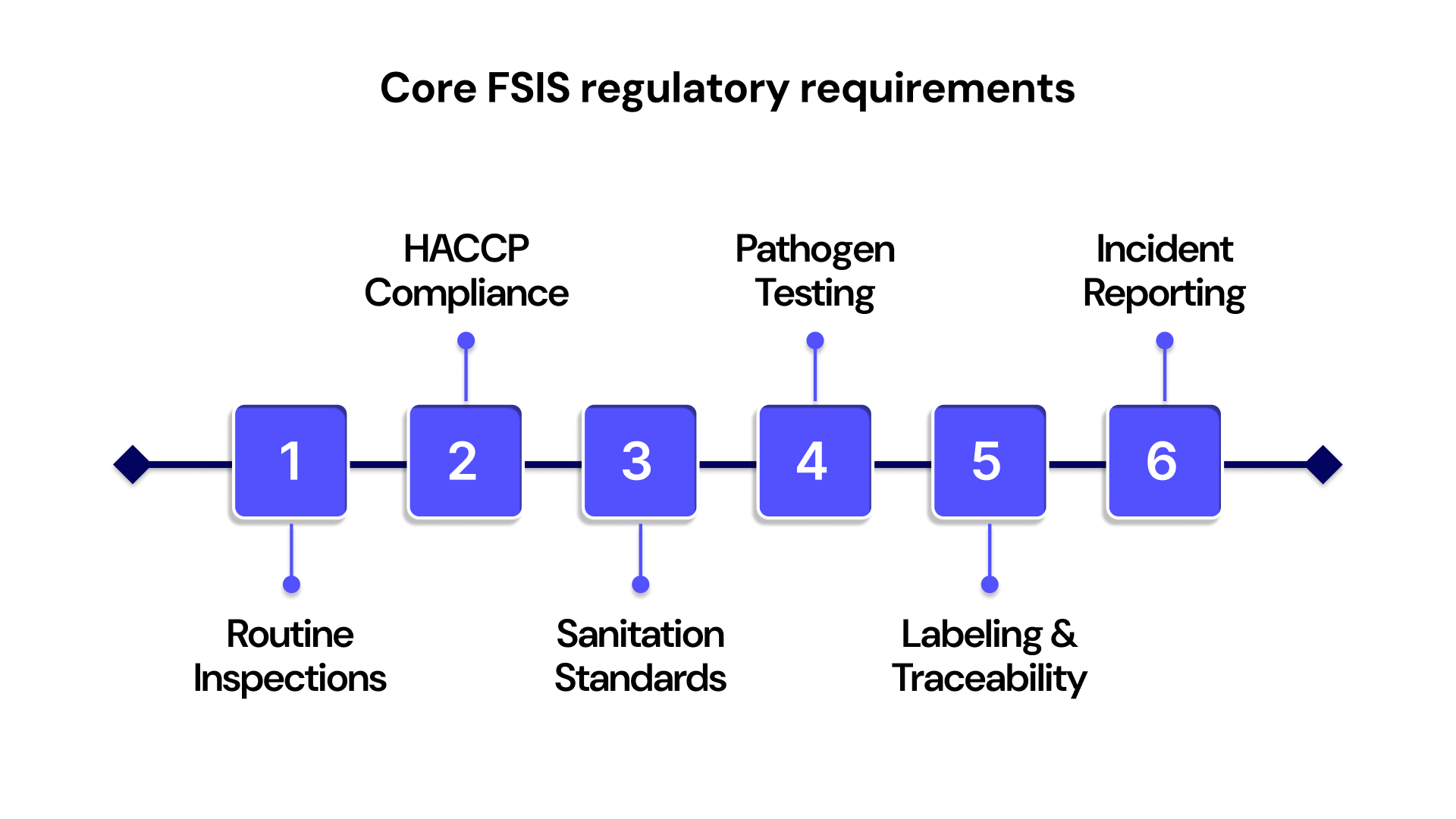
The Core FSIS Compliance Requirements
There is no single FSIS compliance checklist that applies identically to every establishment. Several areas, however, form the foundation of many meat, poultry, and egg-product compliance programs.
Grant of Inspection
For businesses that require federal inspection, obtaining the appropriate Grant of Inspection is a fundamental step before operating as an official establishment.
FSIS provides a formal Grant of Inspection application process for businesses seeking federal inspection.
The establishment must be capable of meeting applicable regulatory requirements, including requirements related to facilities, sanitation, food safety systems, and inspection access.
A Grant of Inspection should not be viewed as a one-time certificate that removes future compliance obligations. Continued operations depend on maintaining the conditions and systems required under the applicable inspection program.
This makes significant FSIS enforcement especially important. If inspection is withheld or suspended in circumstances authorized under FSIS rules, the operational consequences can become immediate.
HACCP Requirements Under 9 CFR Part 417
HACCP is one of the foundations of FSIS food safety regulation.
Under 9 CFR Part 417, official establishments must conduct a hazard analysis to determine the food safety hazards reasonably likely to occur in their production processes. When the hazard analysis identifies one or more hazards that are reasonably likely to occur, the establishment must develop and implement a written HACCP plan meeting applicable regulatory requirements.
The hazard analysis should consider potential biological, chemical, and physical hazards and evaluate where preventive measures are needed.
A compliant HACCP program is not simply a document containing several Critical Control Points. It connects hazards with controls, critical limits, monitoring, verification, records, and corrective action.
Consider a temperature-related CCP in a processing operation. The HACCP plan may establish the critical limit, identify who monitors it, specify how frequently monitoring occurs, define what information must be recorded, and establish what happens if the critical limit is exceeded.
The resulting compliance chain becomes:
Hazard → CCP → Critical Limit → Monitoring → Record → Deviation → Corrective Action → Verification
That traceability is important because FSIS inspectors can evaluate both what the HACCP plan says and whether the establishment is actually implementing it.
HACCP Validation, Verification and Reassessment
A HACCP plan should not remain unchanged simply because it was approved internally several years ago.
Under 9 CFR 417.4, establishments must validate the adequacy of their HACCP plans and verify that the plans are effectively implemented. Ongoing verification can include calibration of process-monitoring instruments, direct observation of monitoring and corrective actions, and review of HACCP records.
Establishments must also reassess the adequacy of their HACCP plans at least annually and when changes occur that could affect the hazard analysis or HACCP plan. Those changes can include raw materials, product formulation, processing methods, production volume, personnel, packaging, distribution, and intended use.
This makes change management a food safety issue.
A facility that introduces a new ingredient, changes equipment, increases production volume, modifies packaging, or changes a supplier may need to determine whether its existing hazard analysis and controls remain appropriate.
Corrective Actions
Corrective action is another area where documentation quality matters.
When a deviation from a critical limit occurs, the HACCP plan must address appropriate corrective action. Under 9 CFR 417.3, corrective action is designed to address the cause of the deviation, return the CCP to control, establish measures to prevent recurrence, and ensure that affected product is appropriately handled. Corrective actions must also be documented.
This is much stronger than writing “issue fixed” in a spreadsheet.
For example, if a monitoring activity identifies a cooking temperature deviation, the establishment may need to control affected product, determine why the deviation occurred, restore the process to control, establish action to prevent recurrence, and document the complete response.
A useful corrective-action workflow therefore looks like:
Deviation identified → Product controlled → Cause investigated → Corrective action assigned → Preventive measure established → Evidence collected → Effectiveness verified → Action closed
A good compliance system should make that entire history easy to retrieve.
Sanitation and Sanitation SOPs
Sanitation requirements are another major part of FSIS compliance.
9 CFR Part 416 addresses establishment sanitation, including grounds and facilities, equipment and utensils, sanitary operations, employee hygiene, Sanitation SOPs, corrective actions, records, and agency verification.
Official establishments subject to the Sanitation SOP requirements must develop written procedures describing the activities they conduct to prevent direct contamination or adulteration of product.
Pre-operational procedures must be performed before operations begin, and other Sanitation SOP procedures must be conducted at their specified frequencies. Establishments also monitor implementation of their Sanitation SOPs.
Effective sanitation therefore requires more than documenting that a room was cleaned.
The organization needs confidence that required procedures occurred, the responsible person completed them, deviations were identified, corrective action occurred where necessary, and records can demonstrate what happened.
Listeria Controls for Ready-to-Eat Products
Ready-to-eat meat and poultry operations can face additional concerns relating to Listeria monocytogenes, particularly where products are exposed to the processing environment after the lethality step.
9 CFR Part 430 contains requirements for specific classes of product, including provisions addressing L. monocytogenes in post-lethality exposed ready-to-eat products.
Depending on the control approach used, establishments may rely on post-lethality treatments, antimicrobial agents or processes, sanitation measures, testing, and other controls. Supporting documentation and verification become important parts of demonstrating that the selected approach is functioning.
FSIS also changed its laboratory method in January 2025 to add testing for additional non-L. monocytogenes Listeria species in relevant sampling projects. FSIS reissued instructions on that approach in January 2026. The additional information can help indicate whether sanitation controls in post-lethality exposed RTE environments warrant further attention.
For compliance teams, the important lesson is that pathogen-control programs should not operate separately from corrective-action and evidence-management processes. Sampling results, investigations, sanitation responses, corrective actions and supporting records should remain connected.
FSIS Recordkeeping Requirements
Recordkeeping is one of the areas where the current VComply article needs an important distinction.
FSIS regulations require establishments to maintain specific records in a number of contexts, but this should not be translated into a blanket statement that every FSIS record must be maintained in a particular compliance software platform or that FSIS universally mandates “real-time digital reporting.”
For HACCP, 9 CFR 417.5 requires establishments to maintain the written hazard analysis, HACCP plan and supporting documentation, as well as records documenting CCP monitoring, corrective actions, verification activities, calibration and other specified information.
The compliance objective is therefore complete, accurate, accessible and properly maintained evidence, not purchasing a specific type of software.
Technology can make this easier, especially where organizations operate several facilities or manage large volumes of recurring records, but software should support regulatory compliance rather than being presented as the regulatory requirement itself.
Labeling Compliance
FSIS also oversees labeling requirements for products under its jurisdiction.
Labels need to comply with applicable requirements relating to product identity, ingredients, inspection marks and establishment numbers, net quantity, handling statements, nutrition information, allergens, special claims and other required information, depending on the product.
Some labels are eligible for generic approval when they comply with regulatory requirements, while certain types of labels or claims may require FSIS evaluation or approval.
Label compliance deserves to be treated as an ongoing workstream because formulations, suppliers, claims and regulatory requirements can change.
FSIS established January 1, 2028 as the uniform compliance date for new meat and poultry labeling regulations issued between January 1, 2025 and December 31, 2026, unless a particular rule specifies otherwise.
That makes 2026 regulatory monitoring particularly relevant for teams responsible for packaging and labels.
How FSIS Inspections Work
One reason FSIS compliance differs from many other regulatory programs is the agency’s operational presence at regulated establishments.
At slaughter establishments, inspection includes ante-mortem examination of animals and post-mortem inspection. FSIS personnel also perform verification activities related to HACCP, sanitation and other regulatory requirements.
This means compliance failures may be identified while production is occurring, rather than months later during an annual external audit.
Inspectors can review records, observe procedures, verify whether HACCP activities are being performed, evaluate sanitation, conduct or coordinate sampling, and document regulatory noncompliance.
The practical implication is straightforward: inspection readiness cannot be a once-a-year project.
The records from today’s production may become tomorrow’s verification evidence.
What Is an FSIS Noncompliance Record?
When FSIS inspection personnel determine that an establishment has not complied with an applicable regulatory requirement, the finding may be documented in a Noncompliance Record (NR).
FSIS describes an NR as a written record documenting noncompliance with FSIS regulations.
An NR can identify the regulation involved and document what inspection personnel observed.
One isolated finding may be correctable without becoming a major enforcement matter. Repeated or related findings, however, can indicate a more systemic problem.
For compliance leaders, this makes trend analysis important.
If multiple facilities are receiving findings related to the same sanitation requirement, simply closing each NR independently may miss the larger problem. The organization should ask whether the root cause involves procedures, training, supervision, equipment, recordkeeping, policy, or the design of the control itself.
An effective NR workflow might connect:
NR → Regulatory Requirement → Responsible Facility → Root Cause → Corrective Action → Owner → Deadline → Evidence → Verification → Closure
That creates far more useful organizational knowledge than keeping each response inside a separate email thread.

What Happens When FSIS Finds Serious or Repeated Noncompliance?
FSIS enforcement can move beyond a Noncompliance Record when the situation warrants stronger action.
The agency’s Rules of Practice are contained in 9 CFR Part 500 and provide for regulatory control actions and enforcement actions under specified circumstances. Quarterly FSIS enforcement reporting also explains that NRs document noncompliance with FSIS regulations.
Depending on the circumstances, enforcement can involve regulatory control actions, withholding inspection, suspension, notices of intended enforcement, or other actions available to the agency.
For an official establishment, the operational consequences can be substantial because inspection is tied directly to the ability to produce and move federally inspected product under applicable requirements.
This is why the best time to identify a recurring compliance problem is before several isolated findings become an enforcement pattern.
Food Safety Assessments and System-Level Review
FSIS may also conduct Food Safety Assessments that take a broader look at an establishment’s food safety system.
FSIS’s Food Safety Assessment methodology uses assessment tools to help Enforcement, Investigations and Analysis Officers gather and analyze information about an establishment’s food safety system.
This is different from treating each compliance activity as an isolated checklist.
An FSA can bring attention to whether the establishment’s hazard analysis, HACCP system, sanitation programs, supporting documentation and overall controls operate together effectively.
That creates another reason organizations should maintain clear traceability between requirements, controls, records, corrective actions and responsible owners.
FSIS Compliance Changes and Developments to Know in 2026
A strong FSIS guide should distinguish between enduring regulatory requirements and current agency developments.
Several developments are worth monitoring in 2026.
FSIS Reorganization and National Food Safety Center
In April 2026, USDA announced a reorganization of FSIS and plans for a new National Food Safety Center in Urbandale, Iowa. USDA said the center would become a primary hub for administrative, technical and support operations, while scientific capabilities would also be expanded in Athens, Georgia.
Importantly for establishments, USDA said the reorganization does not reduce the frontline inspection workforce or interrupt food safety inspection activities.
This is primarily an organizational change within FSIS rather than a new establishment compliance standard, so businesses should not treat the reorganization itself as a new regulatory requirement.
New Salmonella Control Pilot for Raw Poultry
In June 2026, FSIS announced a voluntary pilot project for eligible chicken and turkey slaughter or processing establishments subject to existing Salmonella performance standards.
The pilot is designed to evaluate different Salmonella-control approaches, including biomapping and validated Critical Control Points in qualifying HACCP systems.
This development needs to be described accurately because an earlier proposed Salmonella Framework for Raw Poultry Products was withdrawn in April 2025. Organizations should therefore not treat the withdrawn 2024 proposal as though it became a final universal regulatory framework.
The 2026 pilot is important because it may provide insight into the direction FSIS takes on Salmonella control in the future.
Expanded Listeria Species Information
FSIS’s testing approach for relevant ready-to-eat product, food-contact and environmental sampling projects was expanded in January 2025 to include reporting of certain additional Listeria species beyond L. monocytogenes. FSIS reissued instructions addressing this approach in January 2026.
For RTE establishments, this increases the importance of connecting environmental results with sanitation review and corrective action rather than treating each sample as an isolated laboratory record.
New Noncompliance Appeal Process Support
In 2026, FSIS also introduced a web form intended to make noncompliance appeals easier for small and very small establishments.
Organizations should still make sure any appeal is based on the applicable regulation, inspection finding and current FSIS procedures rather than automatically challenging every NR.
Common FSIS Compliance Challenges
One of the biggest difficulties in FSIS compliance is fragmentation. Food safety records may live in production systems, sanitation logs may remain on paper, policies may live in shared folders, corrective actions may be tracked through email, and managers may maintain separate spreadsheets for inspection findings.
Each individual process may appear manageable. The difficulty appears when leadership needs to understand the status of the entire compliance program.
A multi-site organization may need to answer questions such as: Which facilities have open NRs? Which corrective actions are overdue? Which HACCP reviews are approaching their reassessment date? Where are sanitation issues repeating? Which evidence is missing? Have procedures changed after the latest FSIS guidance? Are similar pathogen-control issues appearing at several plants?
Those are management questions, not simply recordkeeping questions.
They require compliance information to be connected.
For a broader discussion of this challenge, see VComply’s 2026 guide to food safety compliance software.
Building a Better FSIS Compliance Process
Strong FSIS compliance starts by converting regulatory requirements into operational responsibility.
Each applicable obligation should be connected to a process or control. That control needs an owner. Recurring activities need schedules. Required records need clear evidence expectations. Findings need corrective actions. Corrective actions need deadlines and verification.
Consider an annual HACCP reassessment.
Instead of placing a calendar reminder in one employee’s inbox, the organization can maintain the reassessment as a recurring compliance responsibility, assign the trained owner, identify the relevant HACCP plan, set the deadline, request the reassessment record, document any resulting changes, and retain review history.
The same model can apply to sanitation procedures, regulatory updates, inspection findings, corrective actions, labeling reviews, policy updates and other compliance responsibilities.
The result is a visible compliance chain:
FSIS Requirement → Control → Owner → Activity → Record → Review → Finding → Corrective Action → Verification
That is much easier to manage across multiple establishments than disconnected spreadsheets.
Industry Best Practices for FSIS Compliance
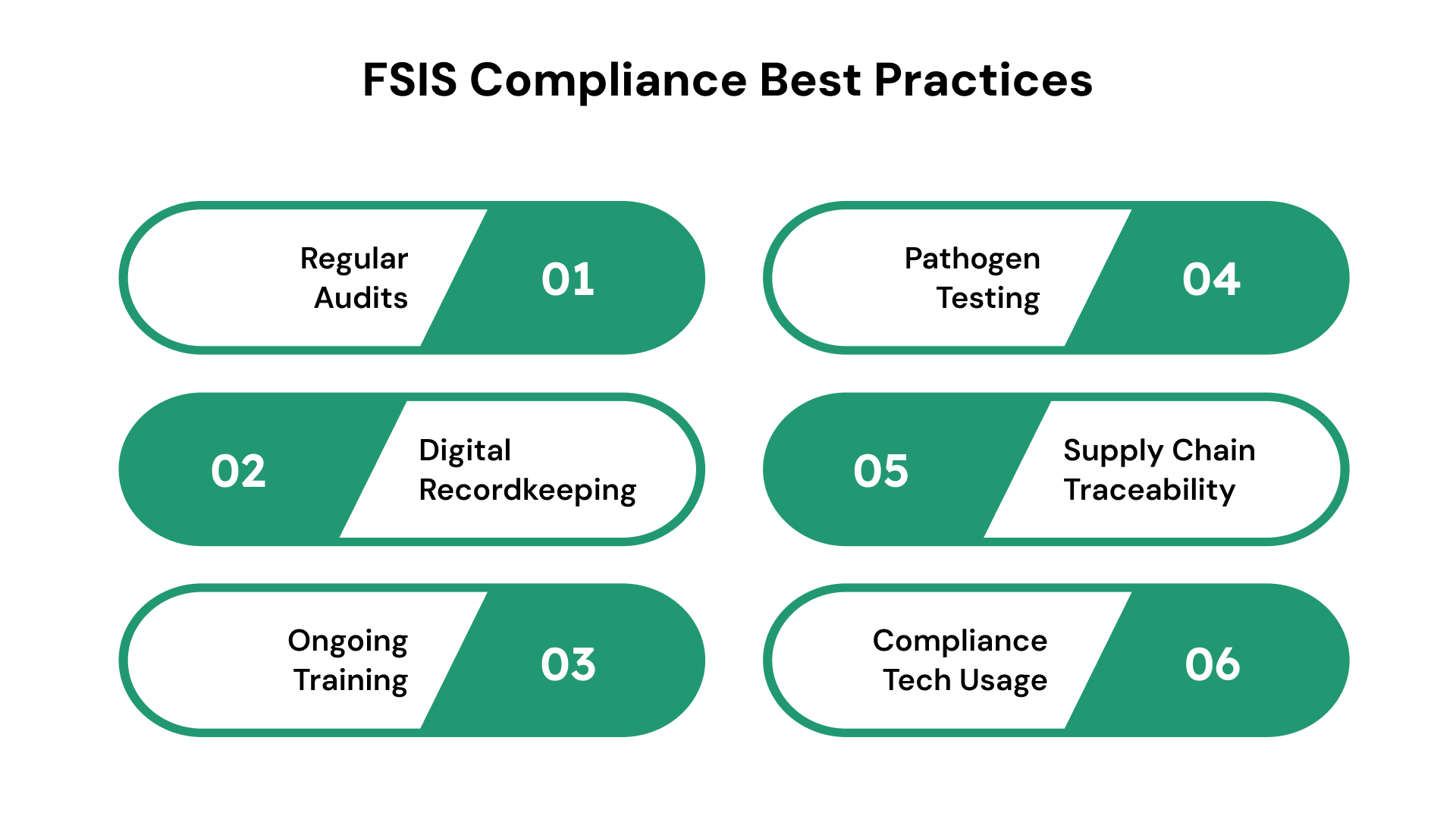
With FSIS regulations tightening in 2025 especially around pathogen control, digital recordkeeping, and inspection readiness. US food businesses must adopt proven strategies to maintain compliance and minimize risk. The following best practices are endorsed by food safety experts and align with current FSIS priorities:
- Regular Internal Audits: Conduct frequent, in-depth reviews of food safety systems, including sanitation procedures, HACCP plans, and documentation. These audits help identify gaps and ensure readiness for FSIS Food Safety Assessments, which are now prioritized at ready-to-eat facilities relying on sanitation measures for Listeria control.
- Comprehensive Digital Recordkeeping: Maintain detailed, accessible electronic records of inspections, testing, corrective actions, and sanitation logs. Enhanced digital documentation is essential for meeting FSIS’s updated standards and supports rapid response during audits or investigations.
- Ongoing Staff Training: Invest in regular training for employees on the latest FSIS requirements, including new protocols for Listeria and Salmonella control. In 2025, FSIS inspectors themselves are receiving updated training and tools to better identify systemic food safety issues, and your workforce should be equally prepared.
- Proactive Pathogen Testing and Environmental Monitoring: Increase the frequency and scope of testing for Listeria and Salmonella, especially in ready-to-eat areas. FSIS now requires broader Listeria species testing and weekly verification of risk factors at high-risk facilities.
- Supply Chain Traceability: Collaborate with suppliers and distributors to ensure full traceability across the food supply chain. This is critical for compliance with both FSIS and new FDA traceability rules coming into effect.
- Use Technology for Compliance Management: Use advanced food safety and compliance management platforms to automate documentation, streamline reporting, and monitor compliance status in real time. This approach reduces manual errors and ensures that your organization can quickly adapt to regulatory changes.
Also read: Best GRC Tool for Food and Beverage Manufacturing in the US
By implementing these best practices, organizations can strengthen their FSIS compliance posture, reduce the risk of enforcement actions, and protect both consumers and their brand reputation.
Adopting these best practices is a strong foundation, but leveraging the right technology can take FSIS compliance to the next level.
How Technology Can Support FSIS Compliance
Compliance technology does not replace HACCP expertise, food safety controls, qualified personnel, laboratory testing, FSIS inspection, or the establishment’s regulatory responsibilities.
Its value lies elsewhere.
A compliance management platform can help organizations structure obligations, assign accountability, automate recurring reminders, organize evidence, monitor corrective actions, maintain activity histories and give leadership visibility across facilities.
For example, if an FSIS inspection results in a finding, the organization can connect that finding to the applicable regulatory requirement, assign corrective action, establish a deadline, collect supporting evidence, record verification and preserve the history for future review.
For organizations operating multiple facilities, dashboards can also reveal where open actions or recurring findings are concentrated.
VComply’s compliance management software is designed to help teams manage regulatory obligations, controls, evidence, tasks and corrective actions from a centralized system.
The distinction is important: FSIS does not require organizations to buy VComply or any particular compliance platform. Technology simply gives teams a more structured way to execute and demonstrate the compliance activities they are already responsible for performing.
How VComply Can Support FSIS Compliance Management
FSIS compliance involves numerous activities that can be difficult to manage when ownership, evidence and deadlines are spread across different tools.
VComply can help organizations convert regulatory requirements into assigned responsibilities and repeatable workflows. Teams can maintain obligations, designate owners, automate recurring compliance tasks, attach evidence, monitor status and manage corrective actions from one system.
For a multi-establishment food manufacturer, that could mean maintaining common FSIS requirements centrally while still assigning plant-specific responsibilities. Leadership can see which locations have open actions, where evidence is missing, what is overdue, and whether similar issues are appearing across several facilities.
Policy workflows can also support the distribution and acknowledgment of updated procedures, while case and corrective-action workflows can help document incidents, findings and remediation.
The objective is not to replace the food safety system.
It is to make accountability around that system easier to see and manage.
FSIS Compliance Checklist for Food Manufacturers
Before considering an FSIS compliance program well controlled, an organization should be able to demonstrate that applicable regulatory requirements have been identified; HACCP plans and hazard analyses are current; monitoring and verification occur as required; Sanitation SOPs are implemented and maintained; required records are complete and accessible; pathogen-control activities are documented; labeling responsibilities are monitored; inspection findings are tracked; corrective actions have responsible owners and deadlines; recurring issues are analyzed across time and facilities; regulatory updates are reviewed for applicability; and management has visibility into unresolved compliance gaps.
The exact checklist should always be adjusted to the establishment’s products, processes, inspection program and applicable regulations.
Frequently Asked Questions About FSIS
What does FSIS stand for?
FSIS stands for the Food Safety and Inspection Service, a public health regulatory agency within the U.S. Department of Agriculture.
What does FSIS regulate?
FSIS regulates meat, poultry, processed egg products, Siluriformes fish and other products under its jurisdiction. Its responsibilities include inspection, food safety verification, labeling, pathogen-control programs, imports and exports, recalls and enforcement.
What is FSIS compliance?
FSIS compliance means meeting applicable USDA FSIS requirements relating to food safety, sanitation, HACCP, inspection, labeling, recordkeeping, corrective actions and other regulatory obligations that apply to an establishment and its products.
Is FSIS part of USDA?
Yes. FSIS is an agency within the U.S. Department of Agriculture.
What is the difference between FSIS and FDA?
FSIS primarily regulates meat, poultry, processed egg products and Siluriformes, while FDA regulates most other foods. The two agencies operate under different statutory authorities and inspection programs.
Is HACCP required by FSIS?
FSIS’s HACCP requirements are contained in 9 CFR Part 417. Official establishments must conduct a hazard analysis, and where one or more food safety hazards are reasonably likely to occur, they must develop and implement a written HACCP plan meeting the applicable requirements.
What is an FSIS Noncompliance Record?
A Noncompliance Record, commonly called an NR, is a written FSIS record documenting noncompliance with an applicable FSIS regulation.
Does every FSIS Noncompliance Record result in a shutdown?
No. An NR documents regulatory noncompliance, but the regulatory response depends on the facts and circumstances. More serious violations or patterns of noncompliance can contribute to stronger enforcement action under applicable FSIS authorities.
Does FSIS require electronic compliance software?
FSIS requires establishments to maintain various records under applicable regulations, but organizations should not interpret those requirements as a universal mandate to purchase a particular compliance software system. Software can help structure records, responsibilities, evidence and corrective actions, while responsibility for meeting FSIS requirements remains with the establishment.
How often should an establishment review its HACCP plan?
Under 9 CFR 417.4, every establishment must reassess the adequacy of its HACCP plan at least annually and whenever changes occur that could affect the hazard analysis or alter the HACCP plan.
What happens after an FSIS inspection identifies a problem?
Depending on the issue, inspection personnel may document regulatory noncompliance, and the establishment may need to take appropriate corrective action. More significant or recurring issues can lead to additional regulatory or enforcement activity.
What are the biggest FSIS developments to monitor in 2026?
Relevant developments include FSIS’s organizational reconfiguration around the new National Food Safety Center, the voluntary raw-poultry Salmonella-control pilot, continued expanded Listeria species testing information for relevant RTE sampling programs, and changes intended to make certain noncompliance appeals easier for small and very small establishments.
Making FSIS Compliance an Everyday Operating Process
FSIS compliance works best when it is built into daily operations rather than treated as a project that begins when an inspector asks for information.
HACCP monitoring, sanitation, verification, pathogen controls, labeling, inspection findings, corrective actions and records are connected parts of the same food safety system.
When those activities are spread across paper logs, shared drives, email chains and isolated spreadsheets, it becomes harder to see whether problems are truly being resolved or simply documented.
A structured compliance program connects the regulatory requirement to the control, the control to an owner, the owner to an activity, the activity to evidence, and any failure to corrective action.
That creates a record of not only what the organization intended to do, but what it actually did.
For food manufacturers operating across several plants, that visibility becomes particularly valuable. It allows leadership to identify recurring gaps, compare performance across establishments, follow outstanding actions and prepare for FSIS scrutiny without rebuilding the compliance picture every time information is requested.
FSIS provides the regulatory framework and inspection oversight. The establishment is responsible for making compliance work every day.
How VComply Simplifies FSIS Compliance
FSIS enforcement actions are becoming increasingly data-driven and stringent, with the agency issuing NoncomplianceRecords (NRs), civil penalties, and even suspending operations for facilities that fail to meet regulatory standards.
VComply’s ComplianceOps platform directly addresses these evolving FSIS compliance challenges by:
- Automated compliance task assignments and reminders: Ensures all FSIS-required inspections, sanitation checks, and corrective actions are scheduled, tracked, and completed on time, reducing the risk of missed steps and enforcement actions.
- Centralized documentation and digital audit trails: Stores all compliance activities, records, and corrective actions in a secure, searchable platform, making it easy to retrieve documentation during FSIS audits or investigations.
- Real-time dashboards for compliance status: Provides instant visibility into compliance metrics across multiple facilities, helping organizations spot and resolve potential issues before they escalate.
- Policy management for SOP distribution and acknowledgment: Streamlines the updating and distribution of standard operating procedures (SOPs), ensuring all staff are informed and trained on the latest FSIS requirements.
By integrating ComplianceOps, organizations can move from reactive compliance to a proactive, transparent, and auditable approach, ensuring they meet FSIS’s heightened standards in 2025 and beyond.
Wrapping Up
FSIS compliance in 2025 demands greater vigilance, transparency, and agility from food businesses. With stricter enforcement, expanded testing requirements, and increased digital oversight, organizations must move beyond reactive approaches to build proactive, efficient compliance programs. Failure to meet FSIS standards can result in serious consequences from costly penalties to operational shutdowns—that impact both your bottom line and brand reputation.
With VComply’s ComplianceOps, you can simplify complex regulatory requirements, automate critical tasks, and maintain complete, audit-ready documentation. This empowers your team to stay ahead of FSIS updates, respond swiftly to issues, and ensure consistent food safety across all locations.
Take control of your FSIS compliance journey today, streamline your processes, reduce risk, and protect your business with ComplianceOps. Schedule a free demo today.
FAQs
FSIS regularly reviews and updates its regulations to address emerging risks and scientific advancements. Major updates, such as new testing protocols or labeling requirements, are often communicated through annual plans, constituent updates, and rulemaking notices.
Noncompliance can result in enforcement actions such as Noncompliance Records (NRs), product recalls, civil penalties, suspension of inspection services, or even facility closure in severe cases.
In 2025, FSIS expanded Listeria species testing in ready-to-eat products, enhanced inspector training, prioritized Food Safety Assessments at high-risk facilities, and implemented stricter oversight of Salmonella in breaded and stuffed chicken products. There are also updates to allergen labeling and new compliance dates for labeling rules.
Best practices include maintaining comprehensive digital records, conducting regular internal audits, staying current with FSIS updates, providing ongoing staff training, and using technology solutions for compliance management.
FSIS has set January 1, 2028, as the uniform compliance date for new meat and poultry product labeling regulations published between January 1, 2025, and December 31, 2026. This gives producers time to update labels and comply with new requirements.