What are regulatory compliance services?
Regulatory compliance services help organizations meet legal, regulatory, and internal control requirements through structured processes, documentation, monitoring, and reporting. For credit unions, this often includes managing policies, tracking obligations, conducting assessments, documenting evidence, preparing for audits, and maintaining clear accountability across teams. The goal is to reduce risk, improve consistency, and support ongoing readiness.
What are the 5 key areas of compliance in banking?
Five common compliance areas in banking and credit union operations include consumer protection, anti-money laundering and fraud controls, data privacy and information security, lending and fair practice requirements, and internal governance with audit oversight. Effective compliance programs connect these areas through policies, risk assessments, control monitoring, issue tracking, and reporting so teams can respond consistently and document actions clearly.
How can compliance software help credit unions?
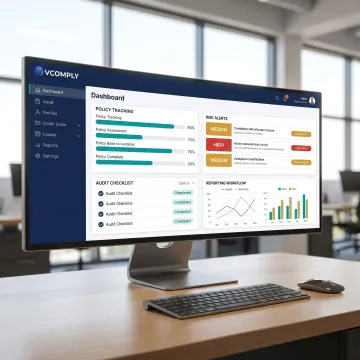
Compliance software helps credit unions centralize tasks that are often spread across email, spreadsheets, and shared folders. A platform like VComply can organize policies, assessments, risk registers, evidence, approvals, and reporting in one system. This improves visibility, reduces missed deadlines, supports audit preparation, and gives leadership a clearer view of compliance status, open issues, and accountability.
What features should credit unions look for in a compliance platform?
Credit unions should look for centralized compliance tracking, policy lifecycle management, risk assessment tools, audit-ready reporting, evidence capture, dashboards, workflow automation, and integration capabilities. Strong platforms also support role-based accountability and recurring task management. These features help teams standardize processes, document decisions, and maintain a more reliable record of compliance activity across departments and review cycles.
Can VComply support policy management for credit unions?
Yes. VComply includes PolicyOps, which supports drafting, reviewing, approving, distributing, and attesting policies through structured workflows. For credit unions, this helps maintain consistency across governance documents, reduces version confusion, and creates a documented trail of approvals and acknowledgments. Centralized policy management also makes it easier to demonstrate control during internal reviews and external examinations.
How does VComply support audit readiness?
VComply supports audit readiness by centralizing evidence, assessments, policy records, issue tracking, and reporting in one platform. Teams can document actions as work happens instead of reconstructing records later. Real-time dashboards, automated workflows, and readiness assessments help identify gaps early, assign follow-up tasks, and maintain a more complete compliance record for audits, examinations, and internal control reviews.
Does VComply offer risk management tools for credit unions?
Yes. RiskOps helps organizations identify, assess, quantify, and monitor risks through a more structured process. Credit unions can use it to maintain risk registers, evaluate exposure, assign mitigation actions, and track progress over time. When connected with compliance and policy workflows, risk management becomes easier to align with broader governance objectives and reporting requirements.
Are compliance assessments included in the platform?
Yes. VComply's Compliance Assessment capabilities include custom questionnaires, goal tracking, evidence capture, automated scoring, and real-time insights. For credit unions, this supports readiness reviews, gap identification, and progress tracking across compliance initiatives. Assessments can help teams prioritize remediation work, document findings clearly, and create a more repeatable process for evaluating control maturity and preparedness.